How to Classify Chalet Common to Unique Pieces
These are the four most frequently asked questions that I receive with regard to glass:
: who is the maker?
: how can I learn to tell the glass apart?
: is it rare?
: what is the value?
With regard to Questions #1 and #2, it takes time and experience to learn how to identify glass correctly and consistently.
The learning curve is quite steep. However, there are a lot of resources on hand to help you become proficient at Canadian vintage glass identification and learn about the different glasshouses. Just a few – the 50 Shades collector’s group is a great place for all to learn. Hundreds of verified Chalet pieces are featured in the Web site “Gallery” sections. And there are over 130 articles here as well. Articles that are general in learning topic as well as articles with a specific, targeted focus Information on the other Canadian glasshouses of the Chalet era is included in many. Building your own resource library is another excellent way to conquer that learning curve. As is consulting resources from accredited sources.
With regard to Question #3, it is necessary to understand what a designation of “rare” signifies.
This also means having an awareness of context – looking at where a “rare” designation “fits in” overall with regard to collecting. To do this, we need to examine the complete picture. I consulted several very reputable sources (https://intelligentcollector.com/about/ being one) to ensure my definitions and categories accurately reflected collectible classifications.
These “objective measure” standards are widely accepted and applied with regard to establishing scales of rarity and influences on value:
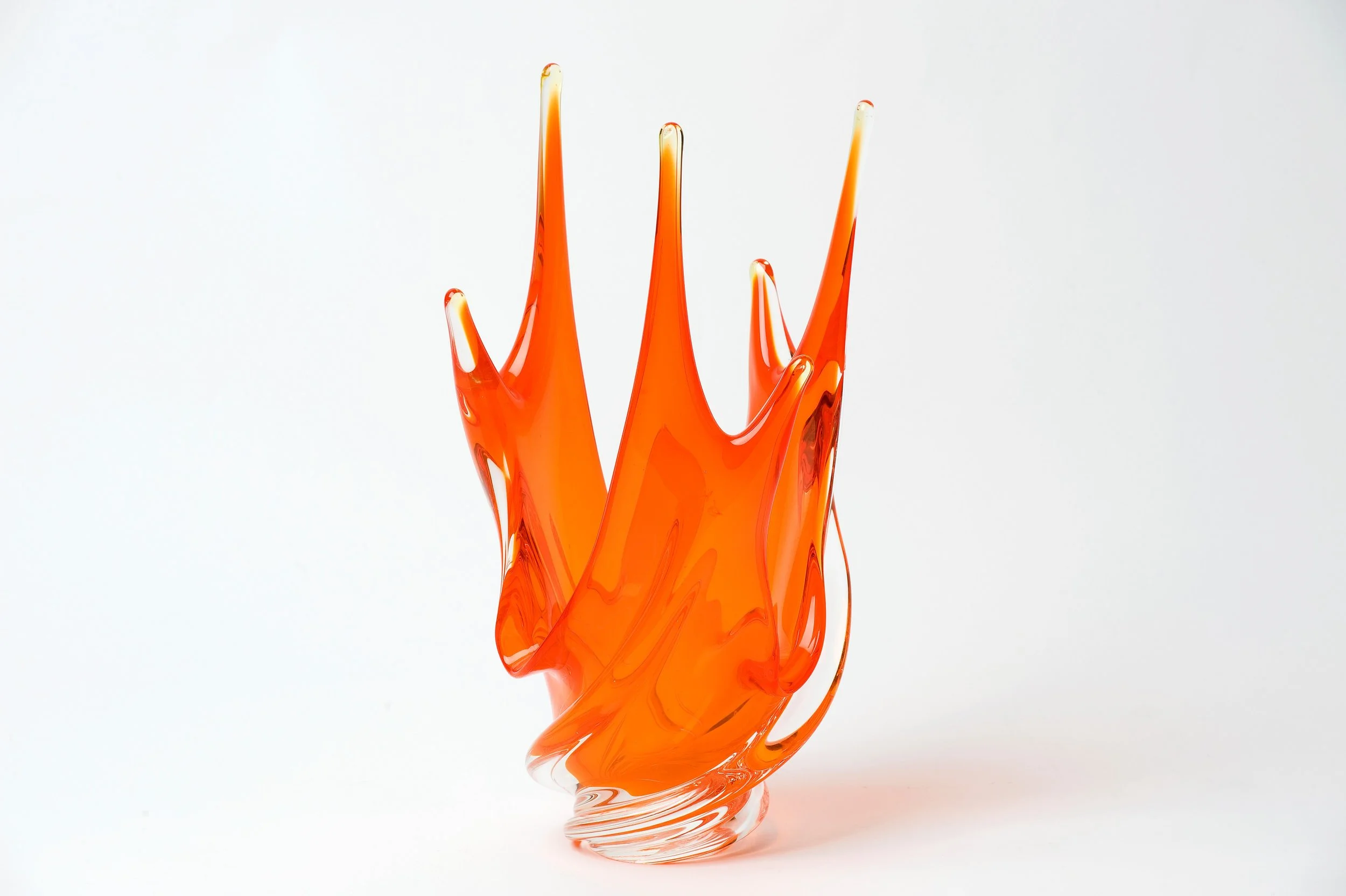
common: a piece made frequently and in large quantities. The Chalet “crystal twist” and Chalet “splash” vases are perfect examples of common pieces. Why? They were produced in regular and frequent production runs and in significant numbers throughout Chalet's history. Each was given an inventory number and feature on both early and later catalogue pages. The “twist” is inventory item #V32 and the “splash” is #B42s. They were made in the full range of the Chalet colour palette. They were ongoing staples of Chalet inventory. Moreover, they had a high survival rate. Therefore, they are seen frequently. These factors result in each being classified as a common piece.
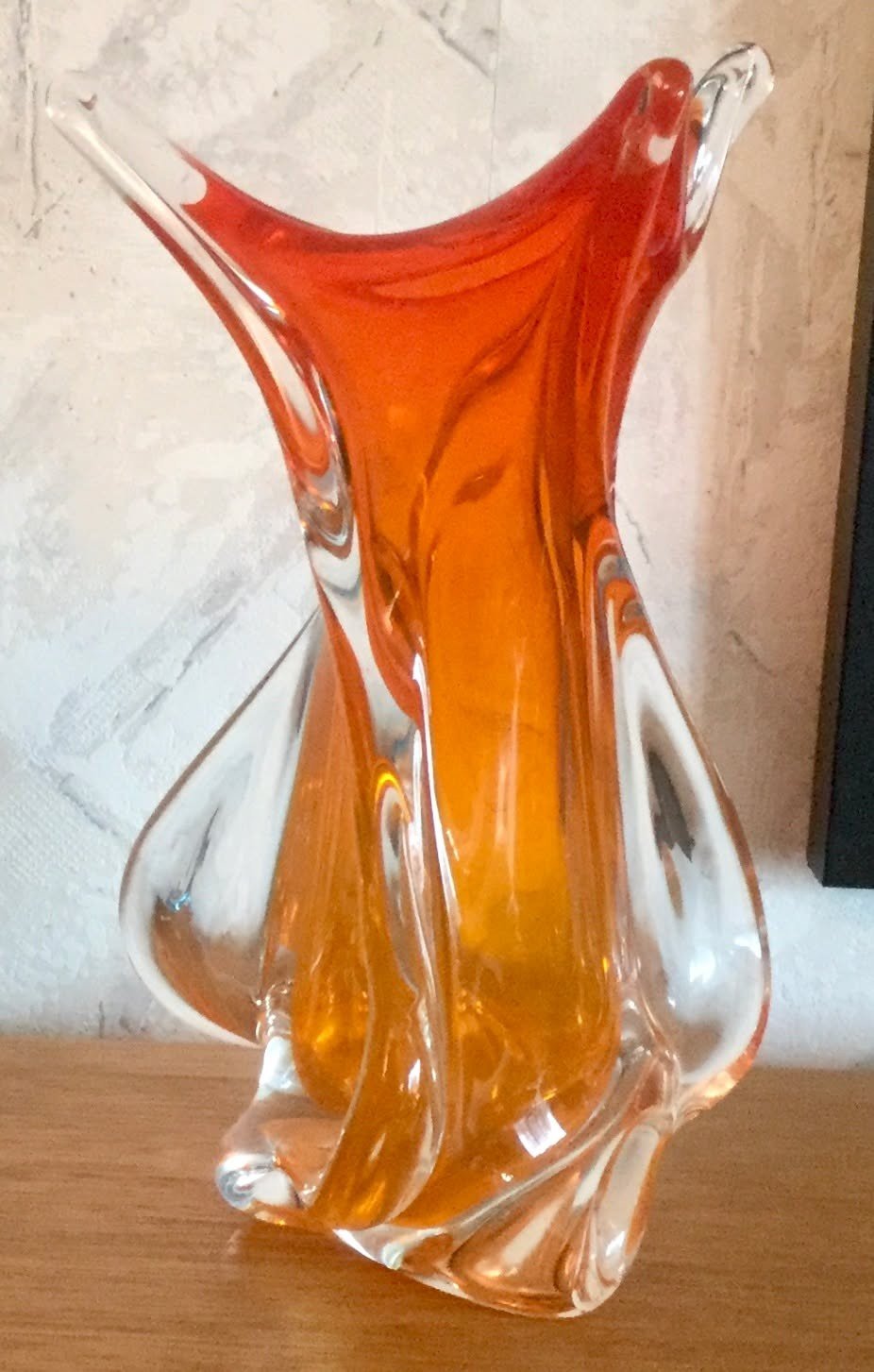
From the collection of Dawn Tolhurst.
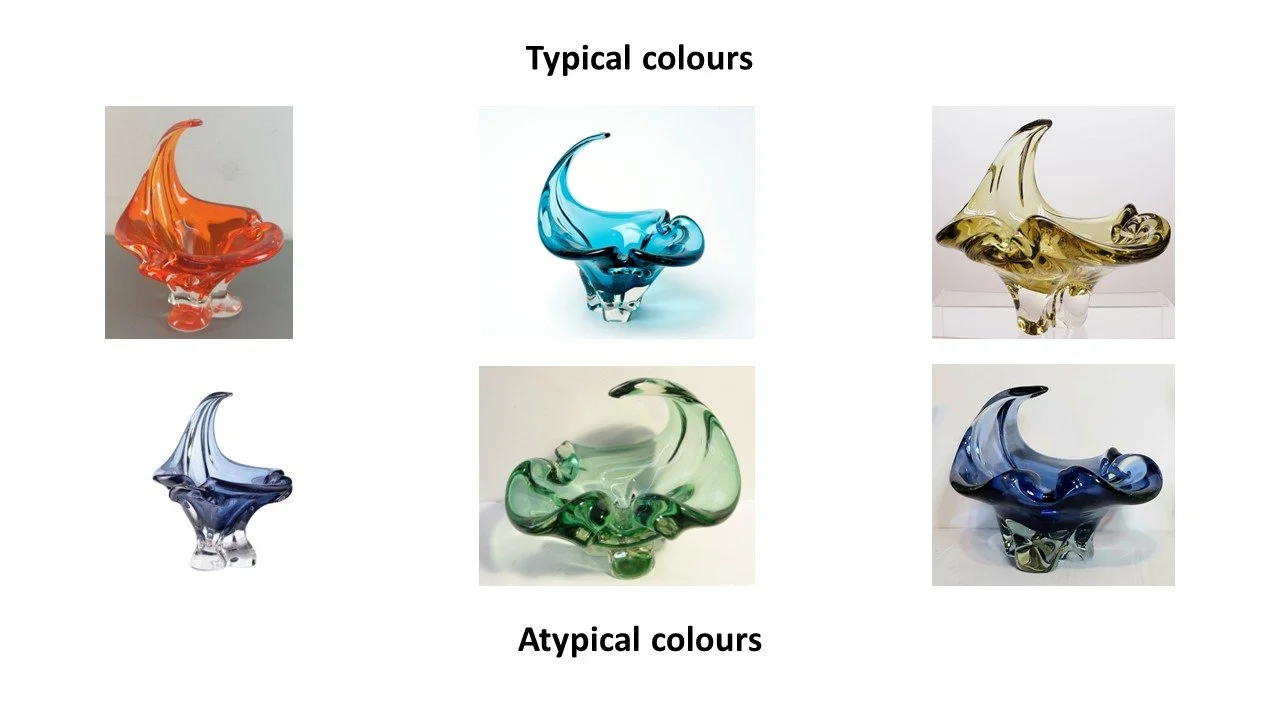
scarce: a piece produced in fewer numbers and less often than a typical common piece. Therefore, there are fewer numbers of this item from the onset. A scare piece can also deviate from the norm in some way. The Chalet A37 pedestal cigar bowl is an excellent example of a scarce piece. Why? Although it was production glass, it was not produced in anywhere the same quantities or variations as the other Chalet pedestal cigar bowl – the A5 “finger” design. And a deviation from the typical Chalet colour palette is seen quite often in this form.
rare: a piece that was produced in very few numbers or items that were originally mass-produced but only released in small quantities, or specific color variations/prototypes. A rare piece deviates from the norm in a very significant way. These items are highly sought after by collectors because they are scarce, limited in supply, or historically significant, ultimately driving up their market value. Rarity may also result from high attrition rates. Meaning that pieces that were once common but were largely destroyed, used up, or lost over time, making surviving examples seldom seen. The fewer the number of identical items in circulation, the higher the rarity.
The Chalet Eucharist set is a good illustration. Why? Because they were produced in limited quantities, produced in only cranberry, produced for a limited, targeted market, and were produced for specific usage.
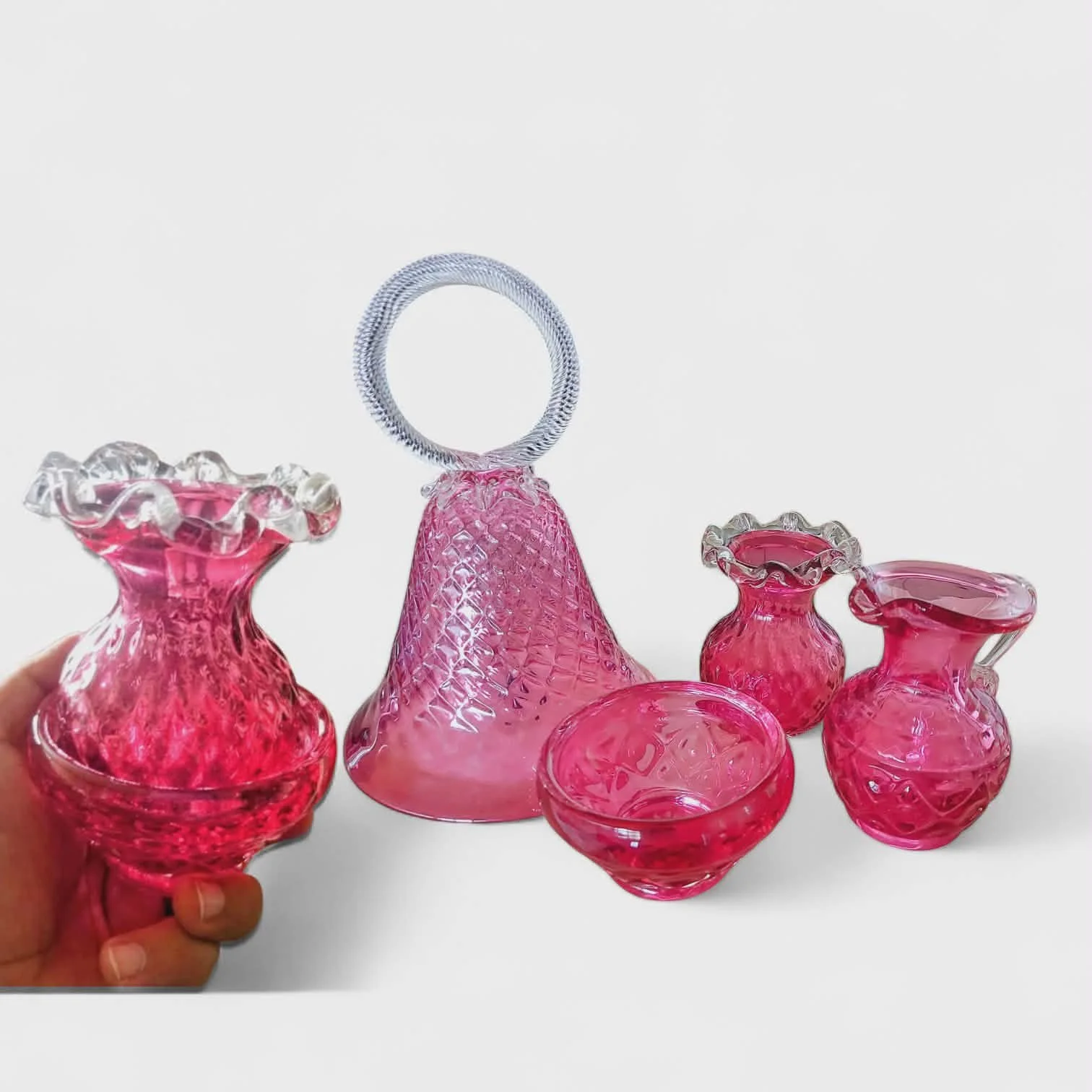
A Chalet Eucharist set had 4 pieces – a bell, a small handled-pitcher, a small bowl, and a small vase. The bowl was sized so that either the vase or pitcher could nestle inside. This Eucharist set is from the collection of the De Marchi family. Roberto De Marchi was an artist at Chalet Artistic Glass.
unique /one-of-a-kind: a piece that was made only once. It could be an artist’s sample that was not put into production or an unusually styled piece that was made at the end of day. Completely stand alone in numbers made, colour, style, and size. Never seen in even another size or colour as it was never duplicated or reproduced.
Chalet Artistic Glass was a factory NOT a collective or artists’ studio. As such, it had established production runs of set product, quotas and a rigid glass blowing hierarchy. Therefore, opportunities to produce unique pieces were few and far between and were controlled by the owners. Typically, a unique piece of Chalet would be an artist’s sample that was not put into production or a special-order piece. We know that this occurred not only through the artists’ recounting but from Chalet company advertising as well.
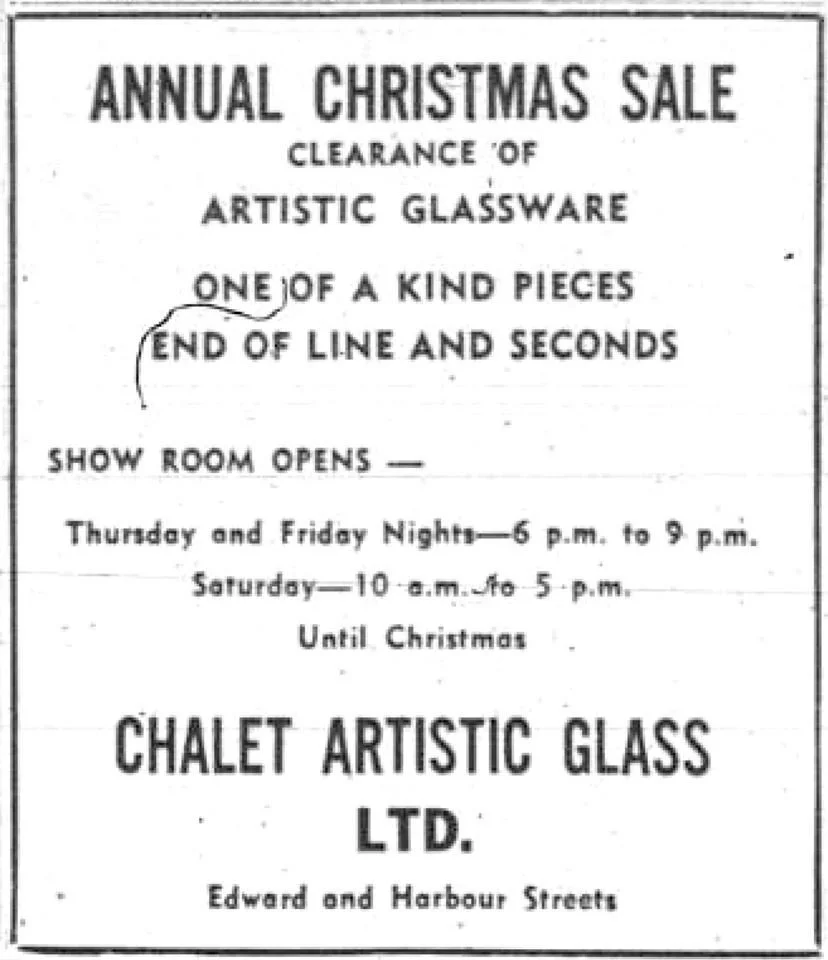
1968. From the archives of the Cornwall Community Museum.
A gallery of verified Chalet pieces that, at time of writing, are also confirmed as unique/one-of-a-kind. “Never say Never!”
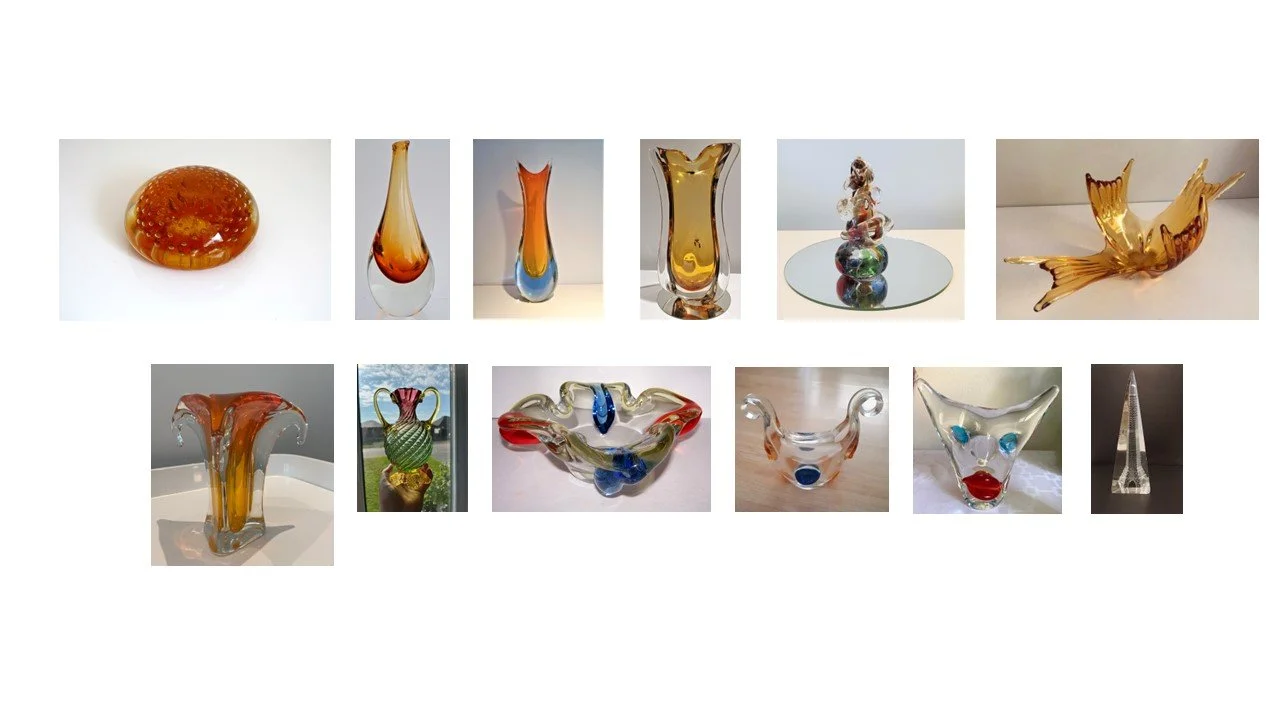
I am fortunate to have all the pieces in the top row in my personal collection. Bottom row, from left to right, Jackie Lyn, Kim Tersteeg, Pina Pina, Jeremiah Shaver, private, Sally Hore.
With regard to Question #4, the market value of most pieces is not static, is fickle and fluctuates regionally. And obviously the “laws of supply and demand also are at play.
Moreover, “collectability” desirability comes into play in a very significant way with regard to every design. This refers to the inherent appeal or quality of an item. If a piece is desirable, that makes enthusiasts want to collect it – to hoard, curate, or display it. A highly collectable item paired with extreme rarity frequently becomes a top-dollar value collector's item. However, certain pieces, even though rare, are not deemed collectable by enthusiasts. Therefore, their market value is not positively impacted by their rarity.
A Chalet example:

A very rare Chalet “bird bowl” A77 piece. We have found only a handful. However, their market value to collectors is negligible as they are not desired pieces. Conversely, “crystal twist” and “splash” vases, although very common, generally command a higher price than we see other common, scarce or rare forms bringing. Why the inconsistency in this case? The high collectibility of these vases.
We have proven as fact that variations in Chalet forms are so common as to be the norm. What does this mean? This means that pieces that do not conform to the production sheet regarding height or are a more unusual shade or shape are actually not “rare Chalet” but only “rarer” versions of that form. However, variation may also cause certain pieces to be more collectible and therefore command a higher market value. Some pieces may strike you as being “less than typical” and therefore should have a higher value but subjectivity does not drive the marketplace. You may be proven right but overall, the “laws of supply and demand” in any marketplace will determine end value.
An example of colour variation within a common form creating both higher collectability and dollar value:
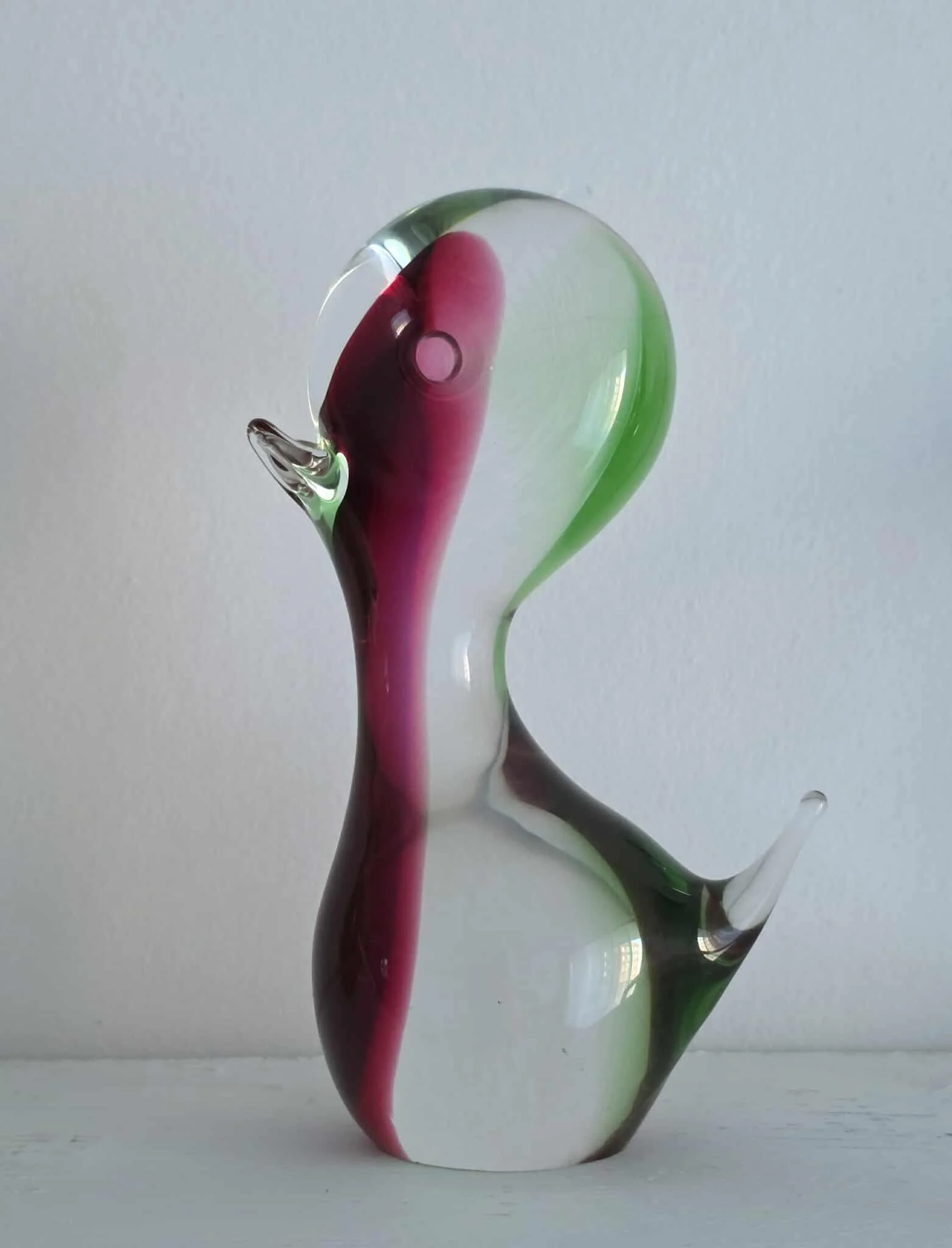
The Chalet animal figurines are collectible across the board. Regardless, within that parameter – certain animals are more eagerly sought than others. The Chalet chick (#704) is more commonly found than most other Chalet animals. So, its value and desirability are at the lower end of the scale. However, in this rarely produced Chalet 2-tone colour combination (seldom found in any Chalet form), its desirability and value both skyrocket! From the collection of Gionny Gueli.
With regard to Canadian vintage art glass, retention of original glasshouse branding is “desired but not required.” An etching or sticker will add some slight extra value to a form but not so much that the majority of collectors turn away from unmarked pieces if the form has been verified by a catalogue page or marked pieces of the same design have been found. However, in the case of unique pieces, the only verification of provenance is a marking. Avoid unmarked pieces that a seller is claiming are “one-of-a-kind.”
I recently had not one but three very interesting conversations about AI use with regard to glass in the last 2 weeks. The focus of each conversation was the same – the information mistakes, value statement and over-the-top asking prices in sales listings that were AI generated. Not only were the asking prices totally unrealistic, but piece details were also wrong – rarity claimed when the piece was not, vintage age claimed when the piece was a modern reproduction, glasshouse maker identification wrong ...
To date, we have seen AI inaccuracy more often than not with regard to glass details. So much so, we have turned off the AI function in both 50 Shades of Chalet and Chalet Glass Collectors FB groups. Not once did the "AI Genie" (that all of a sudden started posting in the groups) get anything right!
So, if you are using AI with regard to determine the market value of your pieces or ones you are interested in purchasing, posting a sales listing, or educating yourself about the glass, please be aware that you are most likely being given inaccurate prices, information and ids. I advise referring to the 50 Shades "Sales" records, the Web site articles and “The Gallery” pages, reaching out to a group Administrator or another experienced collector – just not solely depending on AI having given you either the correct facts or realistic expectations regarding true market value of a piece.
The following terms are not directly related to the three “asked and answered” questions but I thought including them might be helpful as they are often seen in glass descriptions, postings, or discussions.
Contemporary/modern: belonging to or occurring in the present.
Eames era:Charles (1907–1978) and Ray (1912–1988) Eames were American designers who were married in 1941 and made significant contributions in various fields, including industrial design, furniture design, art, graphic design, film, and architecture. Their most influential period was during the 1950s, 1960s, and into the 1970s. The term “Eames era” is often used as a point of reference when dating a piece. Since Chalet glass pieces were produced from 1962 until 1975, they are referenced as being of the Eames era.
mass produced: a process where huge numbers of identical items are created.
mid-century modern (MCM): a style of design. The “MCM movement” was present throughout the world, but gained most popularity in North America, Brazil, and Europe. From (roughly) 1945 to 1970, mid-century modern influences can be seen in interior design, fashion design, graphic design, architecture and urban development. It is characterized by clean, simple lines and lack of embellishment. Bold colors are also an iconic staple of MCM design alongside natural wood tones and earthy neutrals. MCM-style influenced decor and architecture have seen a major resurgence that began in the late 1990s and continues today.
reproduction: a copy of the original that looks just like it. It is intended to mimic the appearance and, often, the technique of the original piece, but is created at a later time.
studio art: also called fine art. It involves the creation of visual art through mediums such as painting, drawing, ceramics, sculpture, photography, printmaking, glass, fiber, or design. Studio art is also a term popularized in the late 1960s and 1970s for unique or limited-edition objects designed and made in a studio (an artist’s workplace), rather than a factory, often by the same person, though not necessarily.
vintage: an object from a different era that is at least 25 years old. This term highlights the age and historical context of an item. Please take note - not to be confused with "retro." That refers to a style inspired by the past rather than the actual age of an item.
