Chalet Silver and Gold
William Shakespeare wrote that, “All that glitters is not gold.” This holds true in Chalet’s case as some pieces could also have had pieces of silver foil or silver-coloured mica powder submerged to glitter within their clear crystal layers. The gold that glittered for Chalet was polvere d’oro – gold dust.
In 2010, Chalet Maestro Bruno Panizzon exhibited two glittering animal figurines at the Cornwall “The Art and Artisans of Chalet Glass” retrospective. He had personally blown both while at Chalet – he worked there from the winter of 1963 until the company’s closure in 1975.
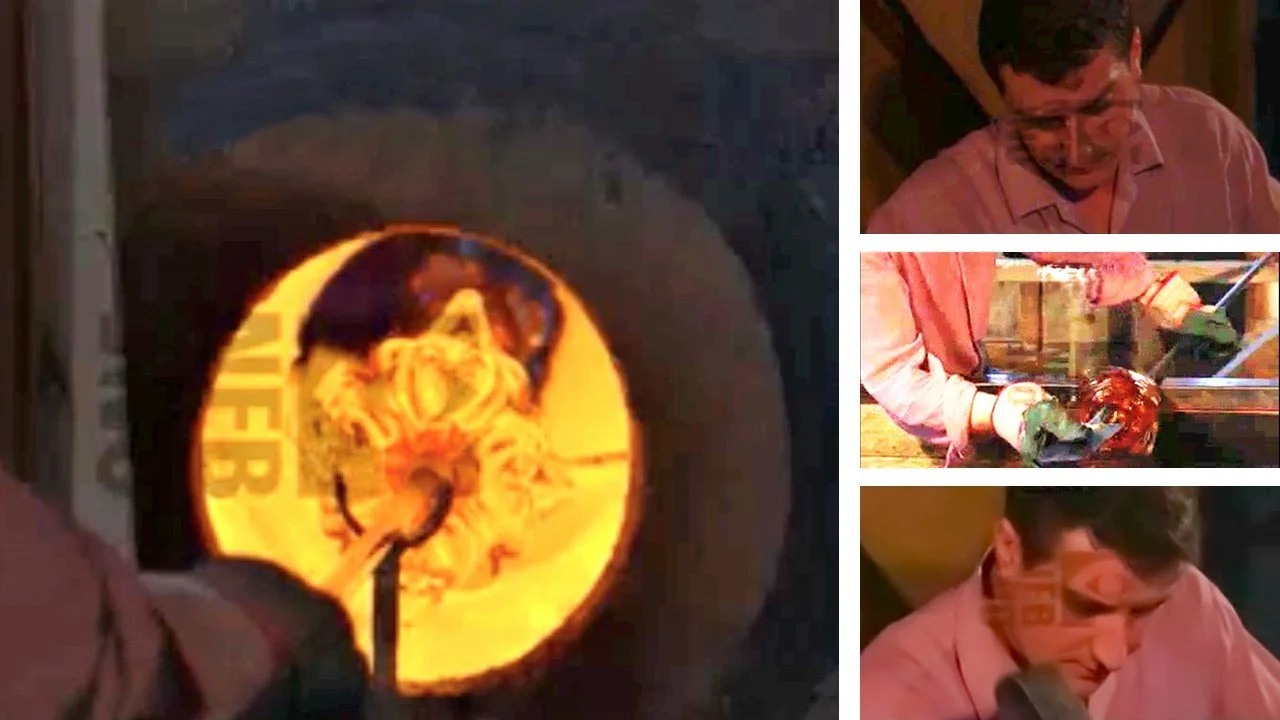
1965. Maestro Panizzon on the Chalet factory floor during the National Film Board filming of “Why Canada.”
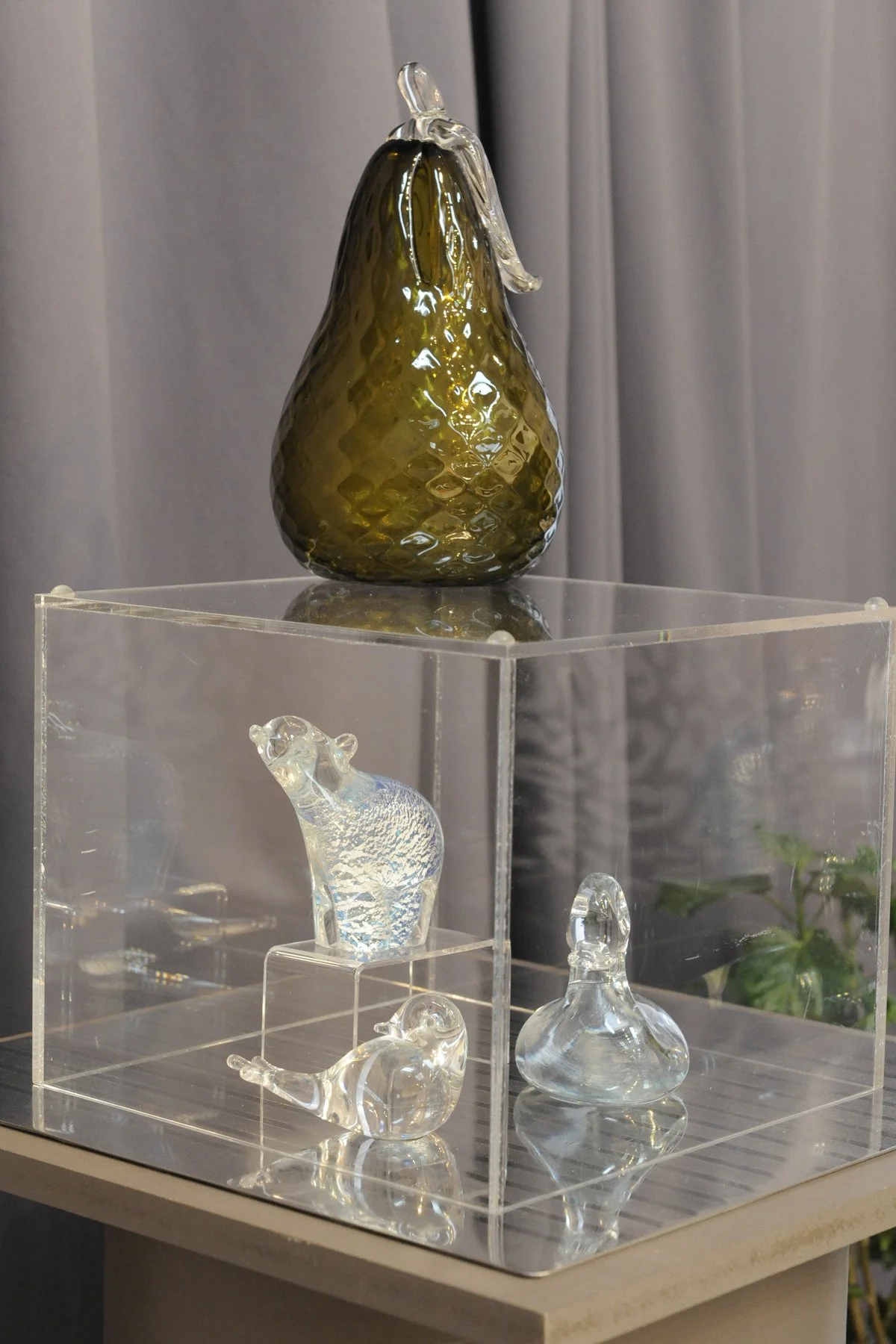
Pieces on loan at the 2010 Chalet retrospective from Chalet Maestro Bruno Panizzon. Note the silver foil polar bear figurine at rear and the mica filled bird at left in foreground. The duck figurine at right is clear crystal only.
Maestro Bruno Panizzon speaking to collector Geoffrey Chown, a 50 Shades member, at the ehibit opening reception (Saturday, October 30, 2010). Geoffrey and his husband, David Dunkley (also a group member), had travelled by train from Toronto to have Maestro Panizzon sign their first Chalet piece – a “splash” vase. Chalet artist Gianfranco Guarnieri in background at left.


Maestro Panizzon at a 2011 Cornwall photography shoot for “The Shapes and Colours of Chalet Art Glass.” The polivere d’oro Chalet “Buddha belly” owl figurine at left was another piece that he created at Chalet.
Maestro Panizzon answered many questions for this article. However, as he passed away on October 20, 2025, I am sorry that he will not be able to see it posted. I would like to dedicate it to him to honour all the assistance he has provided in helping our glass community better understand Chalet Artistic Glass.
The gold dust, silver foil and silver-coloured mica powder used in the animal figurines and in the stems and leaves of the large fruit sets and bookends was not a surface treatment applied to the skin of the glass. Instead, these were added to the molten crystal mix and then blown into the form. Although gold and silver are metals while mica is a mineral – none melt and so remain as solid particles suspended in the crystal. Thereby adding shimmering decorative effects without affecting the clear crystal clarity of the glass. This is unlike the effect achieved when lead arsenate was added to clear crystal molten glass mixture to create other special Chalet figurines. These opaline pieces have a milky, white appearance. The clear glass has lost its transparency and is opaque.
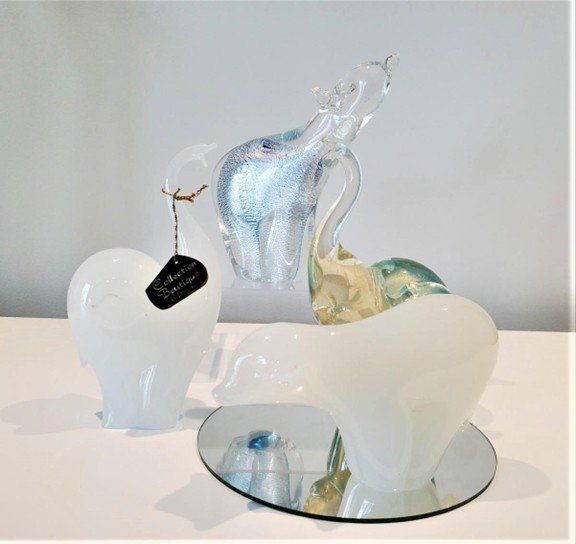
This grouping of Chalet opaline, silver foil and gold dust figurines from the collection of Deborah Patterson.
Chalet owner and Maestro Sergio Pagnin was also the company’s chemist and, therefore, prepared all the coloured and clear crystal mixes each night for the next day’s production runs. This was not an automated process but a painstaking manual procedure. Incorporating gold, silver and mica into blown glass requires precision and skill in first the mixing for the crucibles and then the working of the glass in the vats. The composition of the mix and the proportion of the additives to this must be precise to prevent bubbling and flaws. Constant attention had to be paid so that the proper temperature of the molten mix was maintained to keep the elements stable and evenly dispersed. And obviously, absolute purity of the crystal mix in the crucible was especially essential when working with these expensive materials to ensure that such special pieces could demand a premium price.
It was not uncommon for Chalet to develop products at their distributors’ requests. The artists told us that in the case of Riekes Crisa (Chalet’s major distributor in the United States) that, “The Americans always wanted something different.” And, we have certainly seen that! Maestro Panizzon told me that this was also the case for the gold, silver and mica filled figurines. However, this line was developed for N. C. Cameron & Sons Ltd. – Chalet’s major Canadian distributor. N.C. Cameron specialized in fine English bone china and giftware. For more details regarding this distributor, please refer to pages 188 through 200 in “Chalet Crystal Clear Continued.”
Chalet produced cat, elephant, fish, owl, rabbit, and polar bear polvere d’oro figurines. To produce polivere d’oro pieces, Chalet added very small, fine gold particles to the molten glass. These gold dust particles remained as solids within the mix. The gold chloride “salts” (obtained by dissolving gold metals in a mixture of acids) used by Chalet in its colour formula for their cranberry products did not remain a solid. However, unlike lead arsenate, they do not affect the clarity of the glass.
The majority of Chalet gold dust figurines are in varying shades of blue. You will note that some of these pieces are also Chalet bullicante. A close-up look at the embedded gold dust particles in my blue Chalet “Buddha belly” owl figurine:
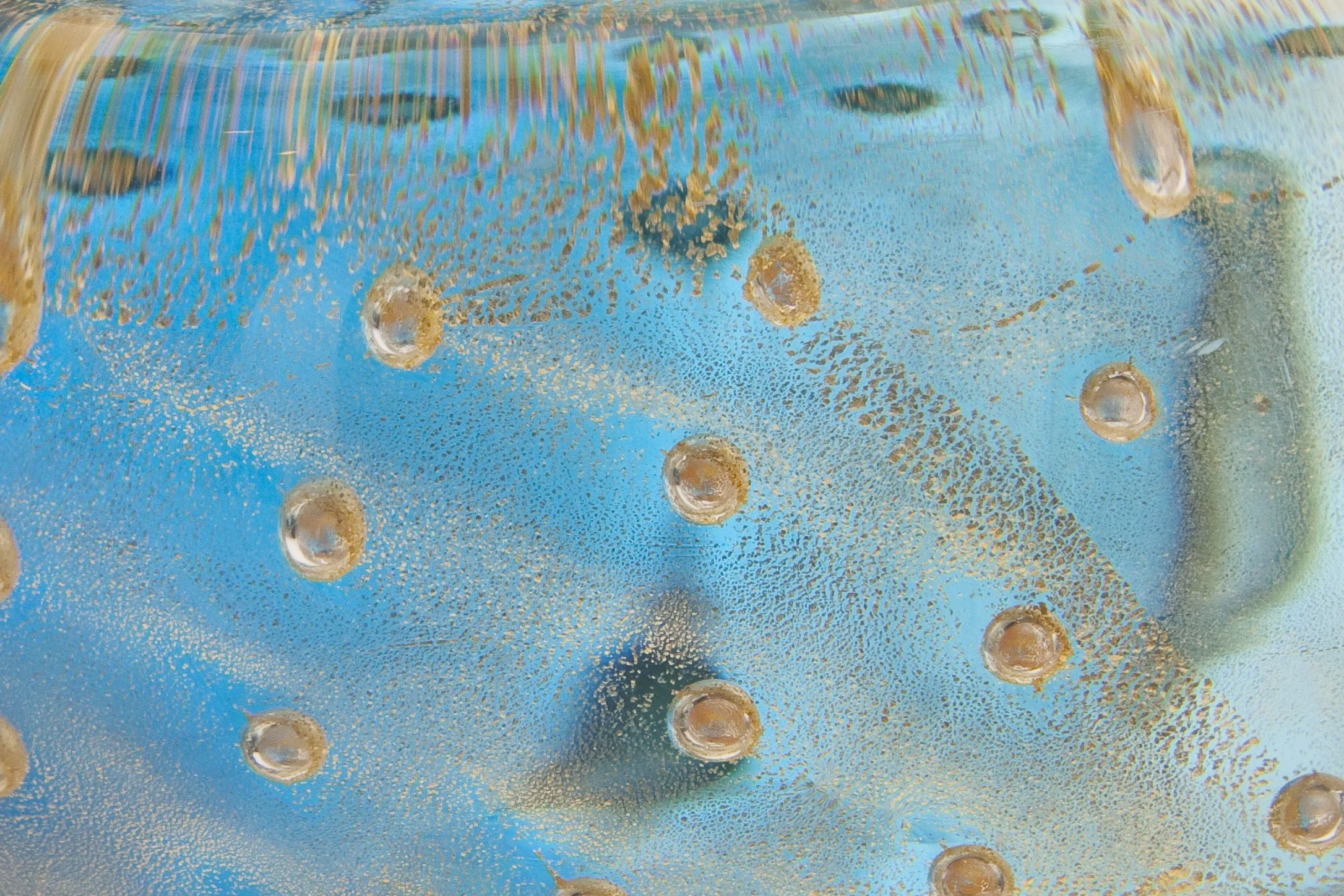
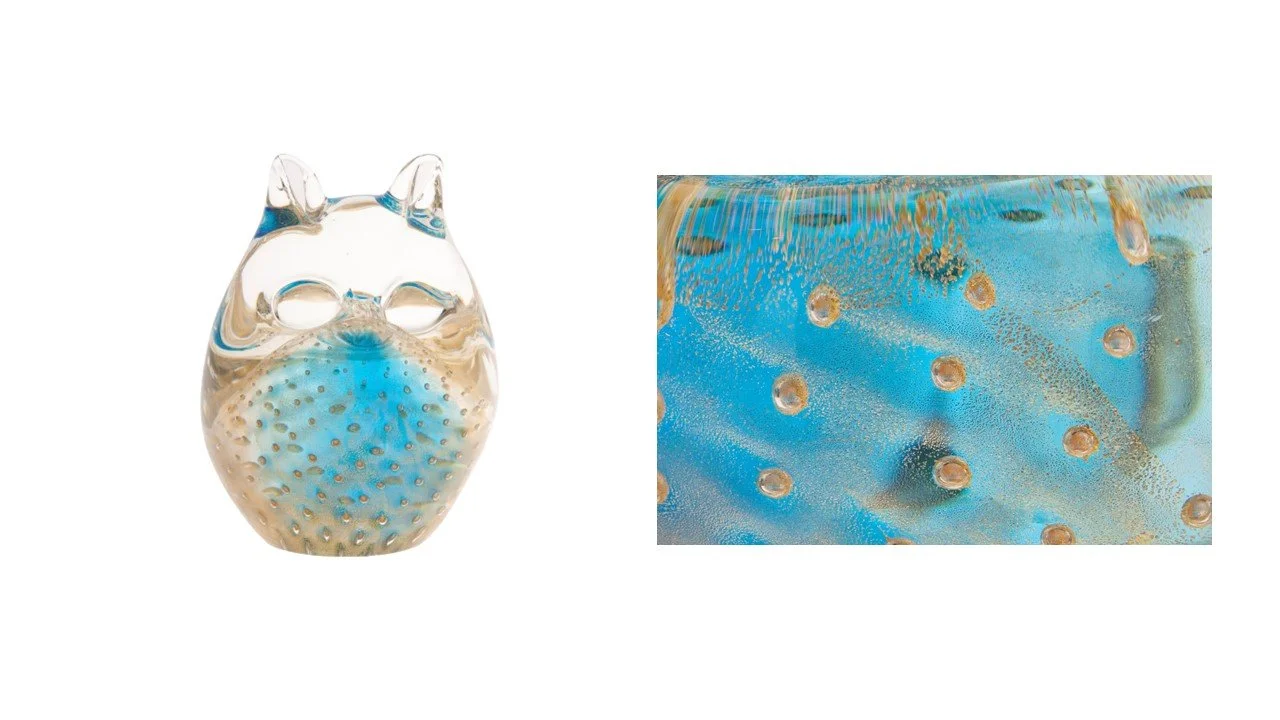
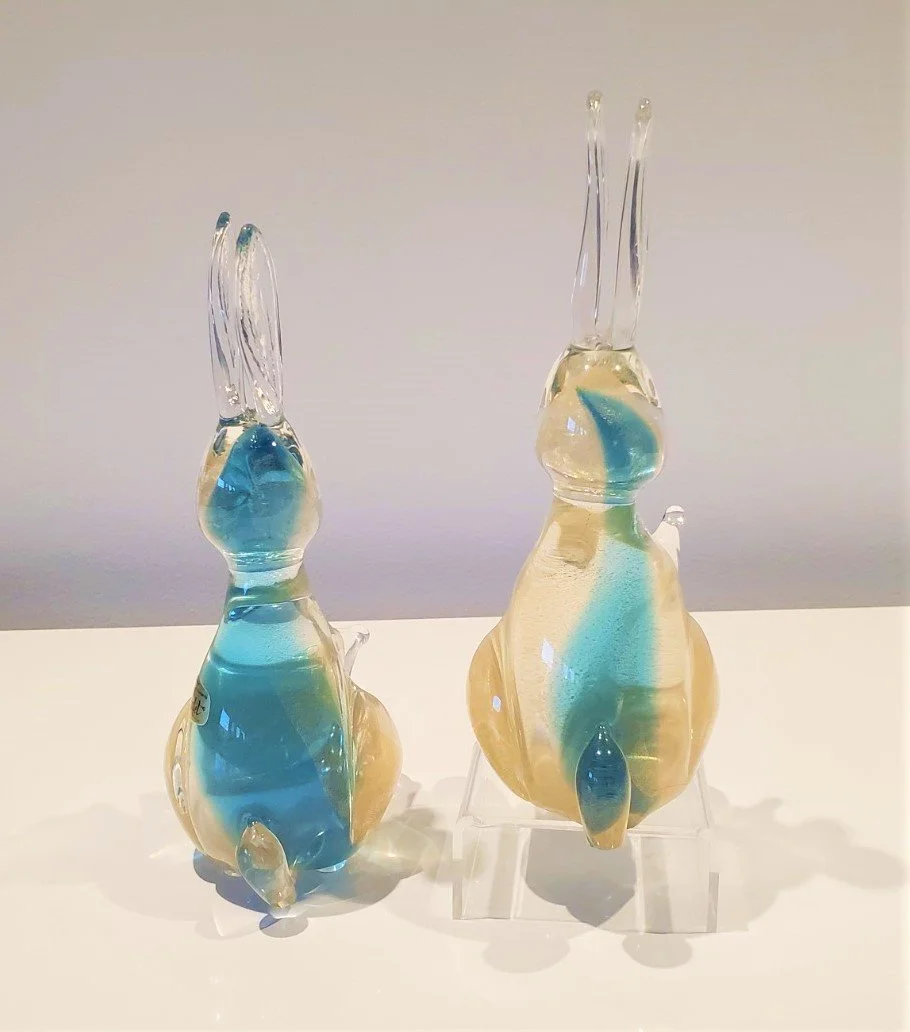
From figurine to figurine, there is a very marked variation in colour, quantity of gold fill and placement of both.
An example.
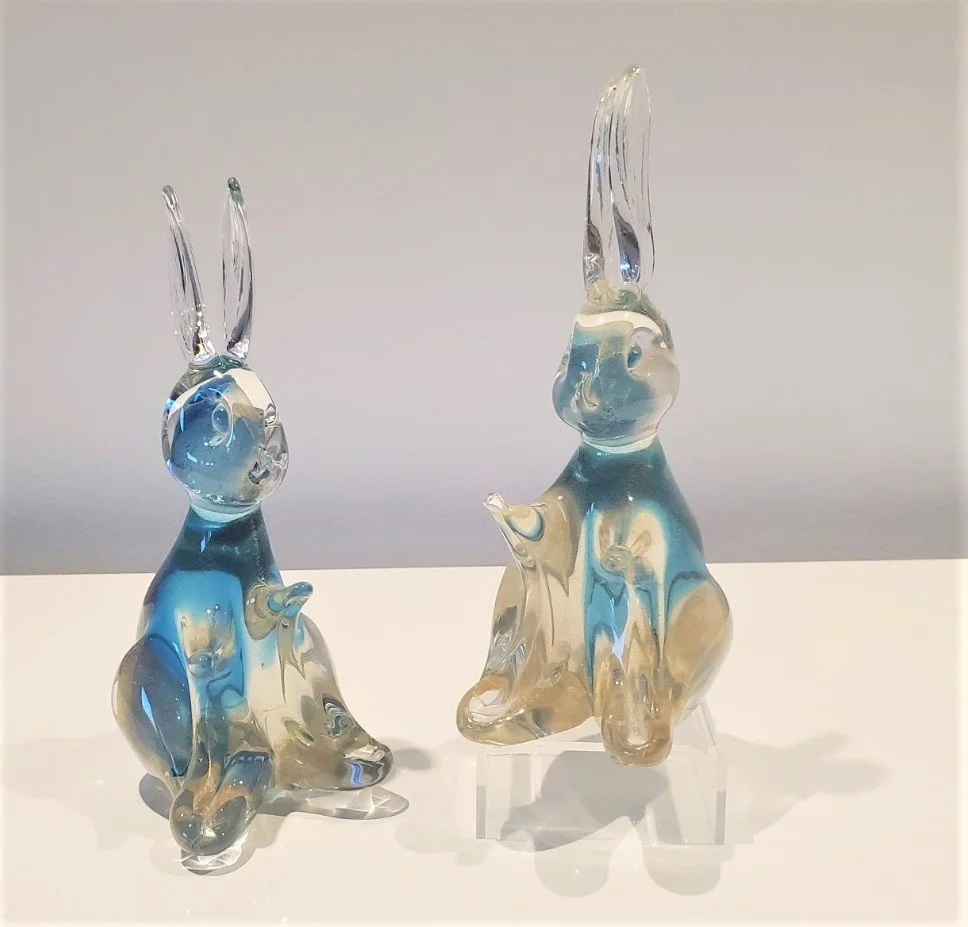
Rabbit figurine at left in both photos from the collection of Troy Danby. Rabbit figurine at right from the collection of Deborah Patterson.
The blue and gold dust cats:
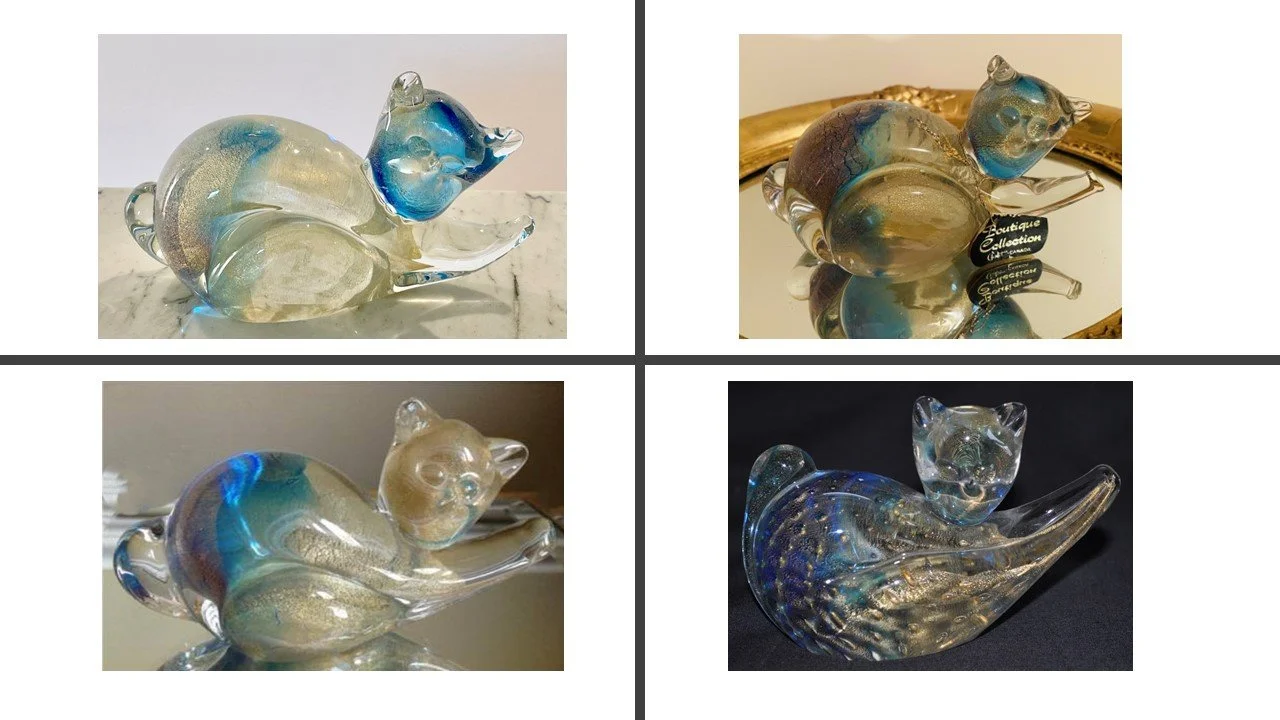
Cat at top left purrs for Jonathon Tremblay. Cat at bottom left gets dusted by Deborah Patterson.
The cat figurine at top right in the gallery is not only etched “Chalet Canada,” but it also retains a very rare hang tag.
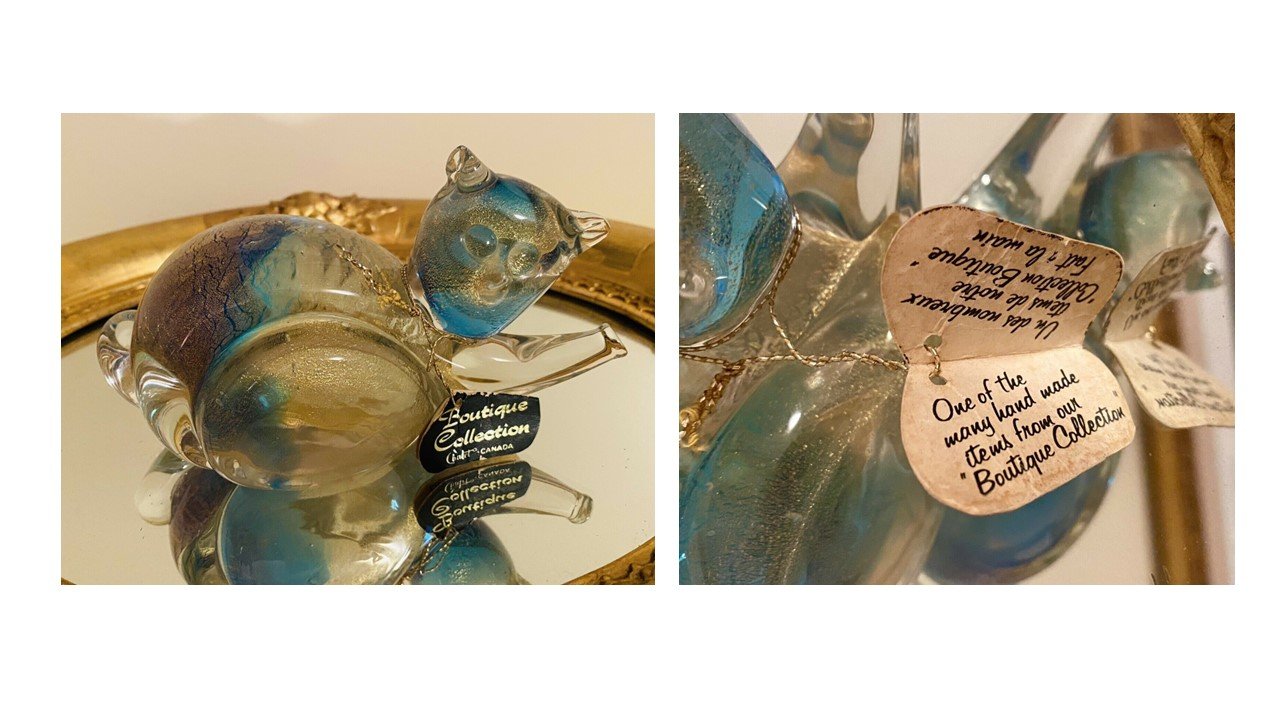

The “Boutique Collection” branding is seen on many of the Chalet opaline (as seen on the opaline elephant above) and gold and silver inclusion pieces. Again, please refer to “Chalet Crystal Clear Continued” for more examples and details.
An exceedingly rare gold-filled gold!
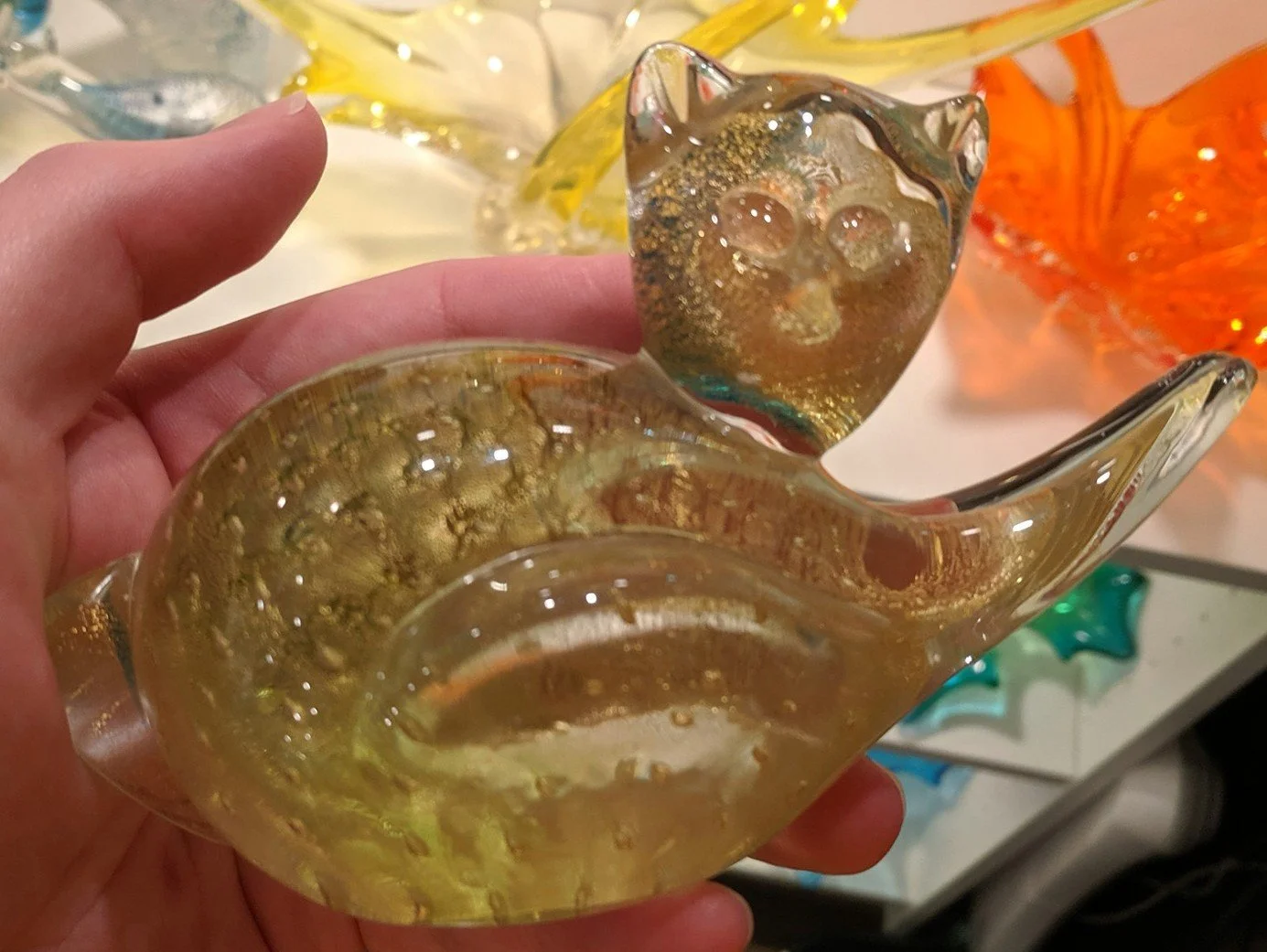
At the time of writing, this is the only gold Chalet polivere d’oro cat figurine of which I am aware. In fact, it is actually the only non-blue/gold cat figurine in this style of which I am aware.
The gold dust elephants:
There are no gold dust filled elephants in colours other than blue of which I am aware.
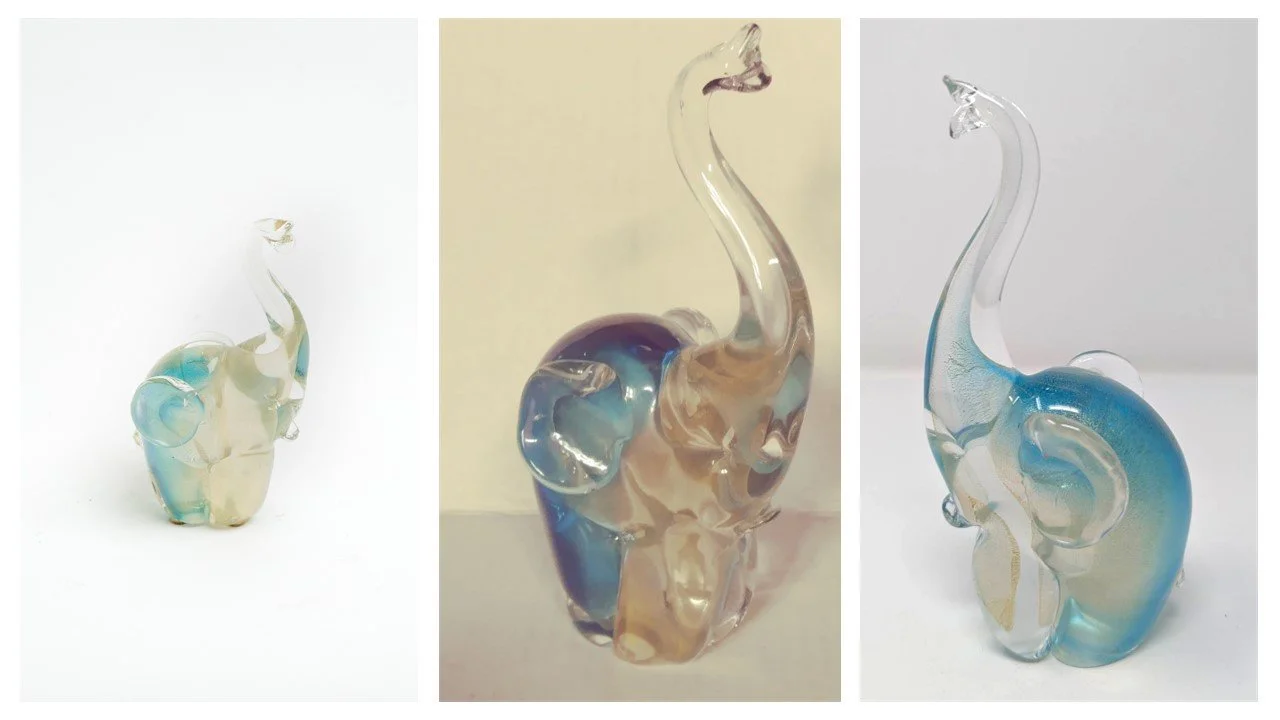
Elephant at left from the collection of Deborah Patterson, pachyderm in middle belongs to E. Crater and the photograph at right is courtesy of Gionny Gueli.
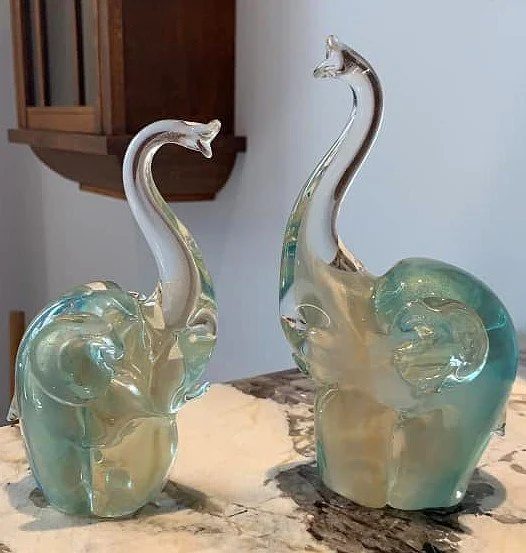
Note the height difference – another typical variation. From Jackie Lyn’s herd.
The gold dust fish:
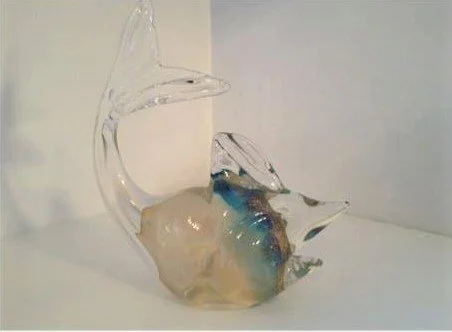
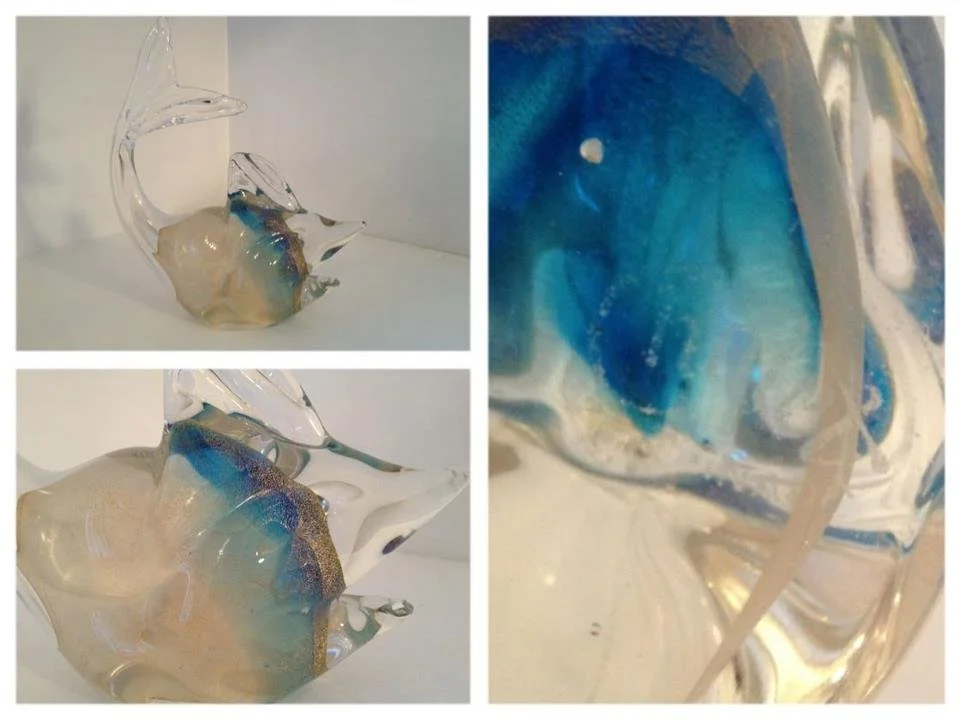
This may be a one of a kind as there are no other verified gold dust Chalet fish of which I am aware. This figurine also from the collection of Jackie Lyn.
The gold dust owls:
Two of the blue “Buddha belly” gold dust figurines. The variation in the tones and colour placement in Chalet pieces is endless.
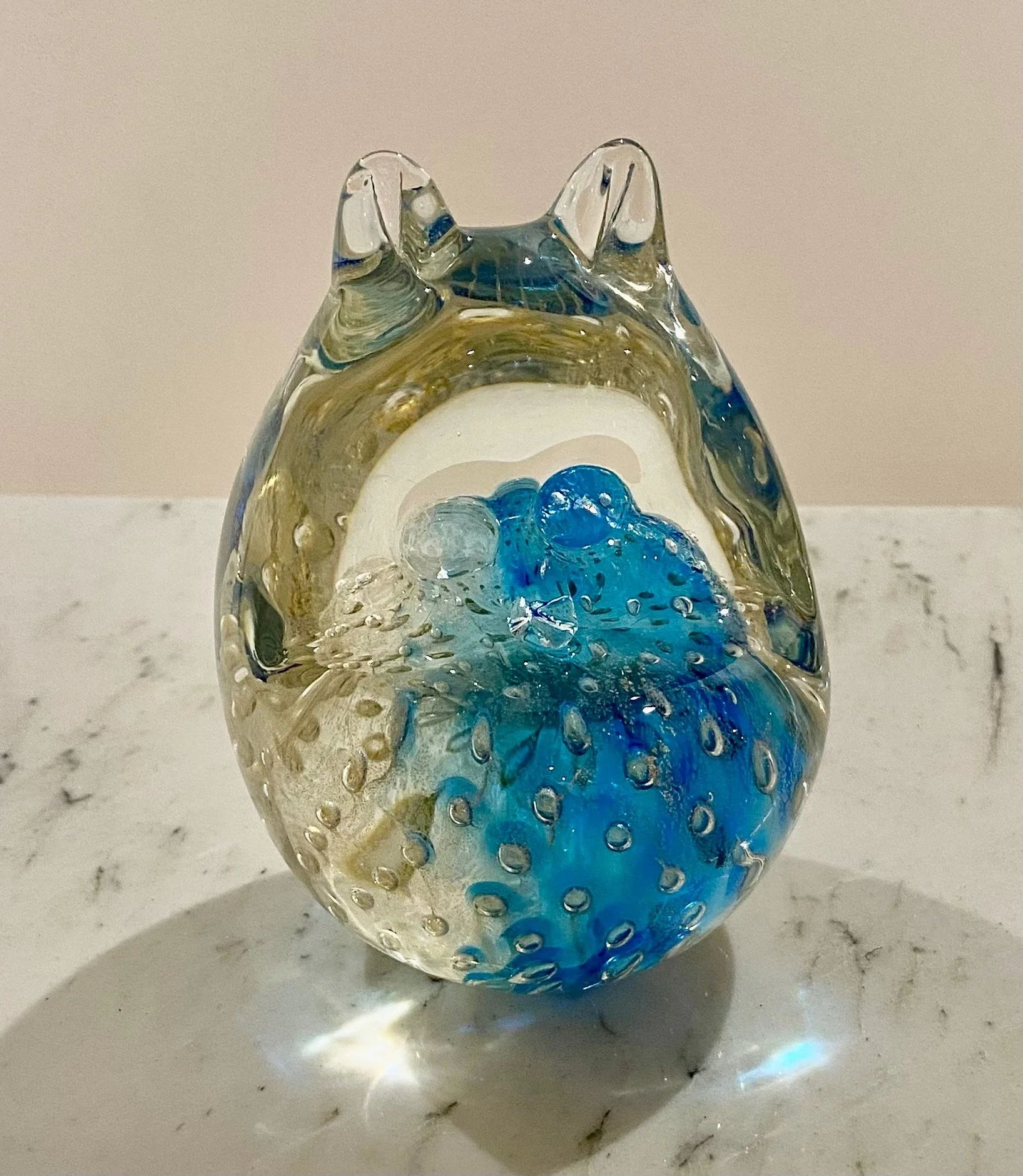
Jonathon Tremblay.
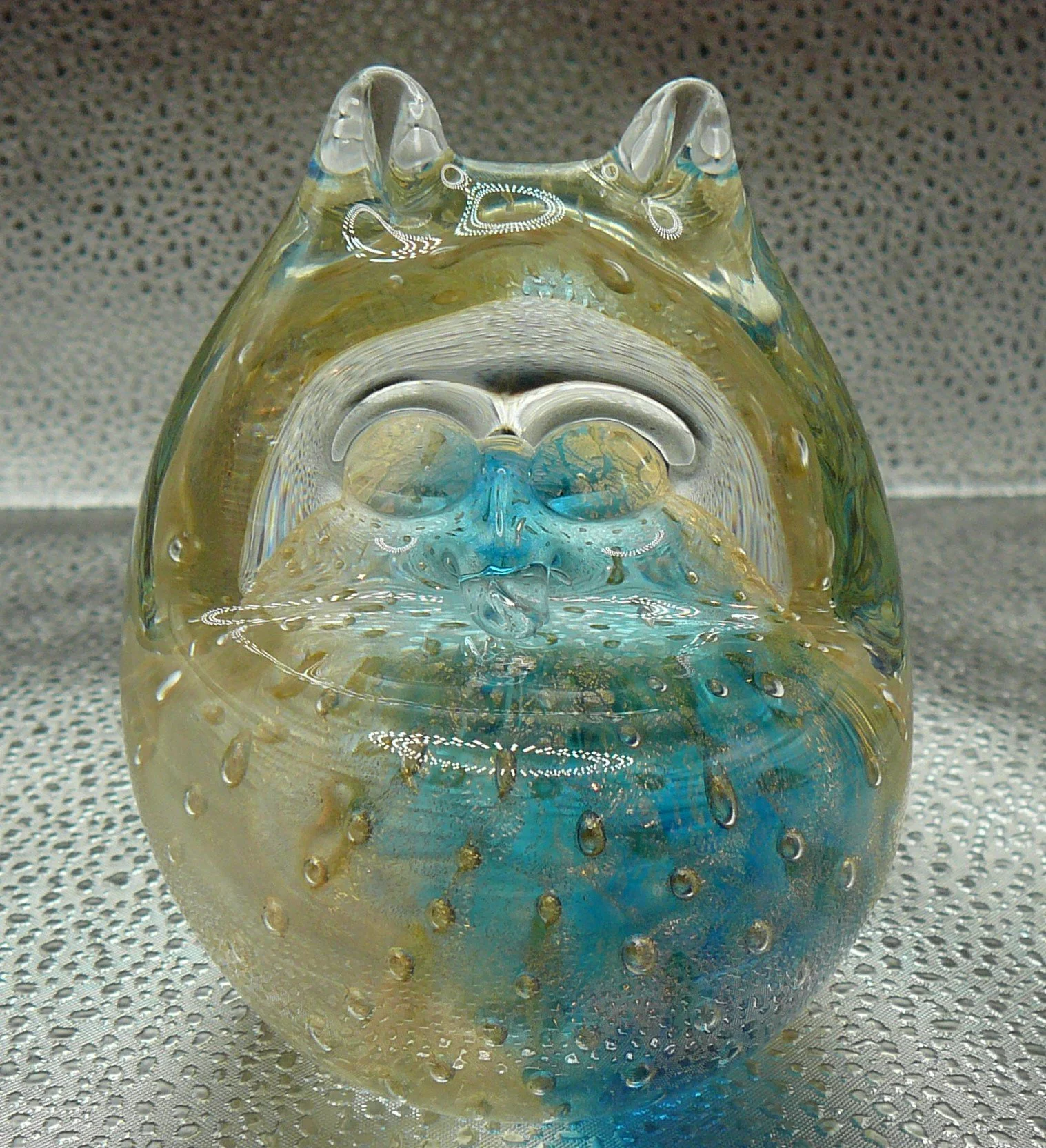
One of Pina Pina’s Chalet “unicorns.”
If 2 are good - 7 are great!
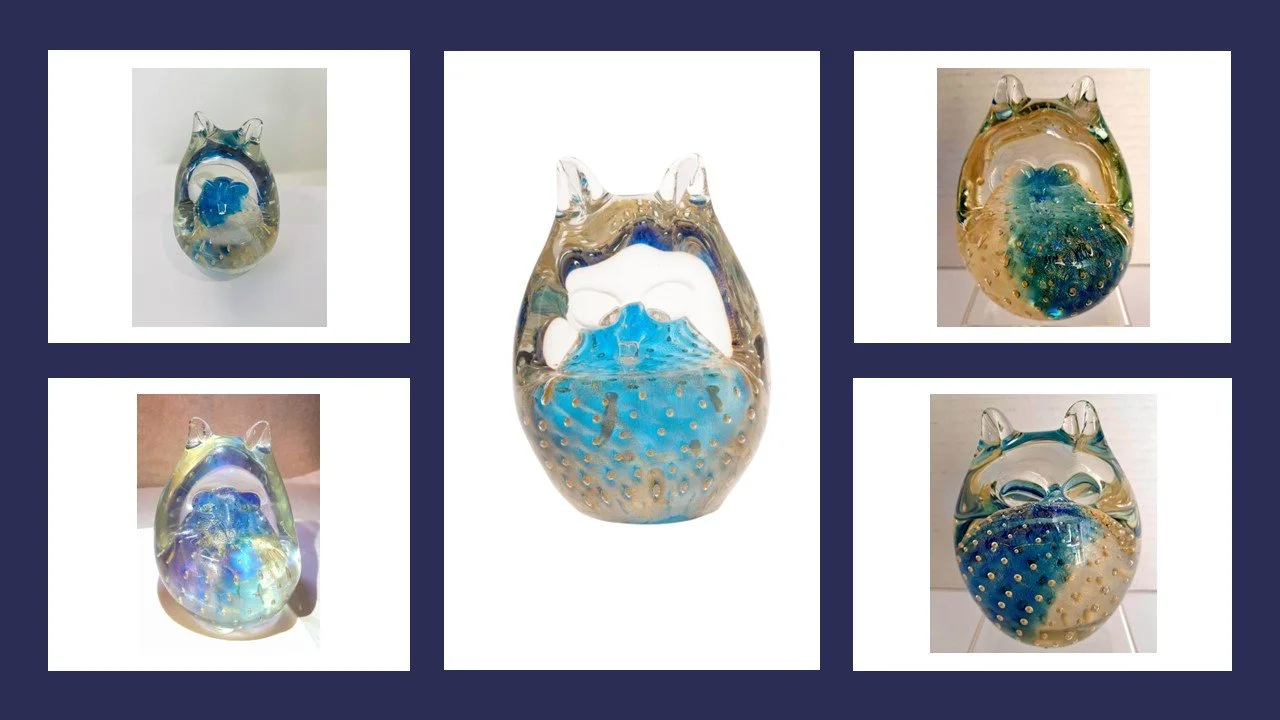
As you see the variation in the tone and placement is both typical and unpredictable. The owl figurine at bottom left is from the collection of Dwain Robertson. The Buddha in the middle is from the collection of Deborah Patterson and Cindy Bishop Laughlin is the proud collector of the two at right.
Exceedingly rare other coloured gold dust owl figurines:
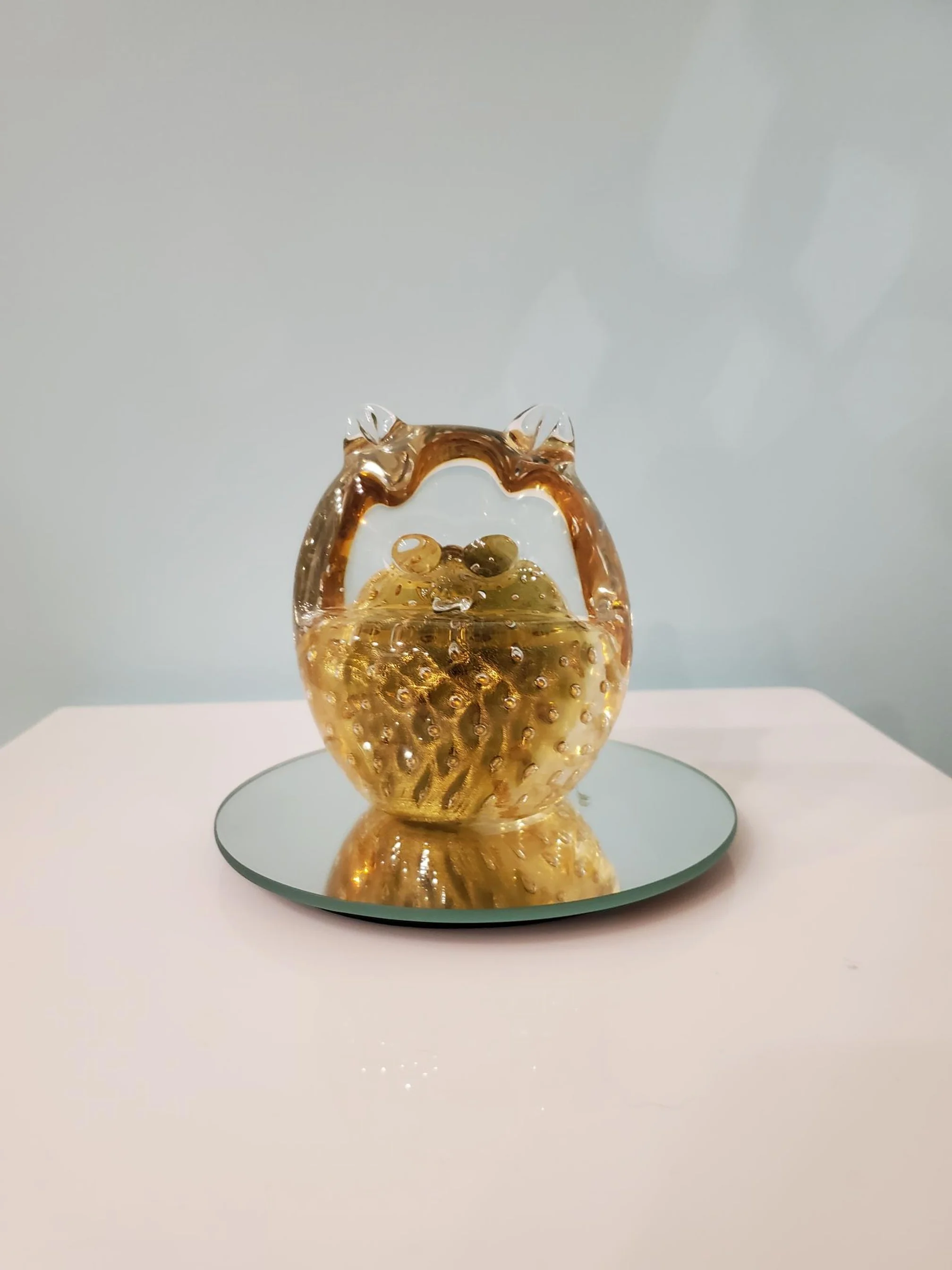
I am extremely fortunate to have this little guy in my collection.
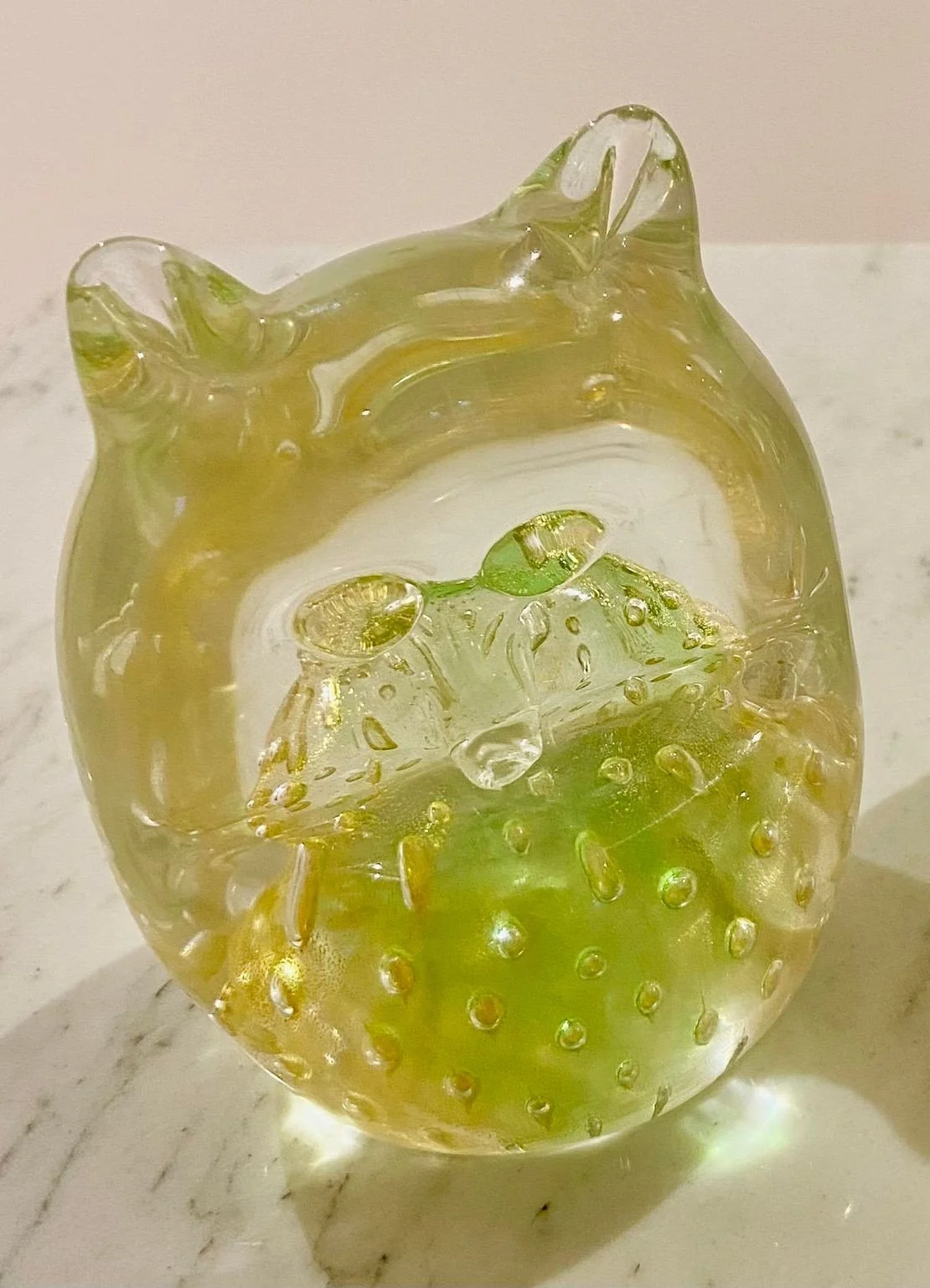
As is Jonathon Tremblay with regard to this Buddha.
The gold dust rabbits:
Again, to date, the gold-filled rabbit figurine has only been found in blue tones. These figurines are exceedingly rare.
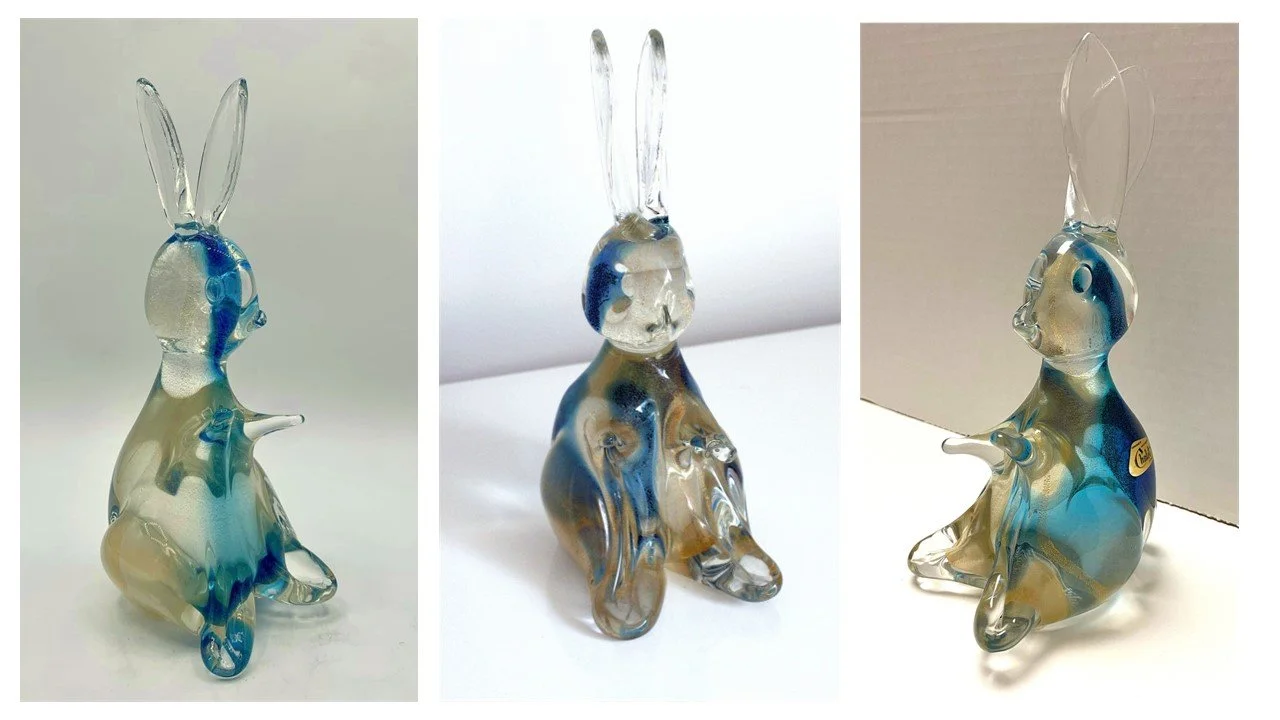
Photograph at left courtesy of Sabrina Brunetti. Rabbit figurine in middle from the collection of Deborah Patterson. Collector Troy Danby owns the figurine at right.
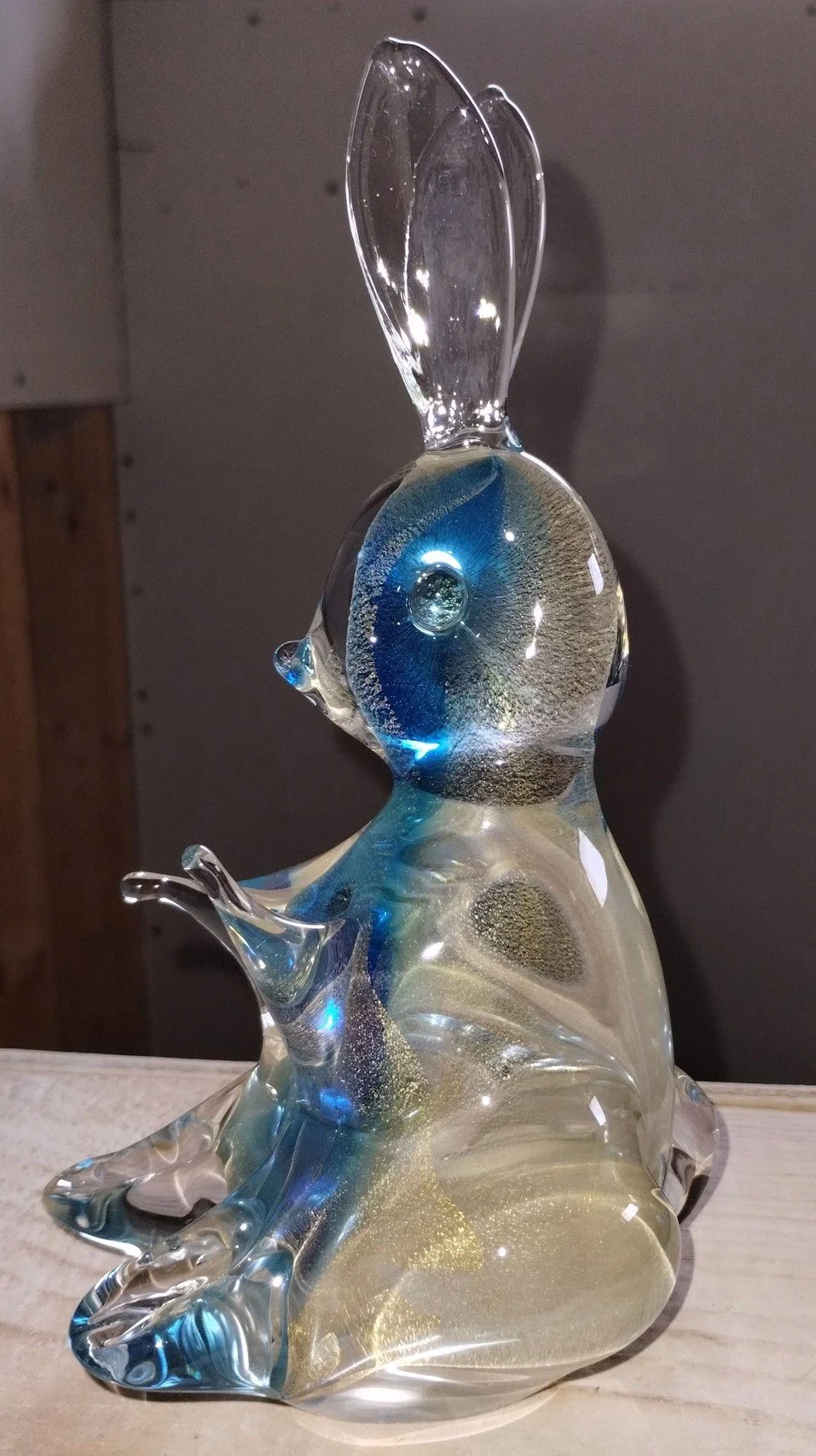
A new addition to Jo Highland’s hutch.
The gold dust polar bears:
Gold dust Chalet polar bears are atypical. They are seen quite frequently with silver foil, but this guy is an anomaly!
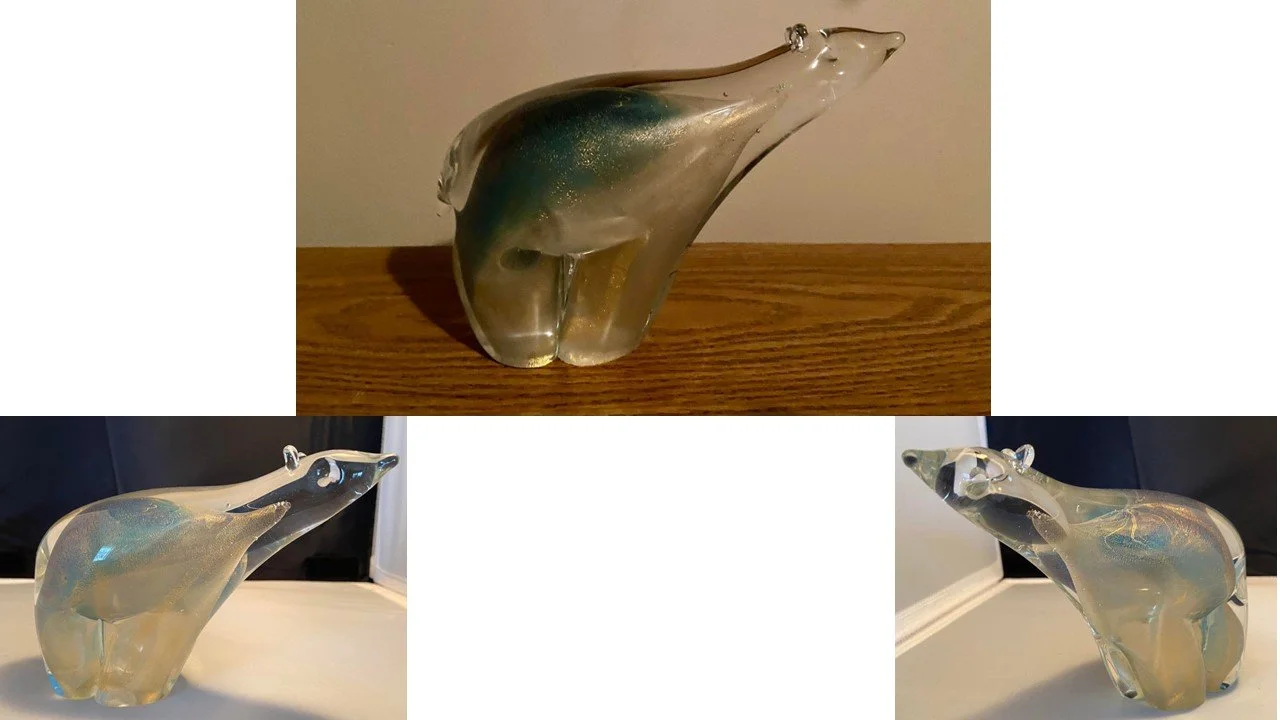
From the collection of Matthew LeDrew.
Chalet also used gold dust and silver foil in some of their “bird bath” ashtrays. Gold dust can be found in some of the applied bird figurines and in the bowl of the piece. Silver foil use seems to have been limited to the bowls.
With gold dust and without gold dust:
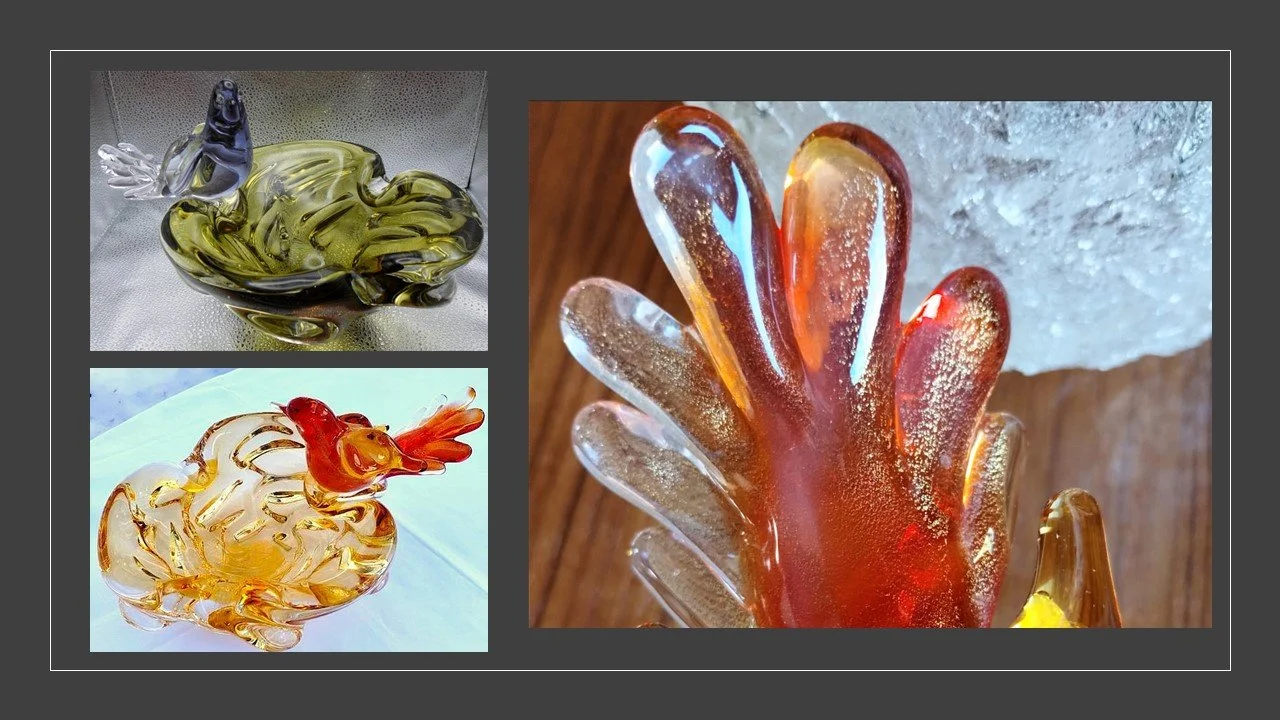
The olive ashtray with the applied purple bird figurine (top left) does not have gold dust in either its bowl or in the songbird. However, the bird figurine on the gold ashtray (bottom left) is a polvere d’oro piece. The “bird bath” without the gold is from the collection of Pina Pina. The polvere d’oro piece is from the collection of Alain Frenette.
These two amazing pieces have gold dust and/or silver foil in both the bird figurine and ashtray bowl:
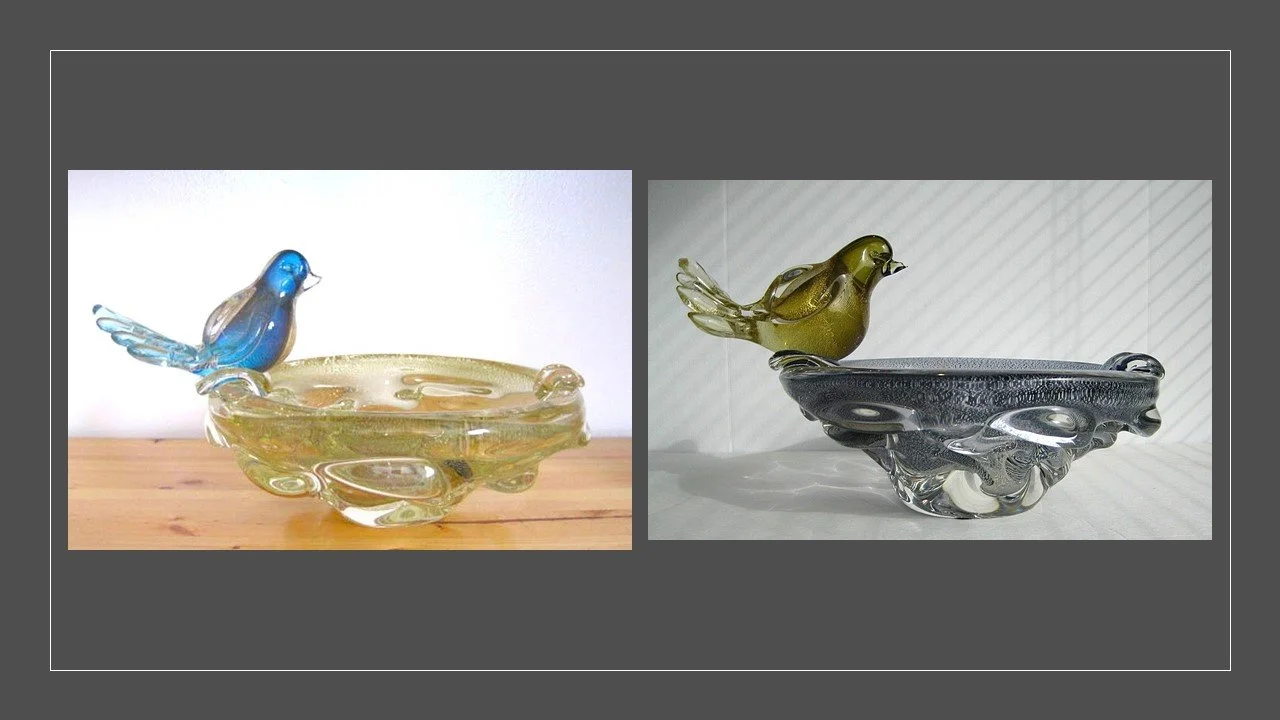
Photograph at left of applied blue gold dust songbird/clear crystal polivere d’oro birdbath courtesy of Robin Thorne. At right, this olive gold dust songbird/purple silver foil birdbath from the collection of Graham Thomas.
Chalet produced cat, elephant, fish, owl and polar bear silver foil figurines. In Chalet silver foil figurines, small ultra-thin sheets of this metal were used. These silver sheets were made by the precious metal having been beaten into an extremely thin leaf-like state of about 0.15 micron in width. To give you an idea of such a thin surface, this reflects about 20 grams of the precious metal covering six square meters. The sheets were then cut into small squares of about 8 cm. To infuse this silver into the form, the Maestro started by rolling these small .925 silver sheets onto the hot glass mass during the early stage of blowing the figurine. Once the silver foil covered most of the gather, he then added a layer of clear crystal. Next, as he began to blow into his canna, the metal sheet within the layers began breaking into smaller pieces which dispersed throughout the piece. This resulted into objects having scattered metallic pieces of differing sizes and shapes captured inside the form producing striking metallic effects. Silver foil may appear close to the surface or submerged within deeper layers of clear crystal. There is no uniformity from piece to piece as you will see below. There is more diversity in the colours seen paired with silver foil as compared to the colours found in the gold dust figurines.
The silver foil cat:
Markedly different from the style of the Chalet polvere d’oro cat figurine:
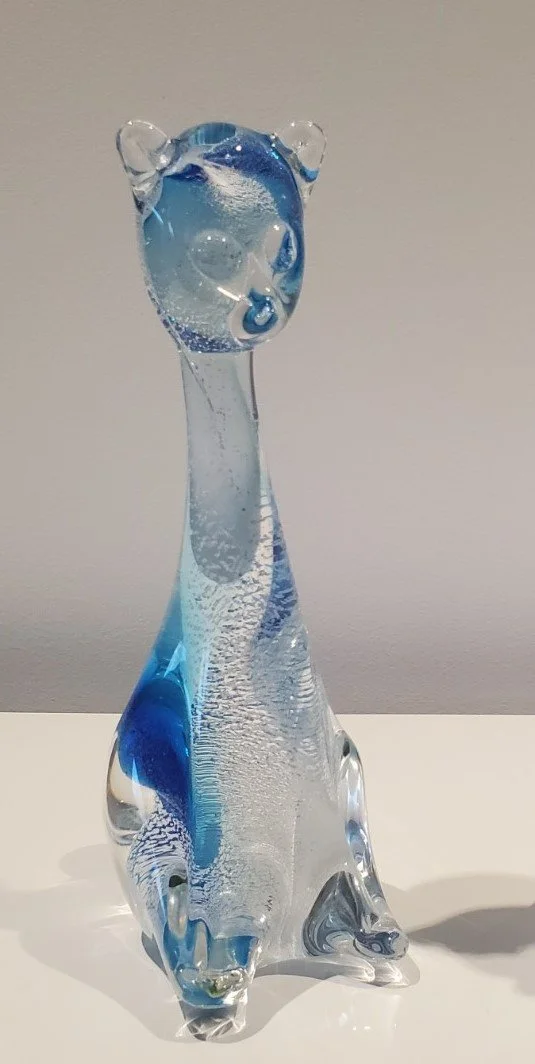
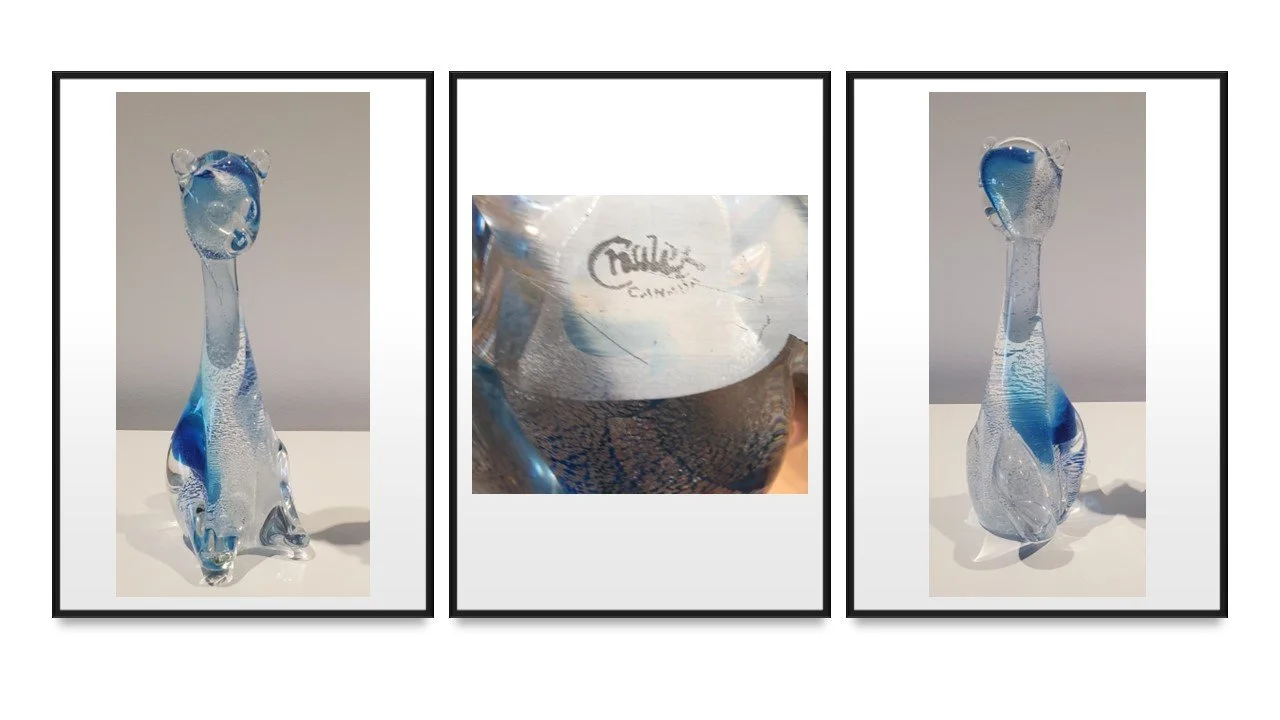
This amazing and unique figurine from the collection of Troy Danby.
The silver foil elephants:
They have been found in two colours. However, as of now, the “trunk up” pose is the only style of elephant that has been found with either silver or gold fill.
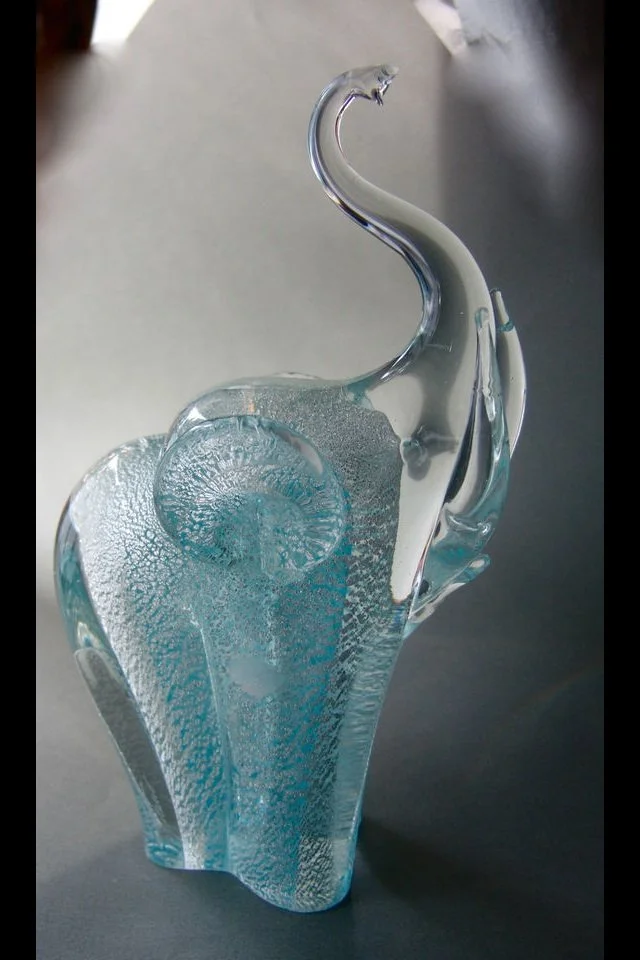
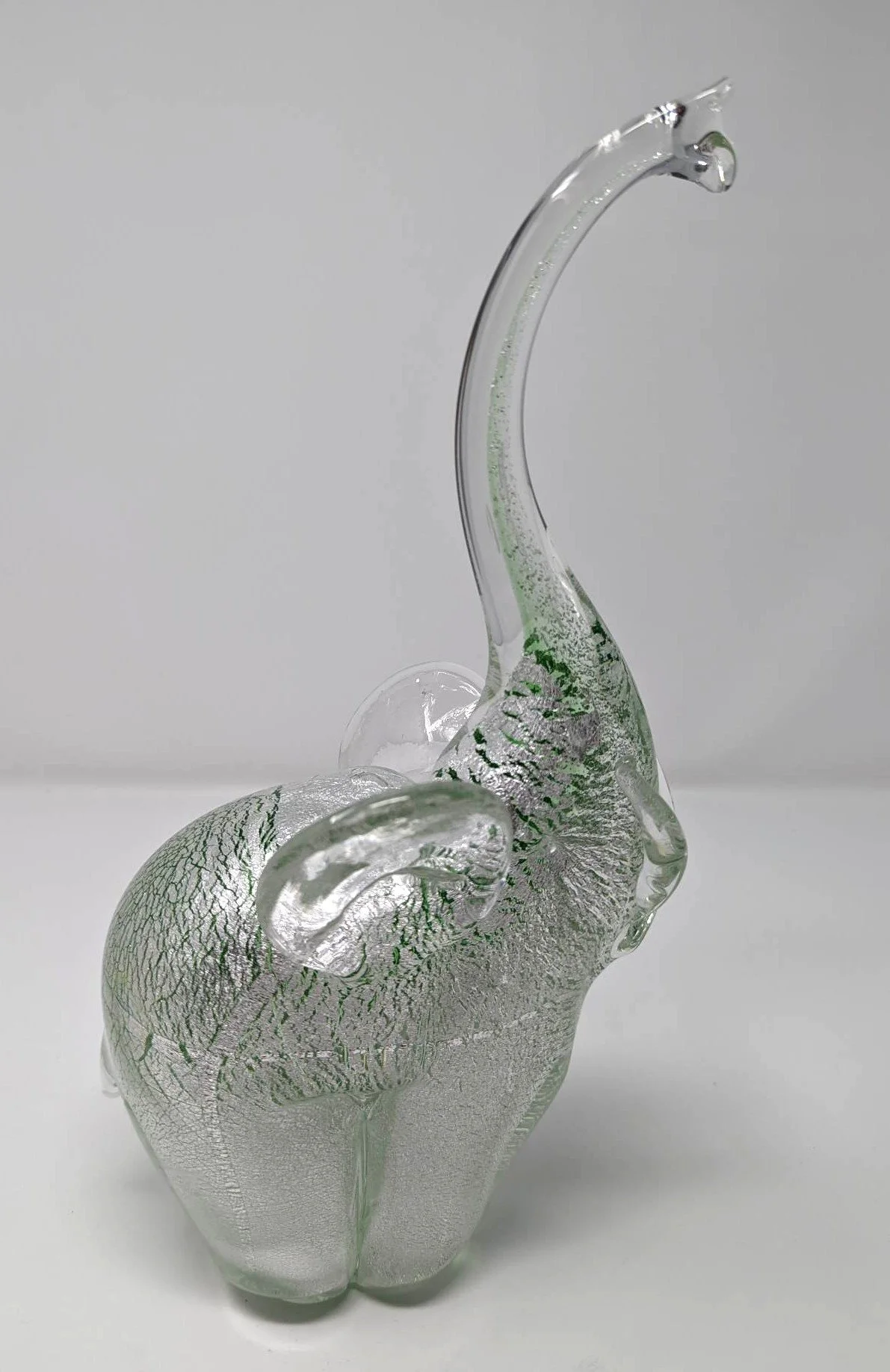
From the collection of Kevin Hall.
The silver foil fish:
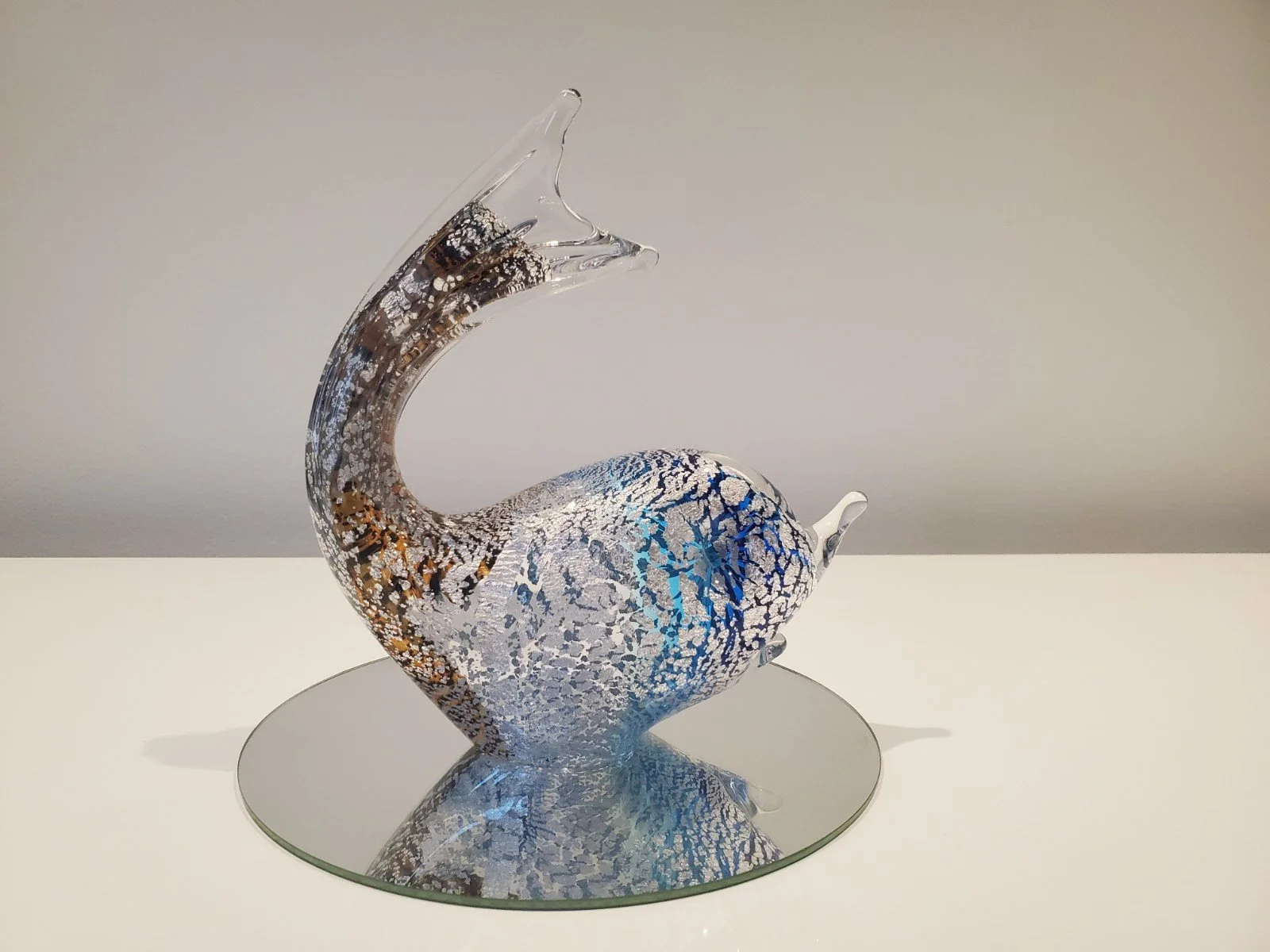
At time of writing, I believe this to be a one-of-a-kind figurine. A 2-tone is rare but one with silver… From the incredible aquarium of Troy Danby.
The silver foil owls:
But ‘Never say Never !” Another 2-tone with silver foil. I believe that this is also likely to be another unique piece.
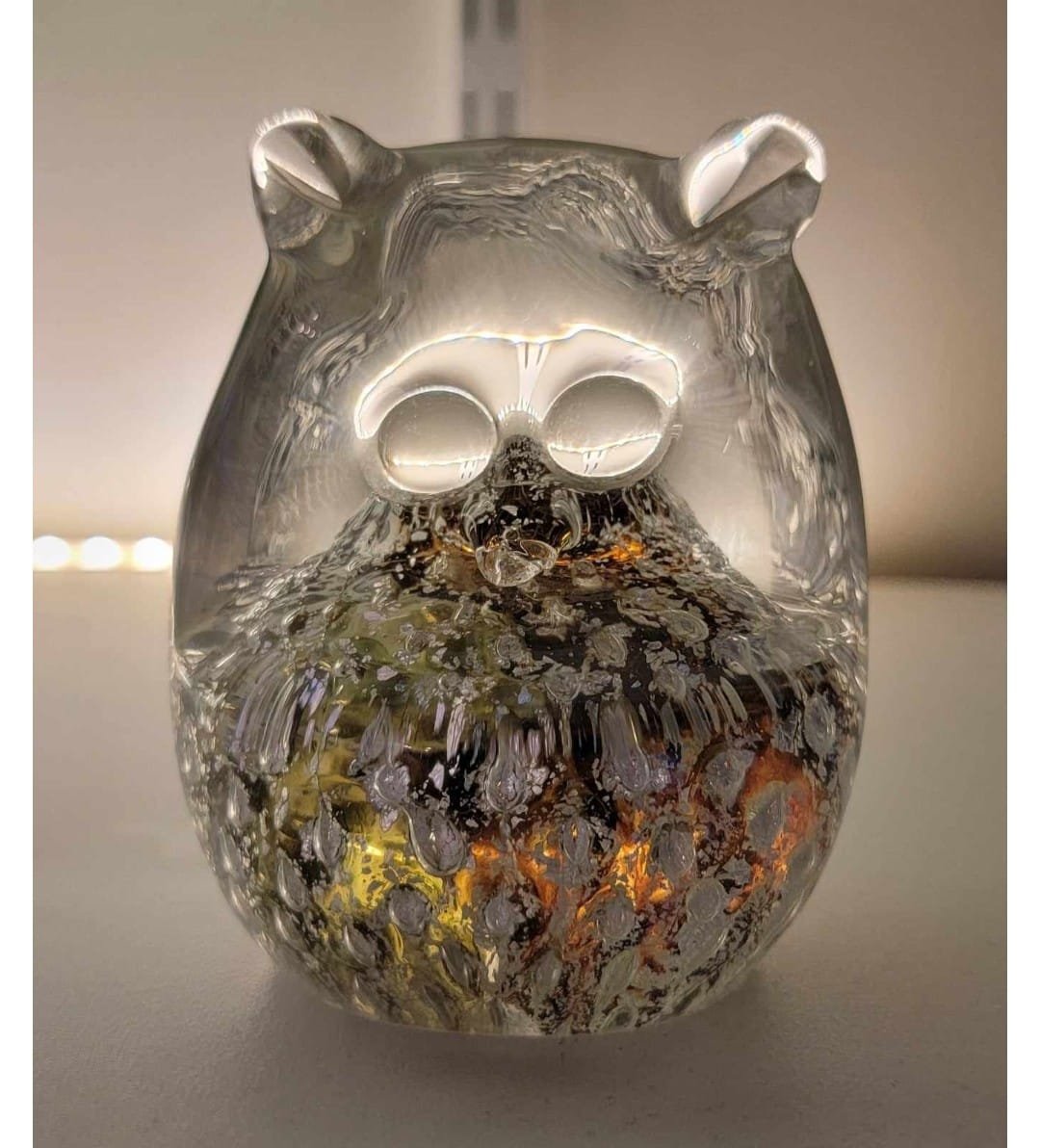
From the incredible roost of Cindy Bishop Laughlin.
The silver foil polar bears:
This figurine is where the most diversity of colour, size and style is seen. The silver foil polar bear has been found coloured in olive green with silver, emerald green with silver, blue with silver, purple with silver and a fantastic crystal clear with silver.
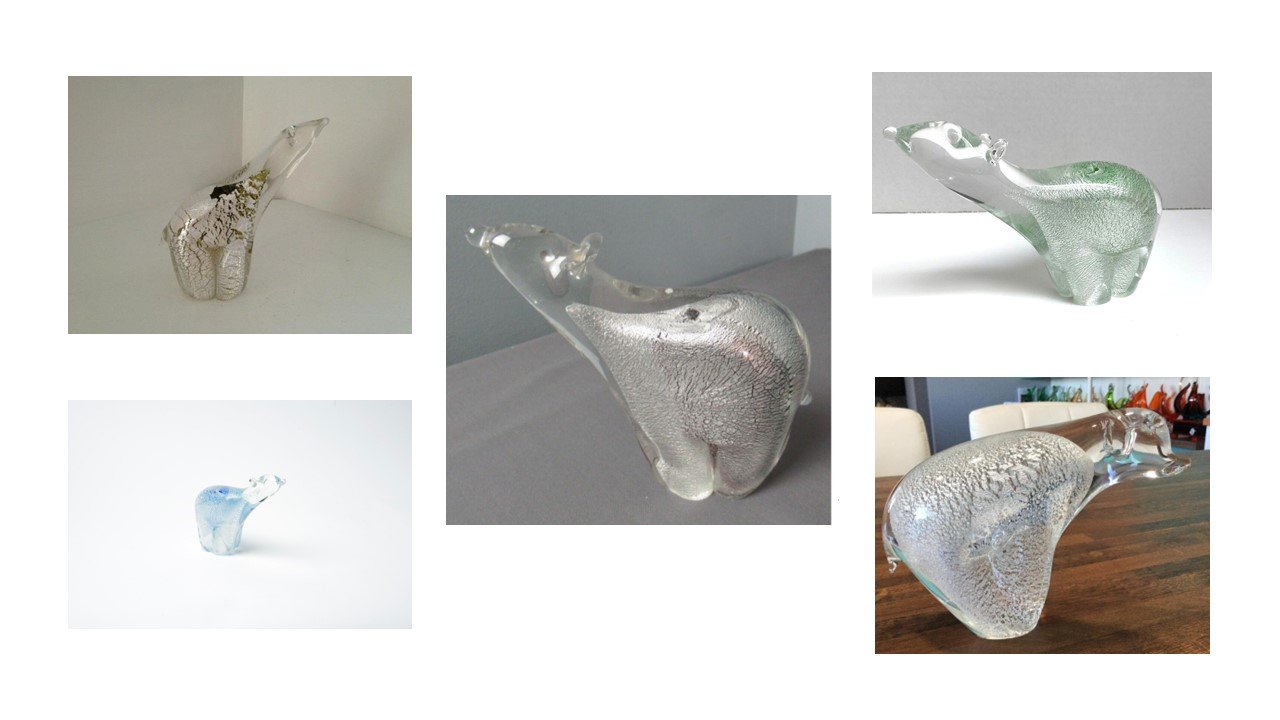
Courtesy of collectors: Jonathon Tremblay (top left), Deborah Patterson (bottom left), Troy Danby (top right) and Candace Nestorowich (bottom right).
They have been found in two styles. And in 2 poses. As well, you will notice the typical variation in colour, colour placement, intensity of silver foil, shaping, height, length and girth.
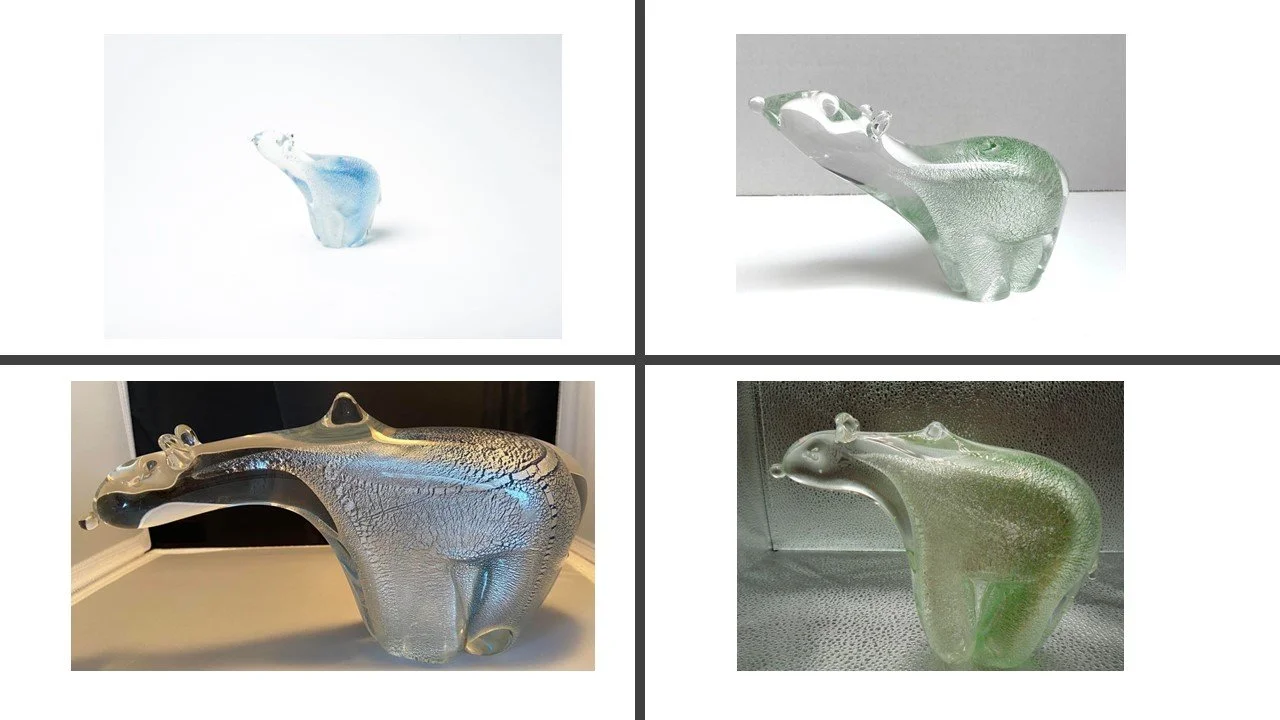
Owners of the “heads up” pose bears with no hump – blue, Deborah Patterson and green, Troy Danby. Owners of the “heads straight out” pose bears with humps – blue, Matthew LeDrew and green, Pina Pina.
Blue with silver foil polar foil polar bears:
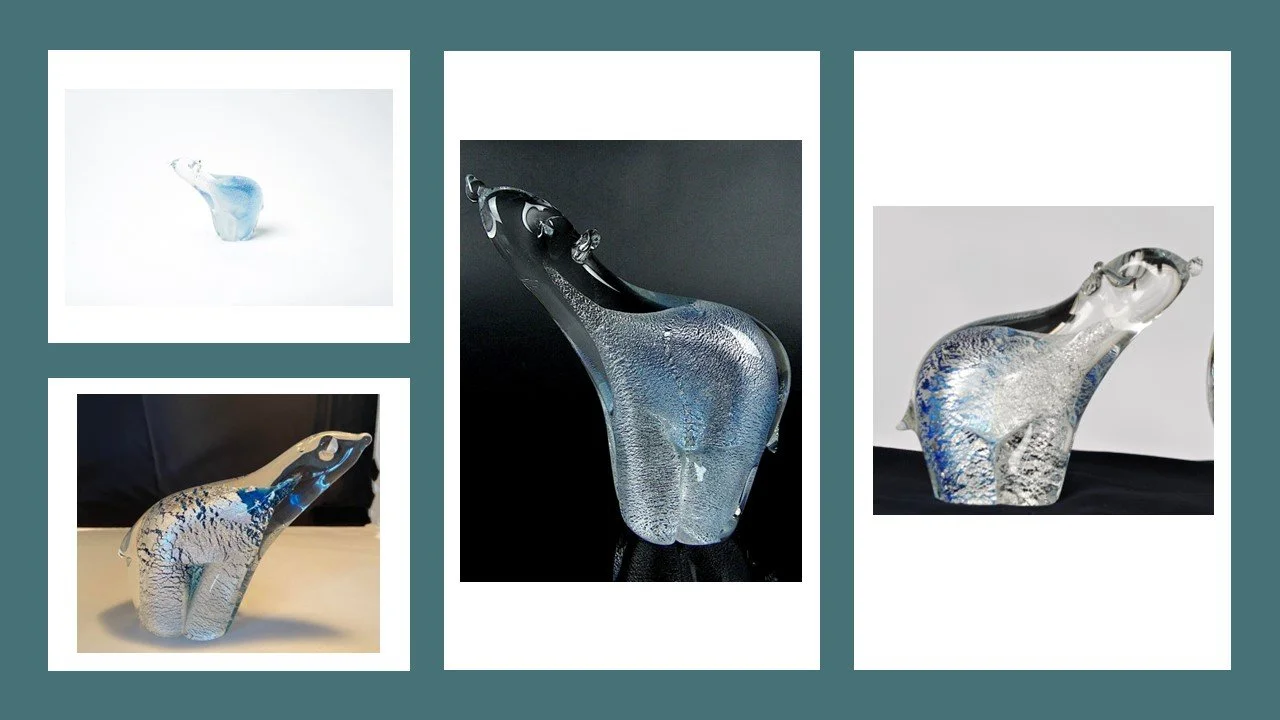
Deborah Patterson – top and bottom left. Maestro Bruno Panizzon – top right.
My blue silver bear (shown at bottom left in photo gallery above) above is a mini!
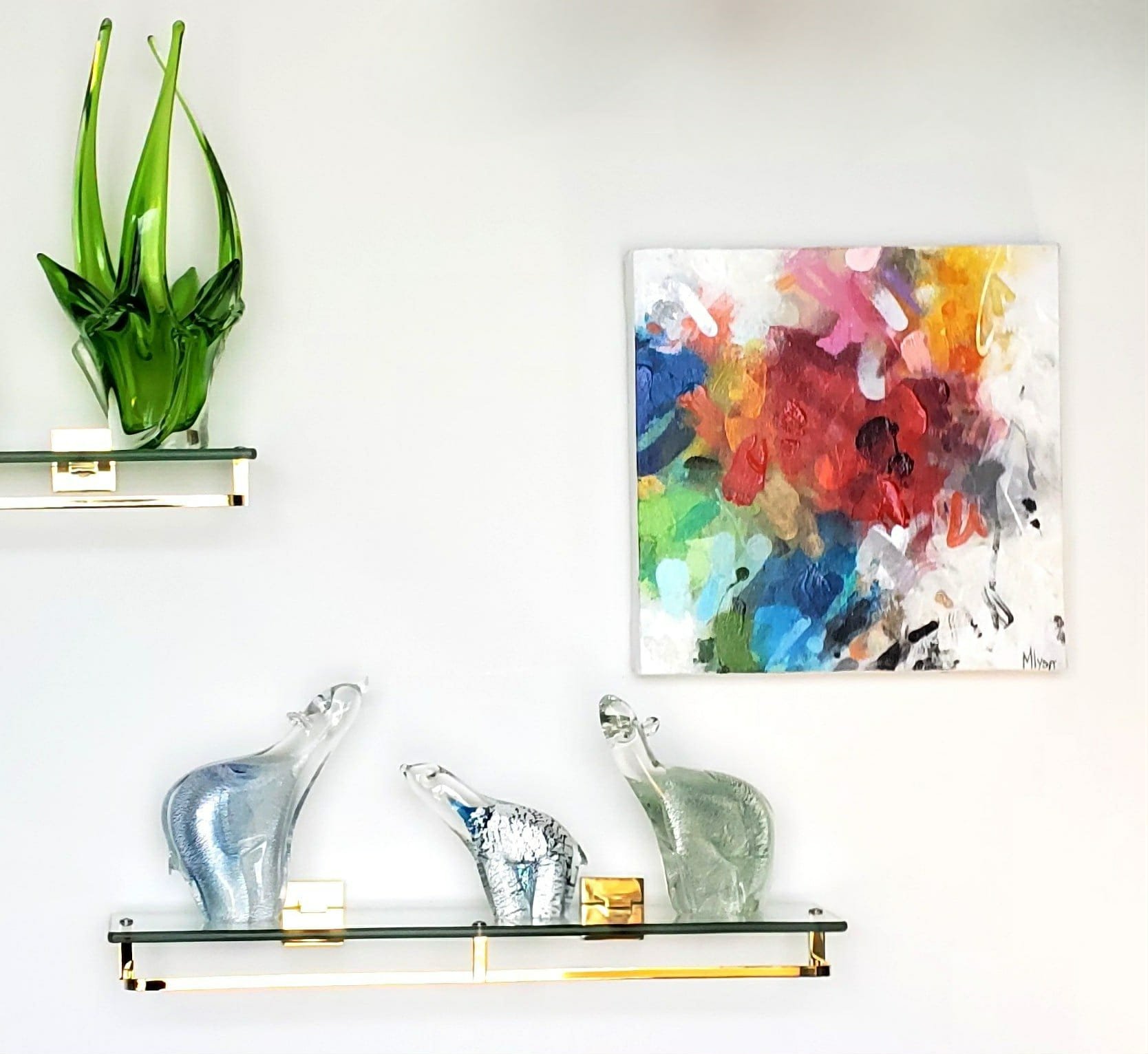
He stands only 4 inches as compared to the 6 ½” height of the blue and emerald green silver foil bears flanking him.
His colour is deep and very saturated, and the silver foil is very dense.
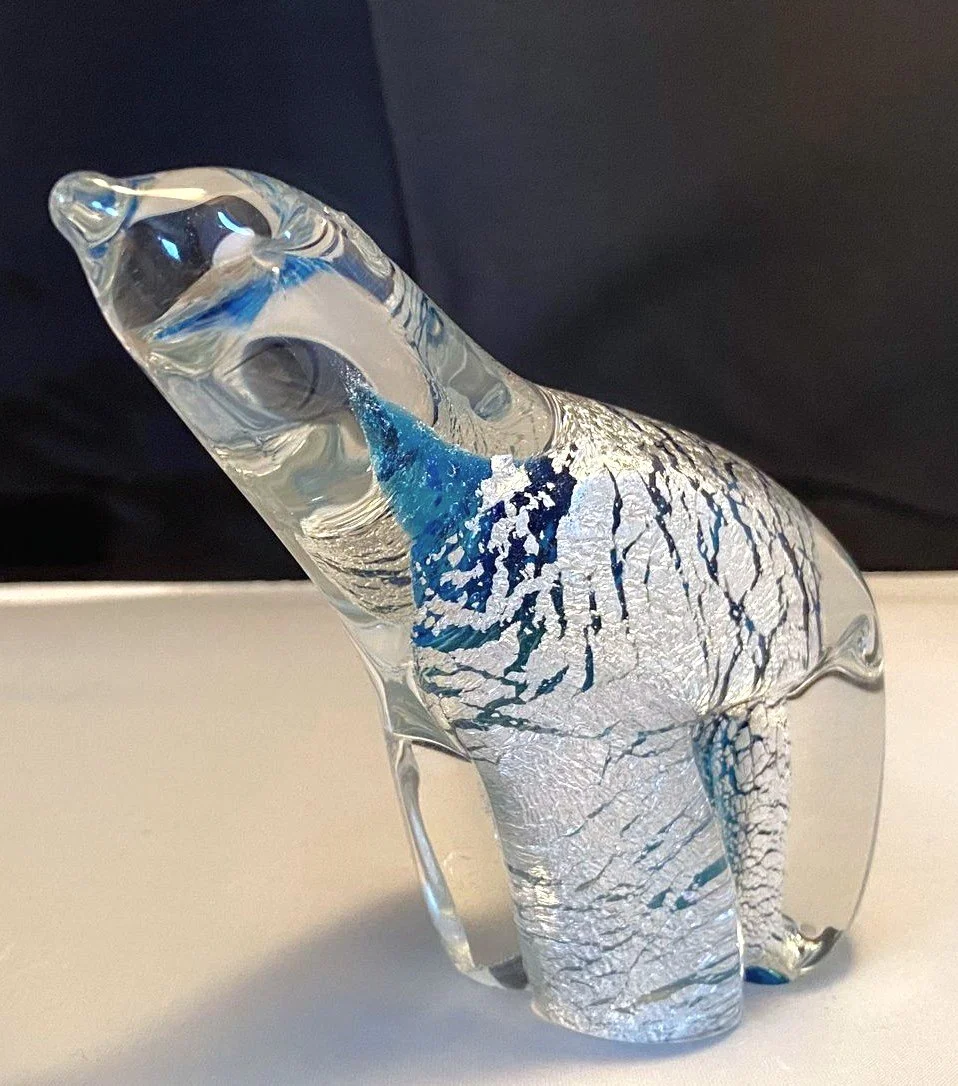
The emerald green with silver foil polar bears:
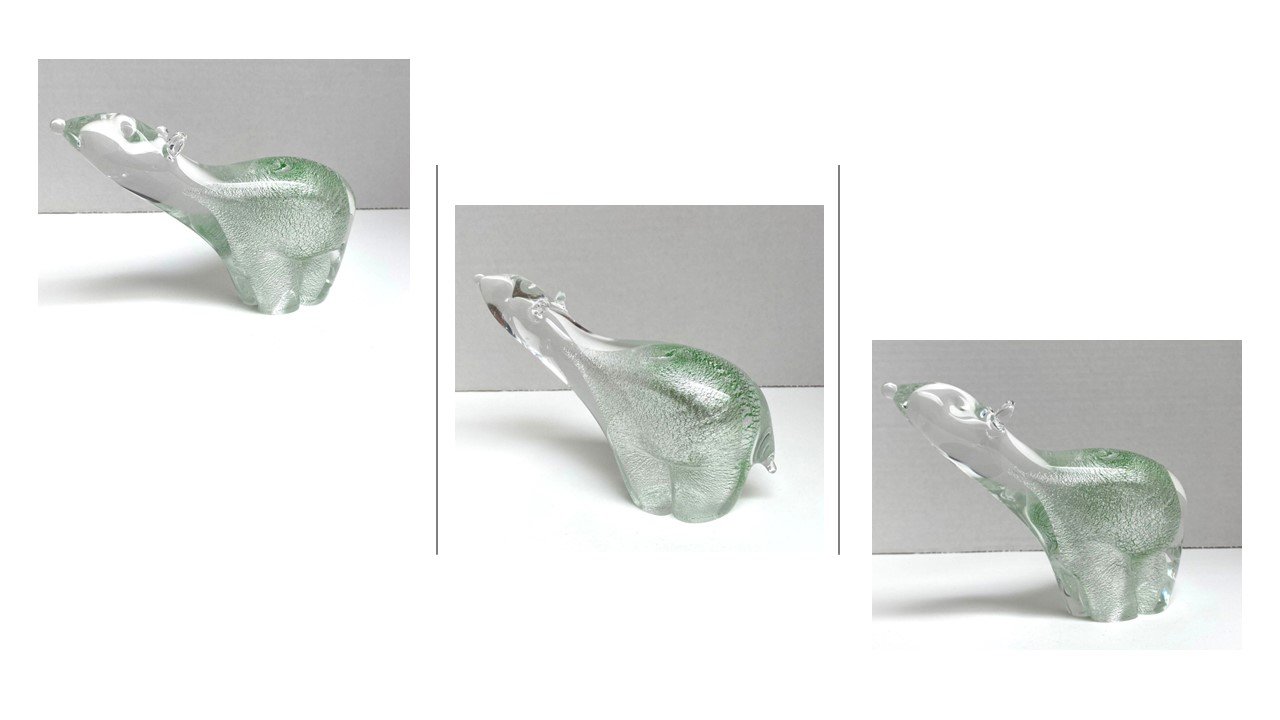
From the Chalet Zoo of Troy Danby.
The olive-green with silver foil polar bears:
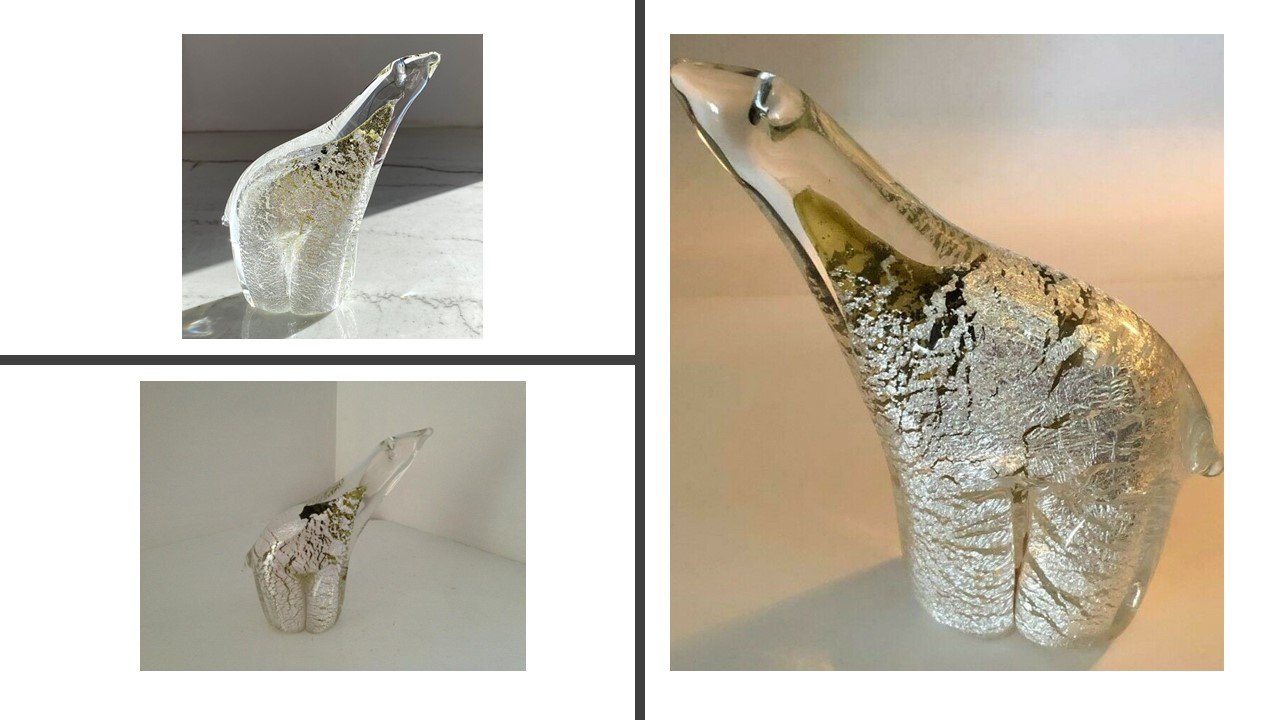
Olive with silver foil bear figurine at top left from the ice floes of Jonathon Tremblay. Photograph at bottom left courtesy of Bradley Atkinson.
Purple with silver foil polar bear:
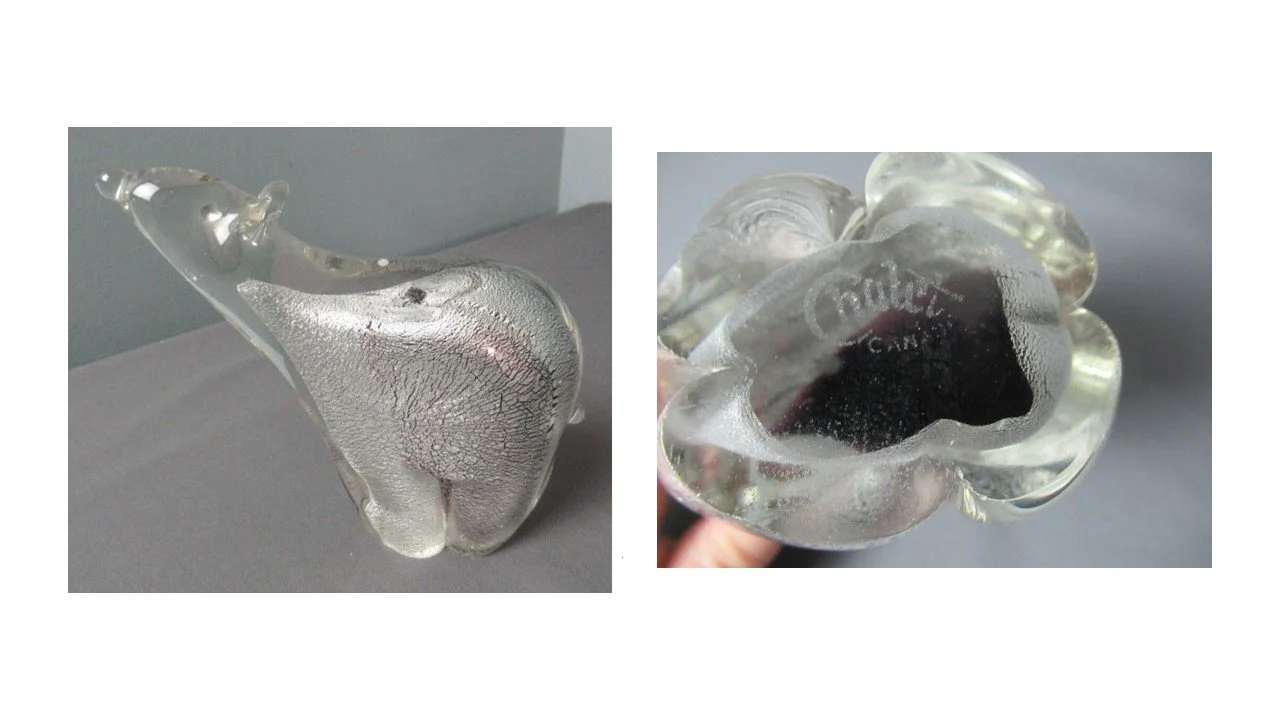
Lastly, a very unique clear crystal with silver foil:
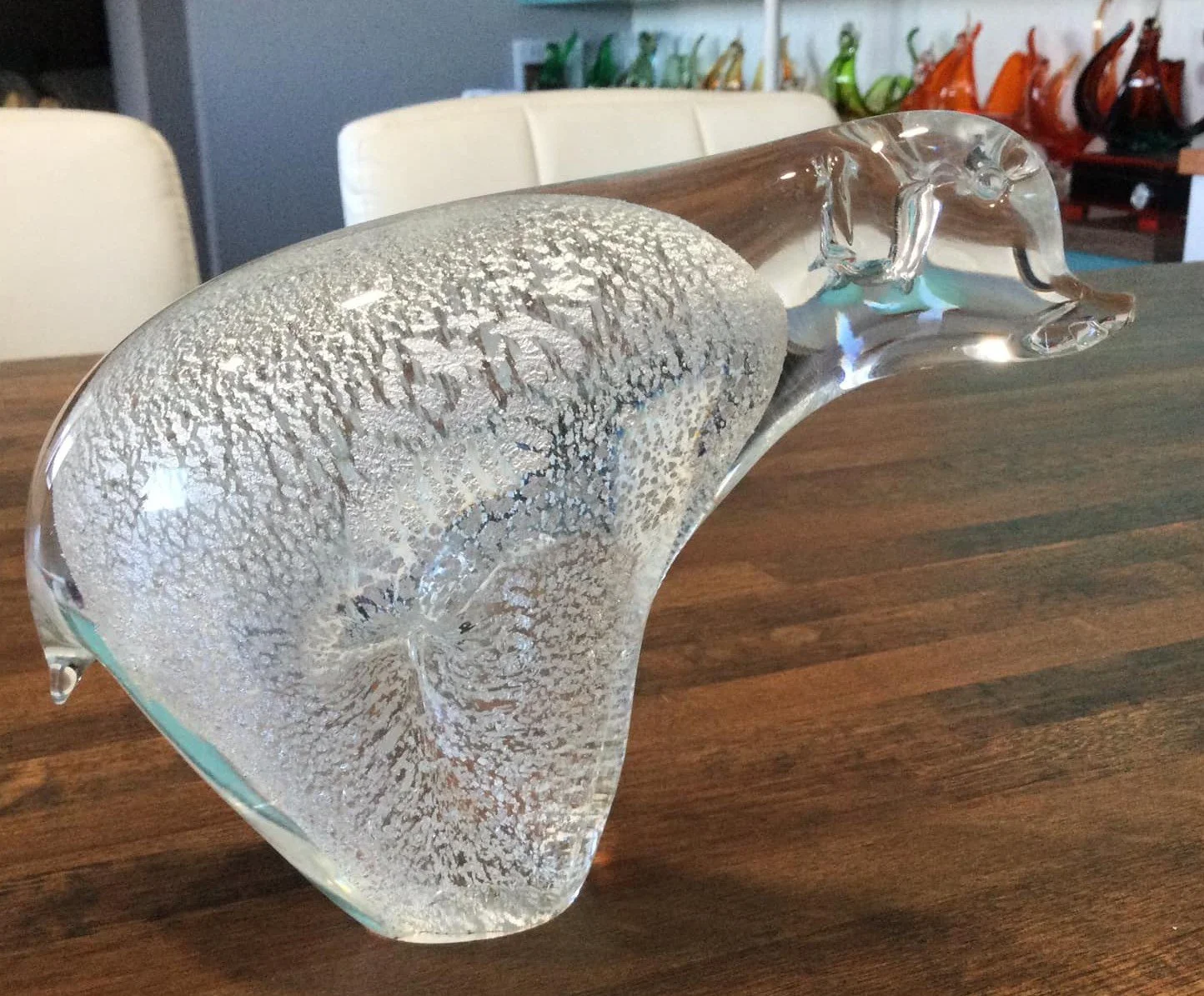
Photograph courtesy of Candace Nestorowich.
A visual recap.
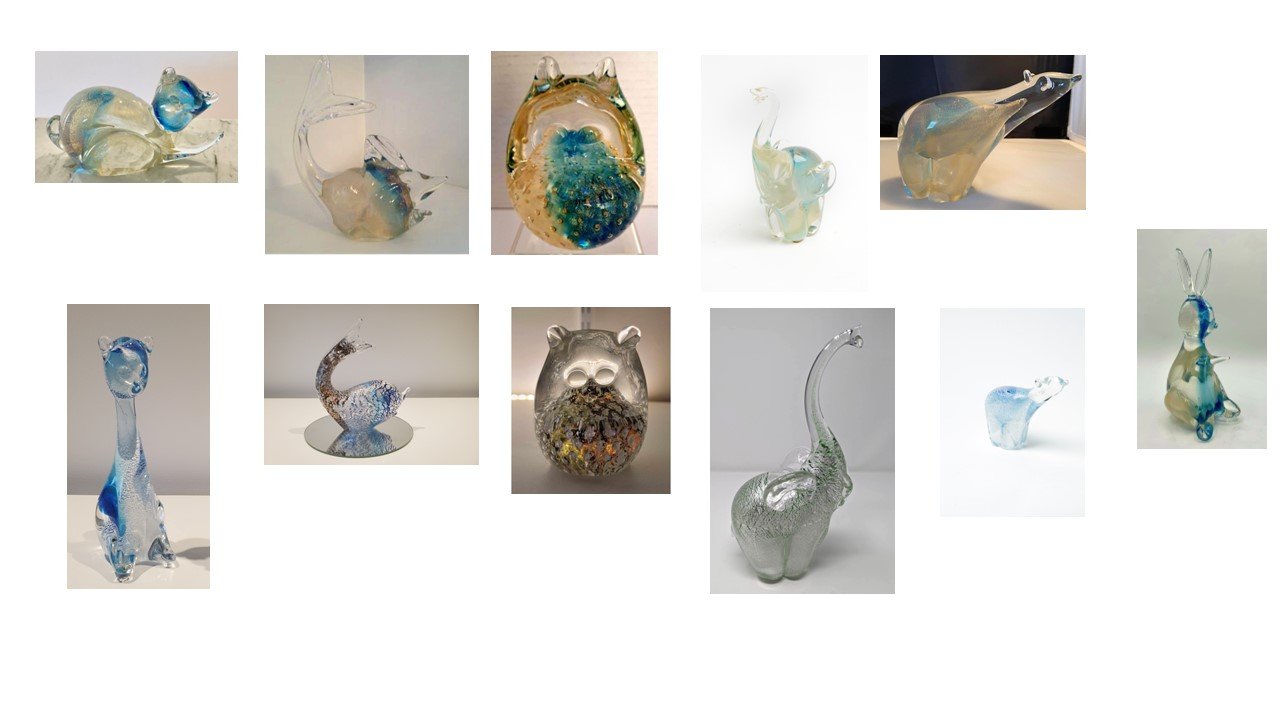
Note that the gold dust rabbit figurine at far left middle does not have a silver foil companion. To date, there have been none found. Fingers crossed for such a discovery!
The polvere d’oro and silver foil figurines were extremely expensive to produce. With regard to an alternative to using silver foil or real silver dust, Chalet tried a “work-around” by using silver-coloured mica powder. As mica powder does not dissolve or typically react to other elements, it does not alter the transparency of the material in which it is embedded.
This powder comes from a naturally occurring mineral called mica, which is ground into a powder and then coated with various metal oxides and pigments to create a wide range of vibrant colors. Therefore, although silver mica powder creates pearlescent or an iridescent “shimmery silver" effect, it does not contain actual silver. True metallic powders and pigments, including the gold, silver and copper used in art glass, are made from real metals and accordingly priced based on the market value of that metal.
Like the Chalet gold dust forms, mica powder was not applied on the surface but added to the molten mix and submerged within the gather. Mica powder creates subtle internal effects within the form. These effects present markedly different under diffused light compared to under directed light or natural sunlight. Maestro Panizzon called these “sparkle pieces.” We have discovered only a mere handful of Chalet mica forms. Maestro Panizzon said that they did not go forward into production after a limited test run.
Shimmery silver, pearlescent silver-white or silver iridescent sparkles – let’s take a look! These pieces are most difficult to photograph to their best advantage. But some collectors took their best shot!
These forms appear to be limited to songbird and duck forms.
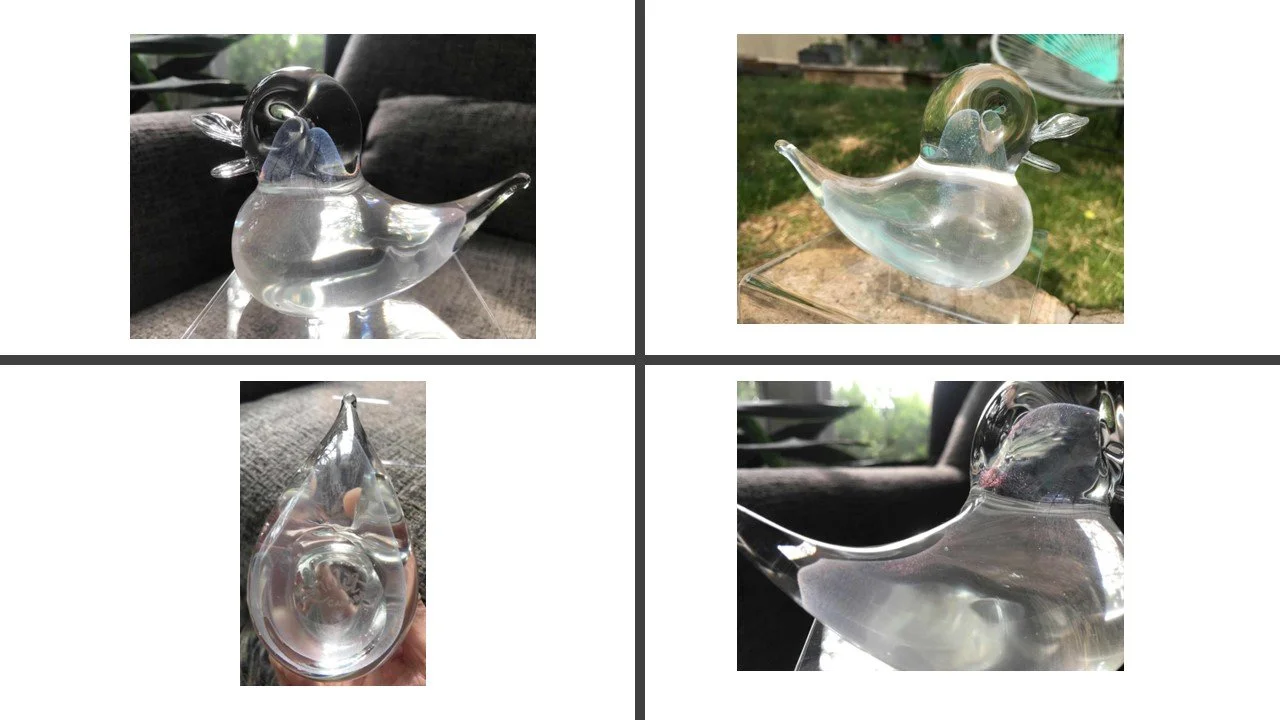
Two styles of mica powder ducks:
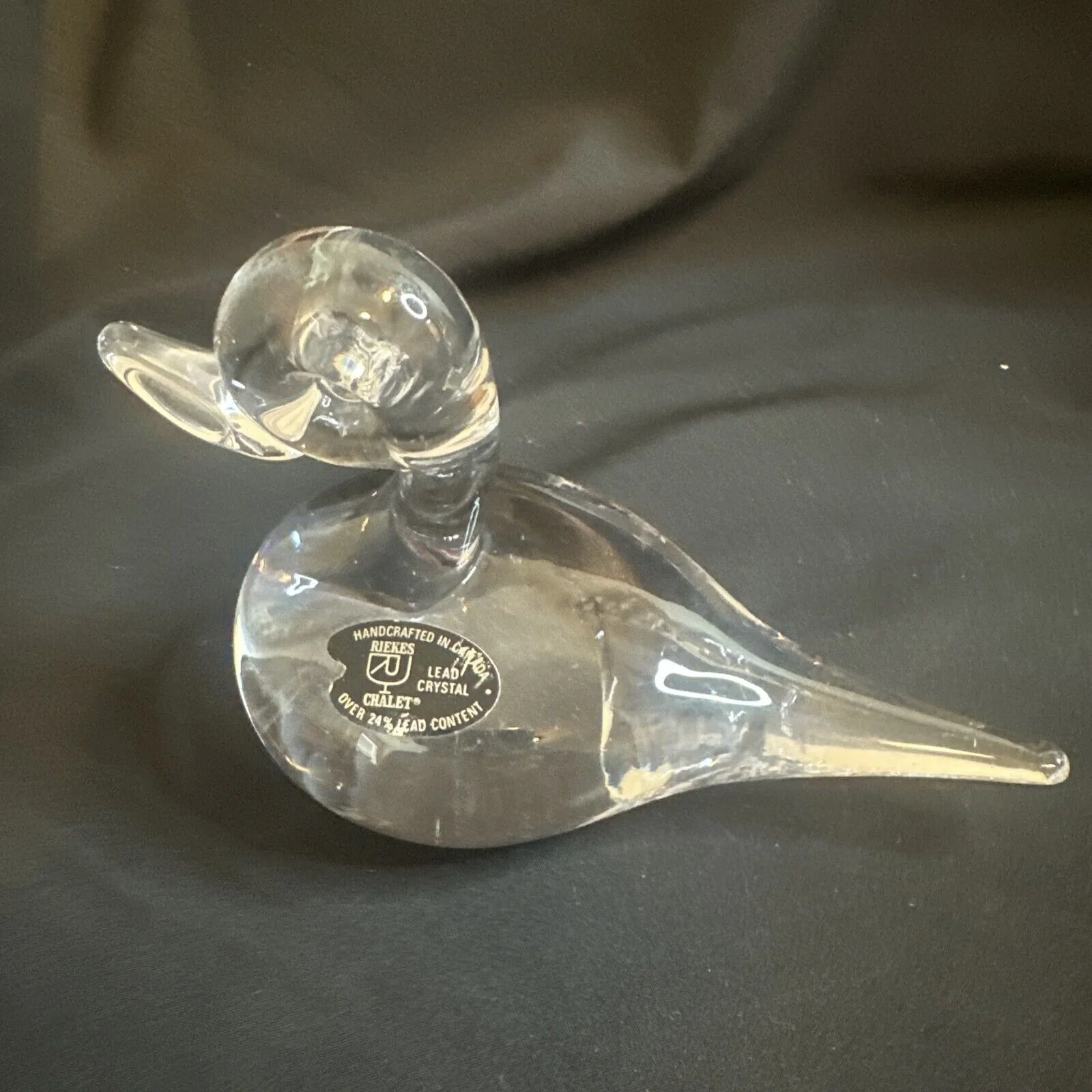
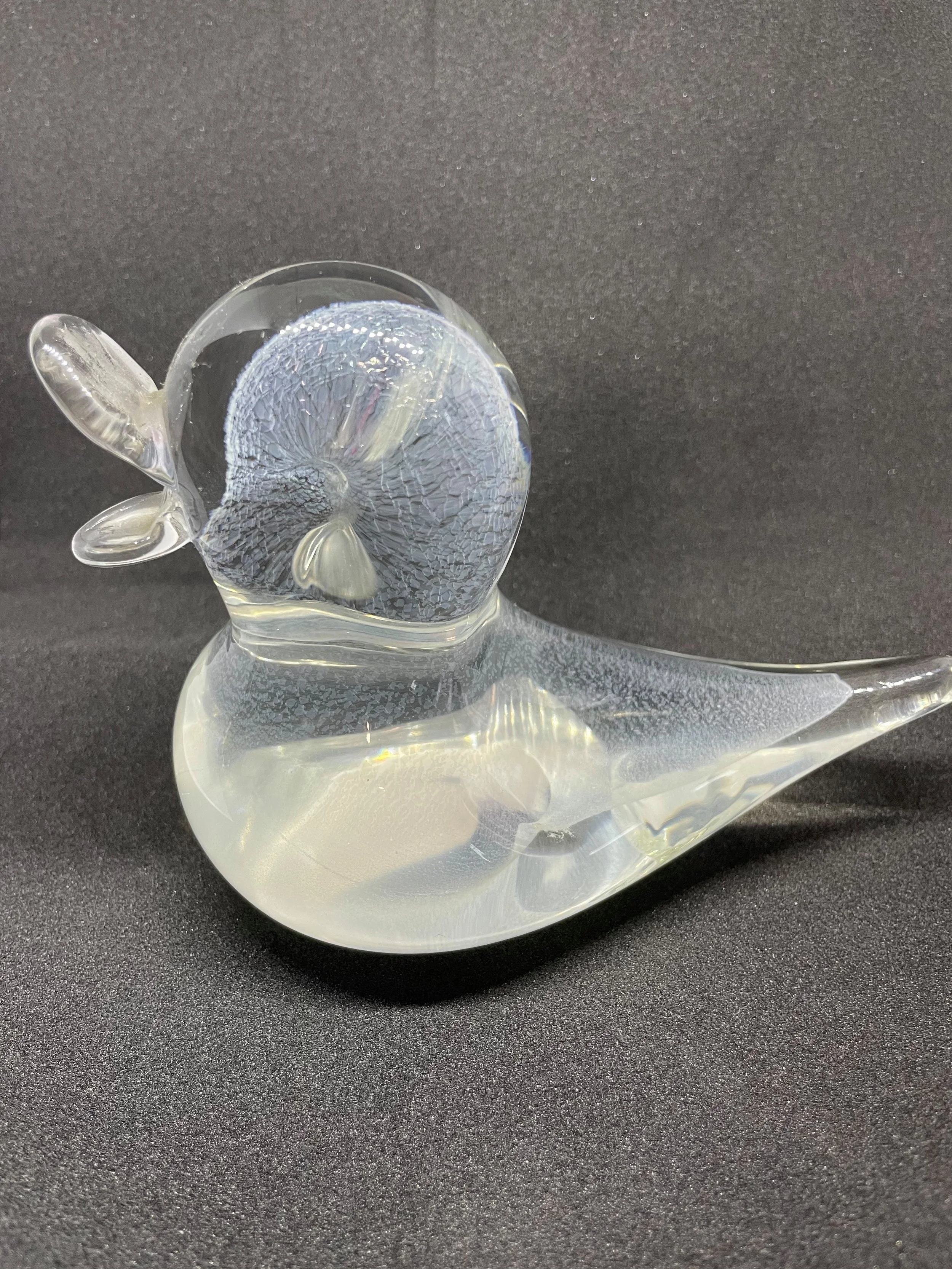
Photograph courtesy of Michael Flink.
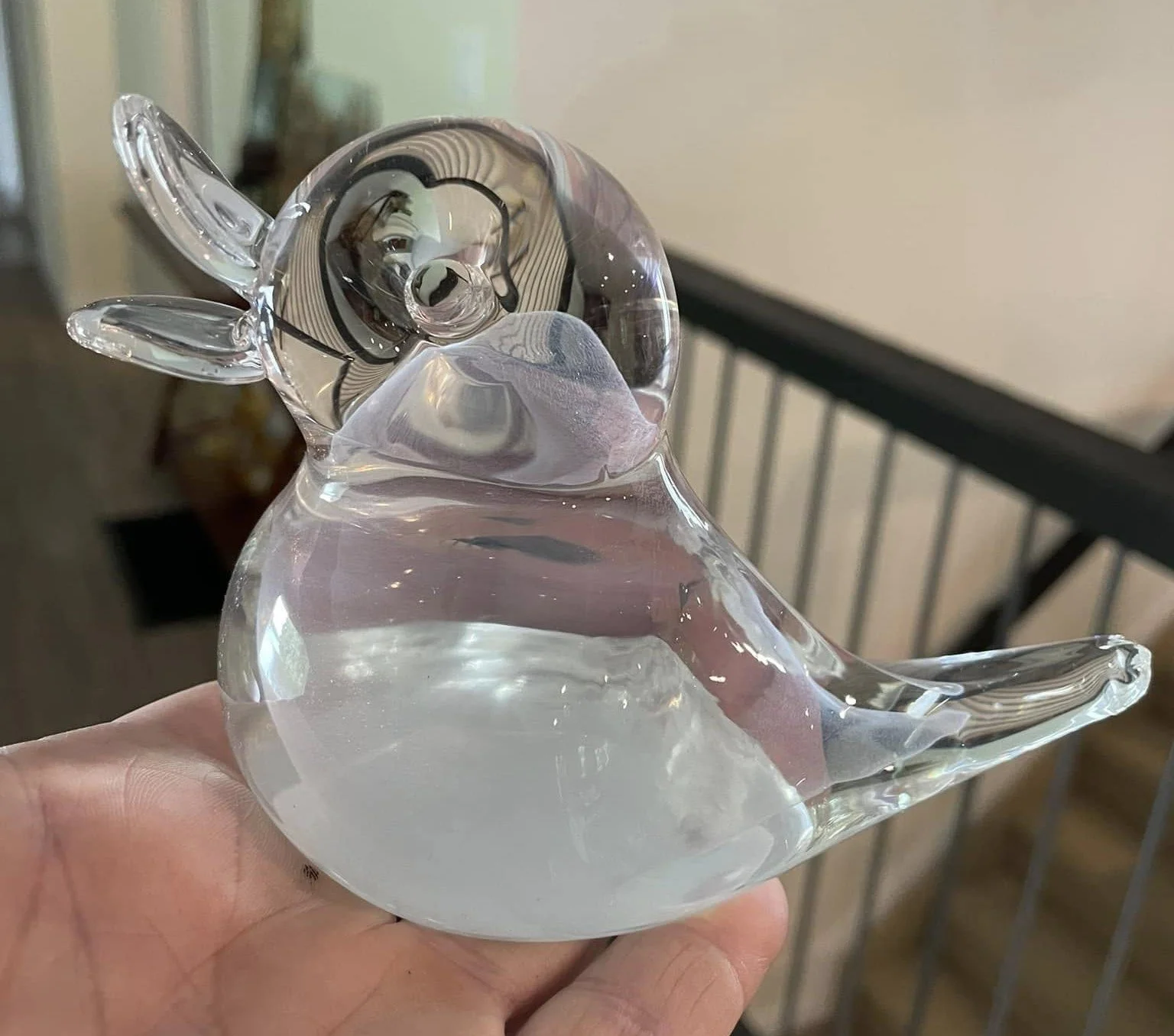
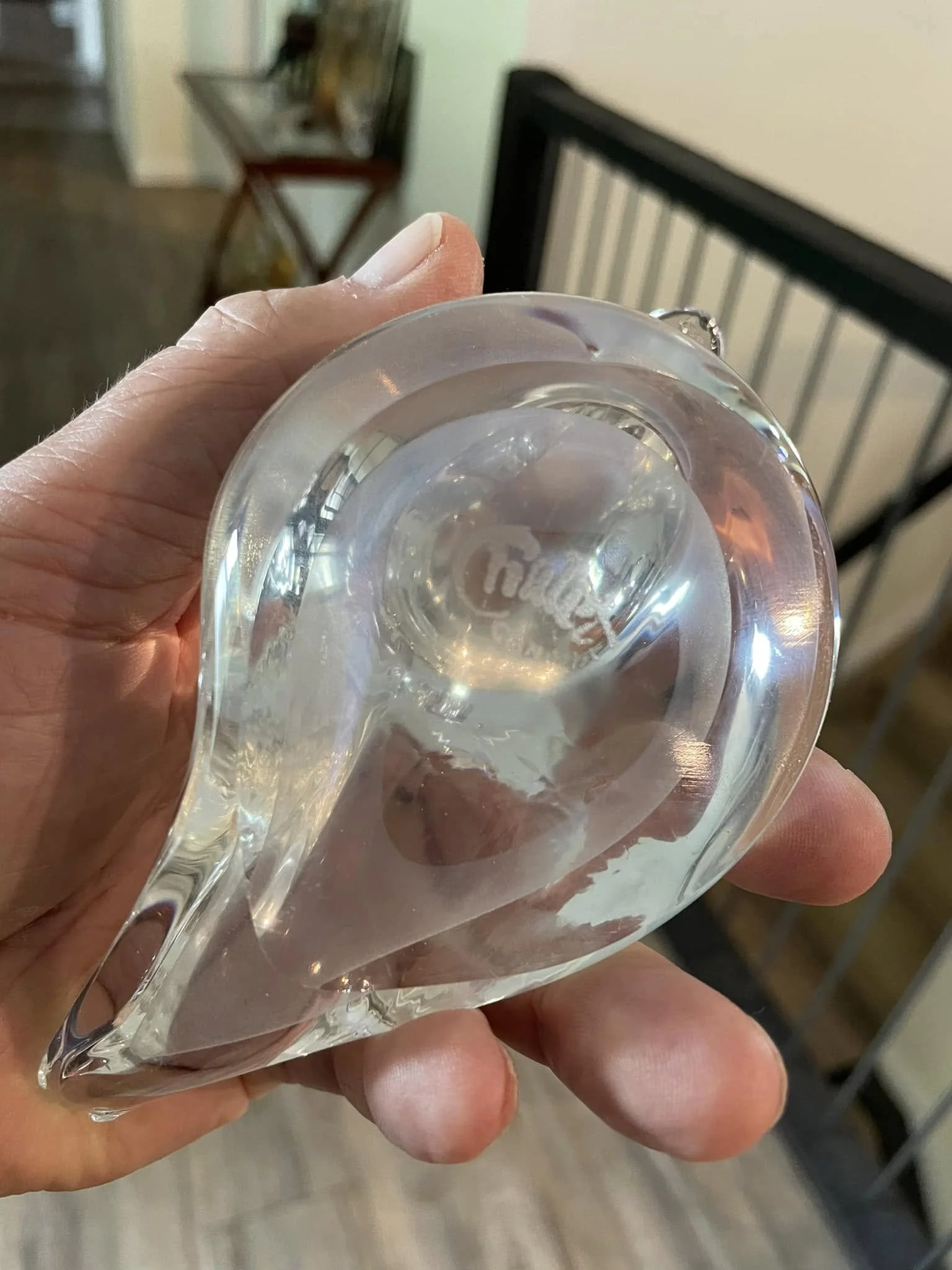
Just quacking around with Linton Meyer.
This photo gallery is of a Chalet mica powder duck figurine from the collection of Jo Highland.
And three different mica powder songbirds:
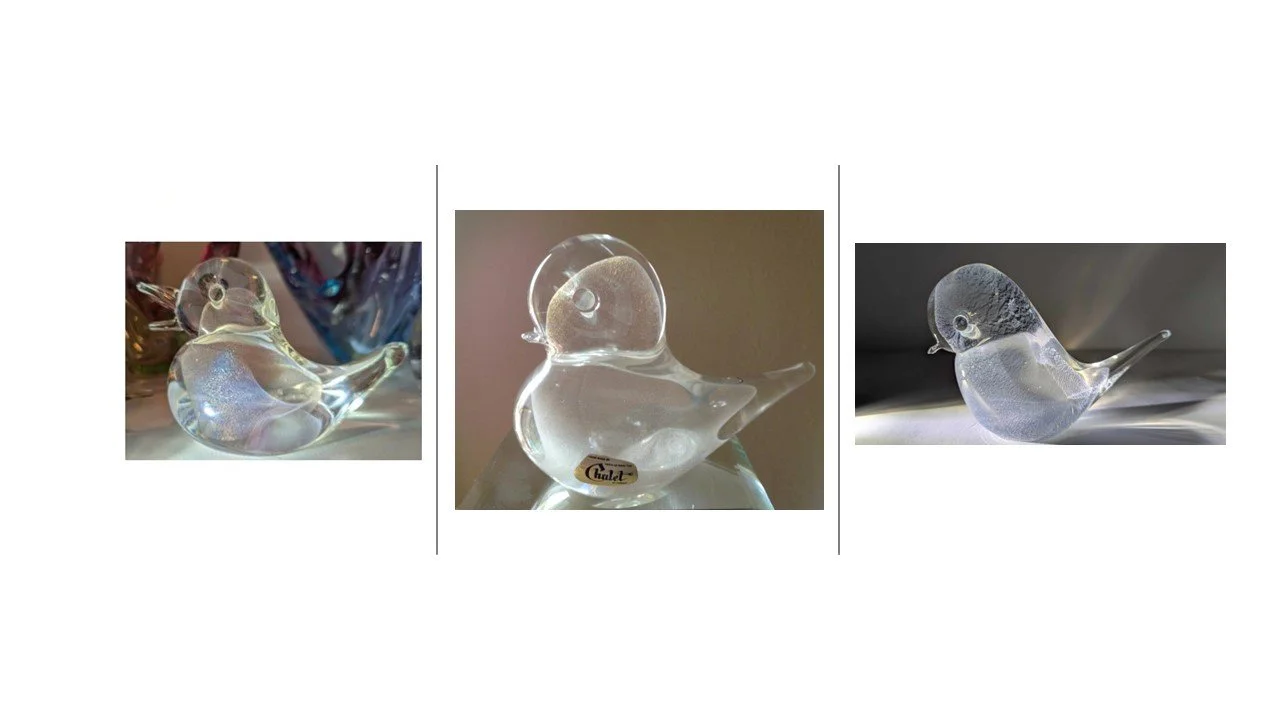
Chalet mica powder songbird at right from the collection of Kevin Hall.
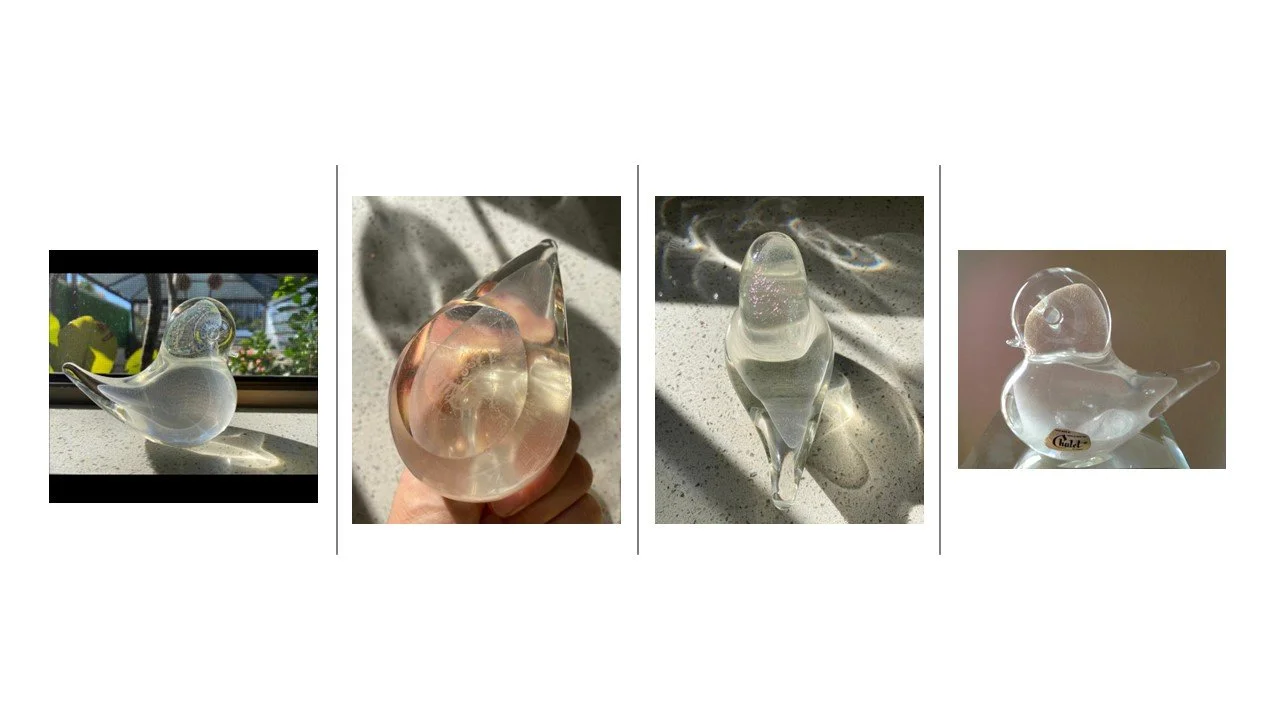
Photographs in this gallery courtesy of Bradley Atkinson.
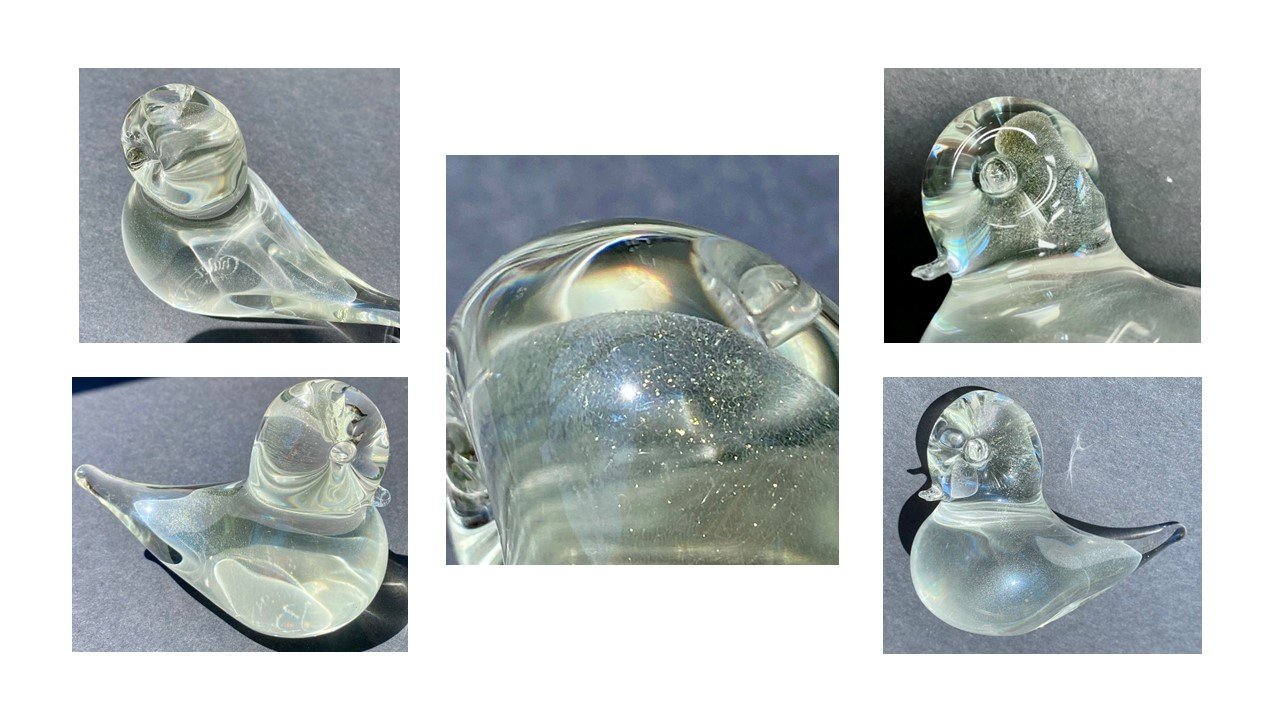
This mica powder songbird figurine from the collection of Jonathon Tremblay.
Gold dust was also used by Chalet in the applied crystal leaves and stems of some of their fruit forms. However, you will have to wait to see those in the upcoming article “Chalet Makes it Pretty.”
But to tide you over while you wait for it:
