The Chalet “Shimmer and Shine” bomboniere.
To which Chalet bomboniere am I referring to as being “the Shimmer and Shine?” I am referring to two styles specifically. Both have special glass skin surface treatments and, in addition, one of the two has a body of opaque not clear glass. Apart from these treatments, the majority of the designs in and of themselves are not unique and typically are found on the catalog pages we have for the Chalet “whimseys.”
These 2 owls are the perfect example of the Chalet “shimmer and shine” bomboniere:
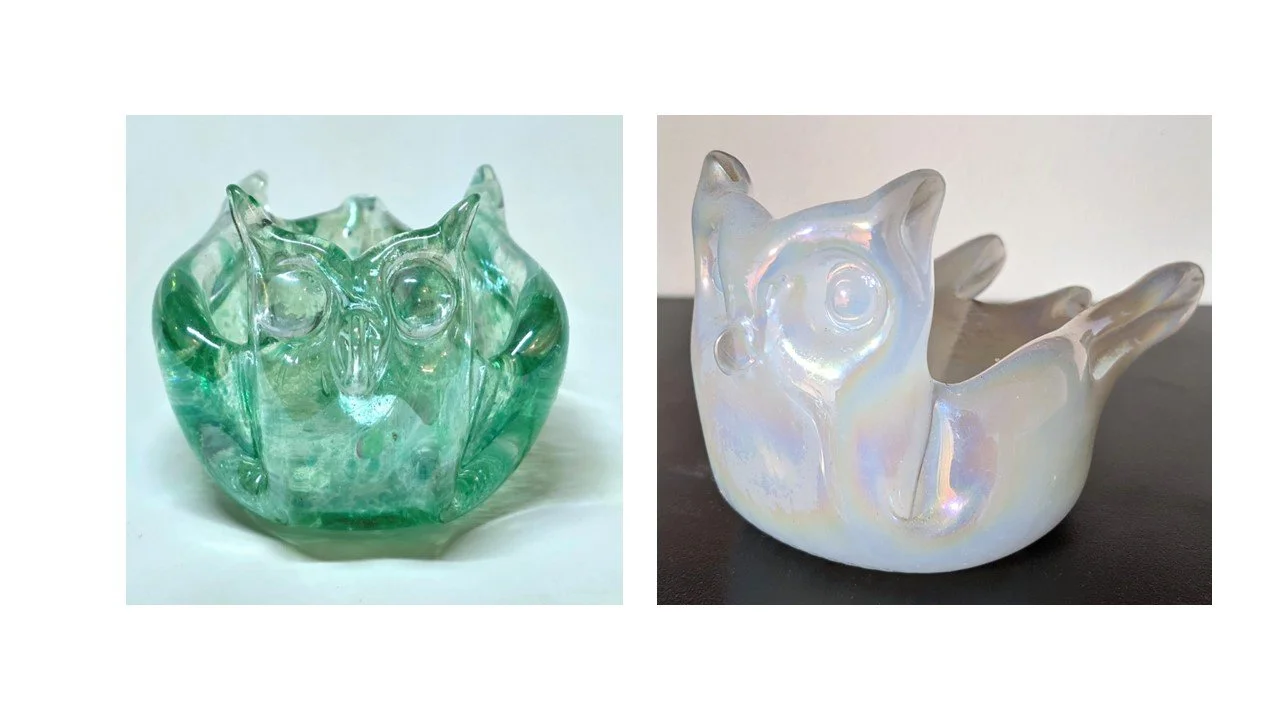
An irradato owl bomboniere on the left and an opal irradato owl bomboniere on the right. From the collections of 50 Shades members Gionny Gueli (left) and Stephen Malcolmson (right).
Let’s examine each “shimmer and shine” treatment and the resulting pieces separately in more detail.
Firstly, the irradato finish and some Chalet irradato bomboniere:
What is an irradato treatment/finish?
An irradato treatment gives the skin (surface) of the glass an iridescent finish while the glass remains translucent. This results in an overall colourful, shimmering effect. This finish was traditionally achieved by drenching a piece at the final stages with kerosene and then burning off the oil. Today’s methods involve treating a piece while still hot with metal chlorides or metallic oxide.
Irradato treatments were not used on the larger hand-blown or hand-molded Chalet pieces. It is found only on the bomboniere forms.
This Chalet bomboniere has an irradato surface finish:
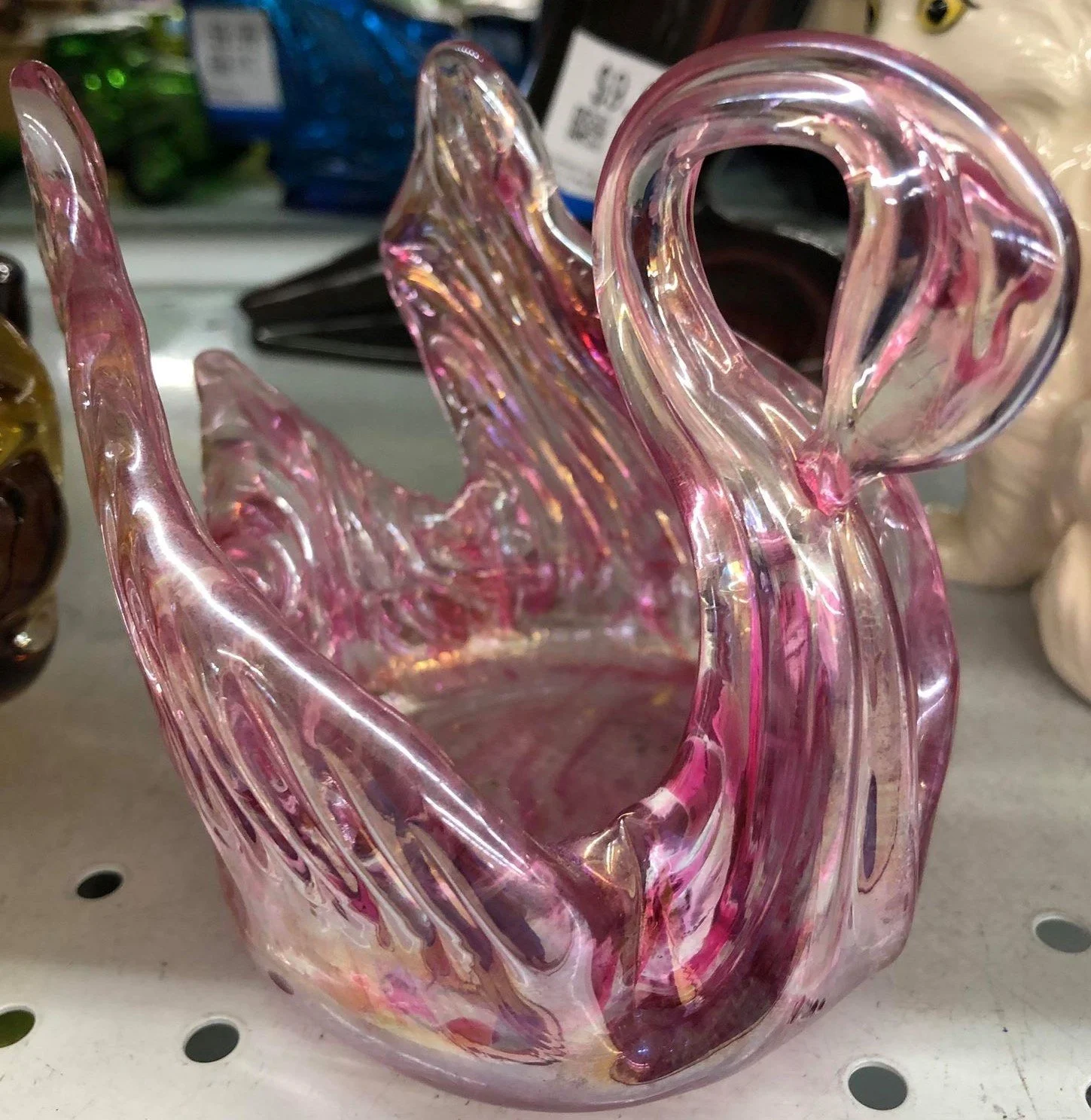
Photograph courtesy of ’50 Shades’ Administrator Alex Wicks.
Several swan and basket designs, the owl and a vase style bomboniere have been found with this finish and in a variety of colours.
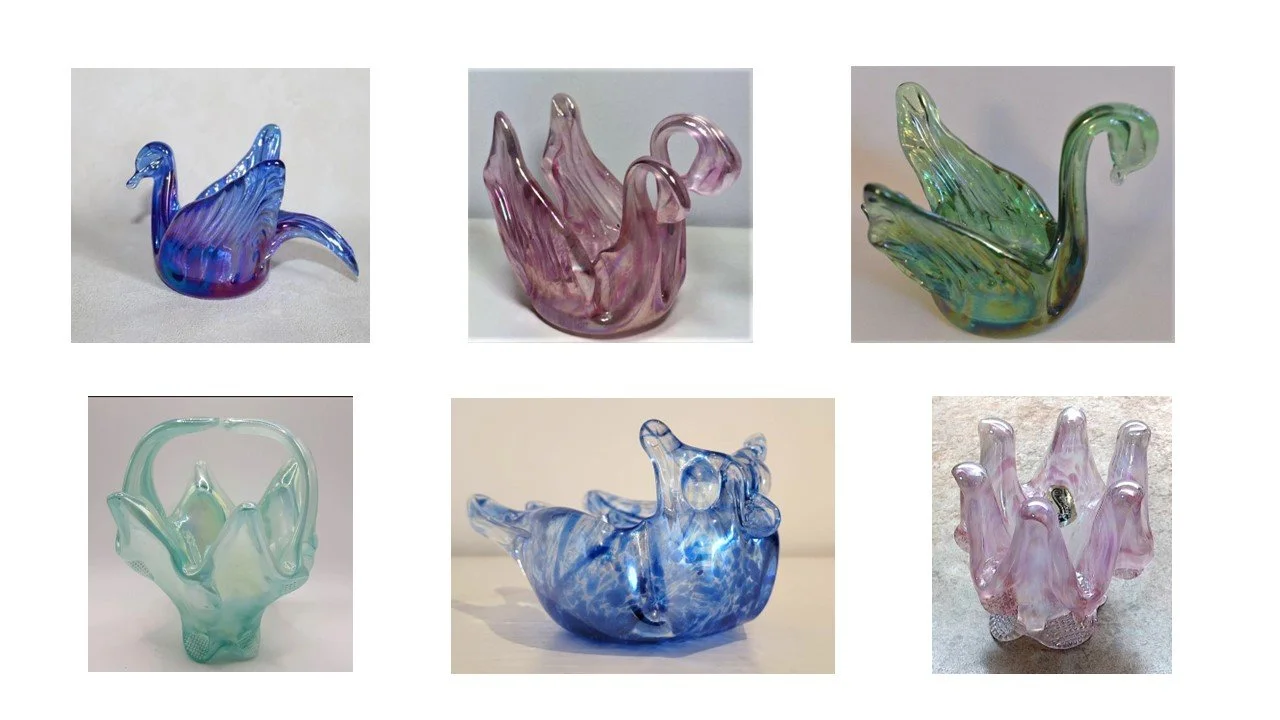
Owl bomboniere (middle bottom row) from the collection of Gionny Gueli. Vase style at right bottom from the collection of Betty Clarke.
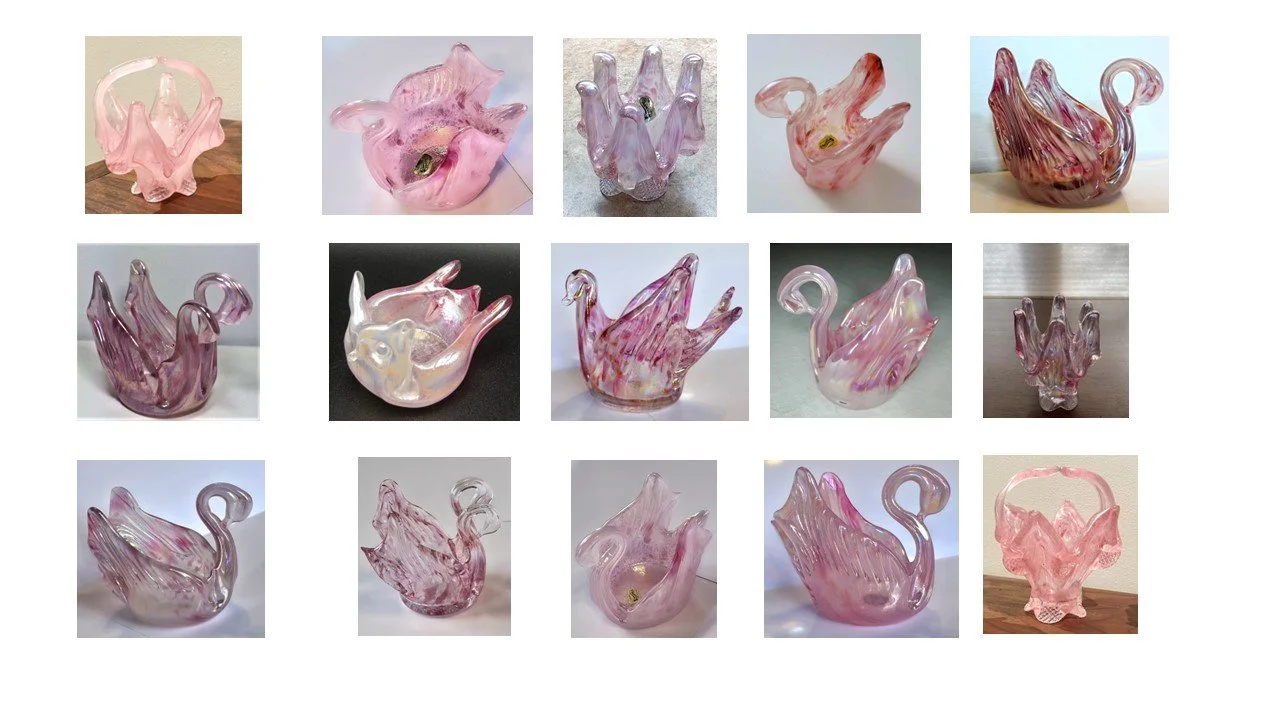
The most frequently seen colour in bomboniere forms with this finish is pink/cranberry. This makes perfect sense as since this effect was not typical for Chalet production line bomboniere, it was, therefore, most likely largely confined to pieces deemed as seconds. Another possibility is that irradato finishes were confined to special orders. Whatever the reason, these pieces were not part of regular bomboniere production.
There is pronounced variation in the pinks seen:
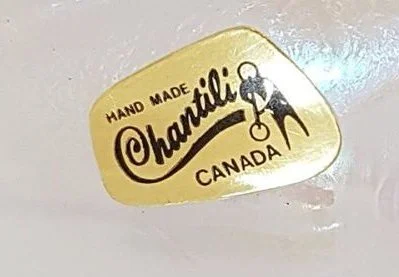
If original branding remains, it is typically the small gold Chantili sticker.
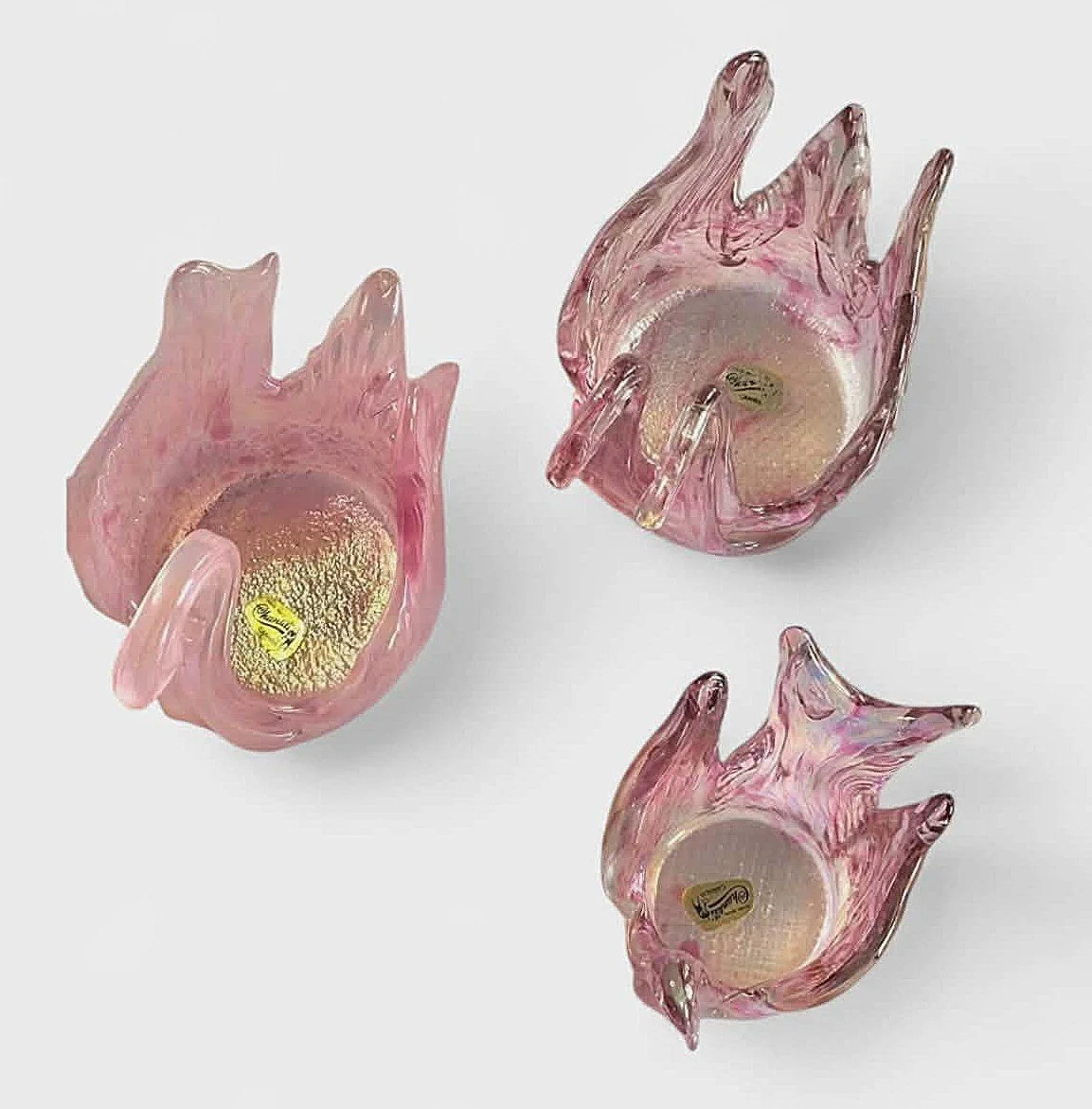
These 3 Chantili stickered Chalet cranberry irradato swan bomboniere are from the collection of Darcy Dietrich and Lorne Olafson.
The irradato swans have been found in both the “head down” 1 and 2 headed styles as well as in the 1 headed “head out” design.
A gorgeous grouping of irradato “head down” Chalet “pink” swan bomboniere.
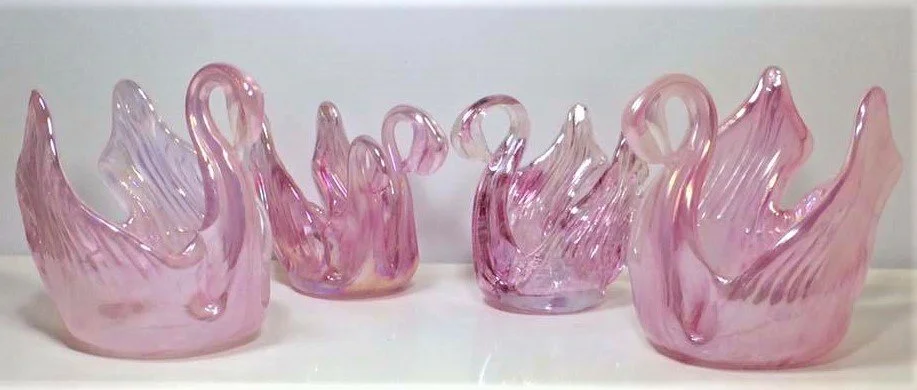
To date, we have found very few irradato pieces in colours other than pink in the “1 head down” design.
A handful in two differing shades of green has been seen:
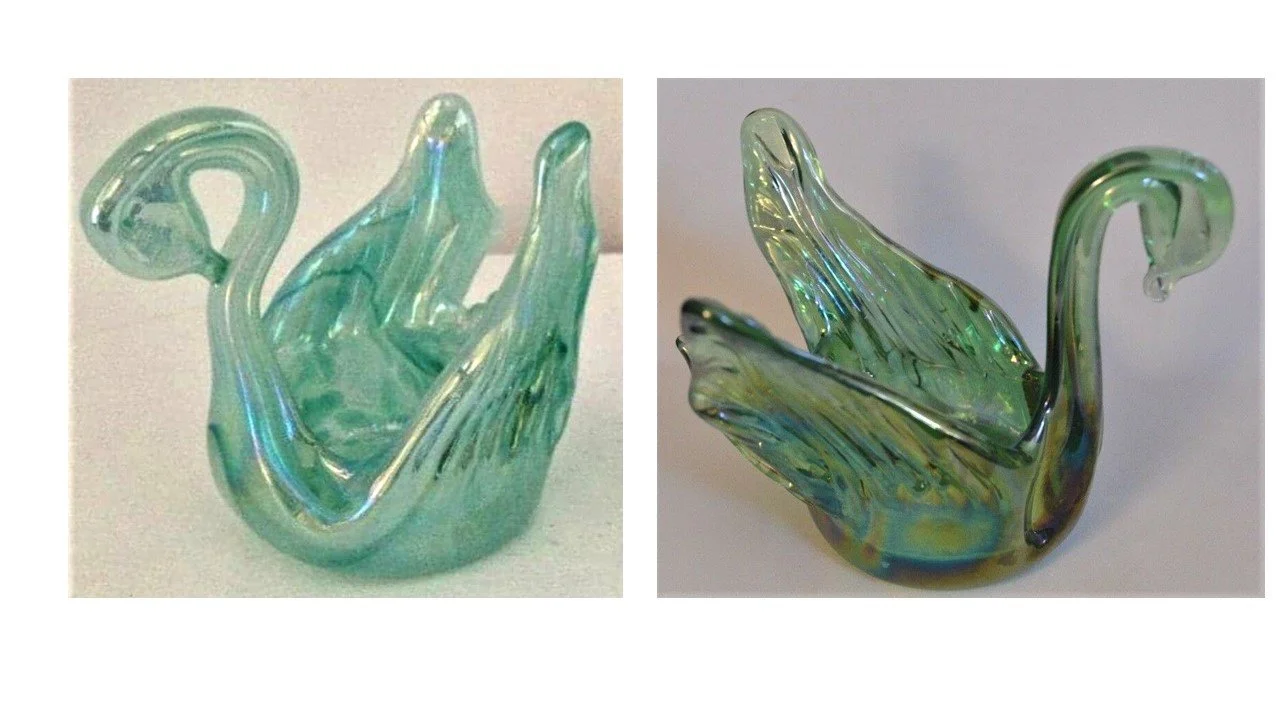
An exceedingly rare blue:
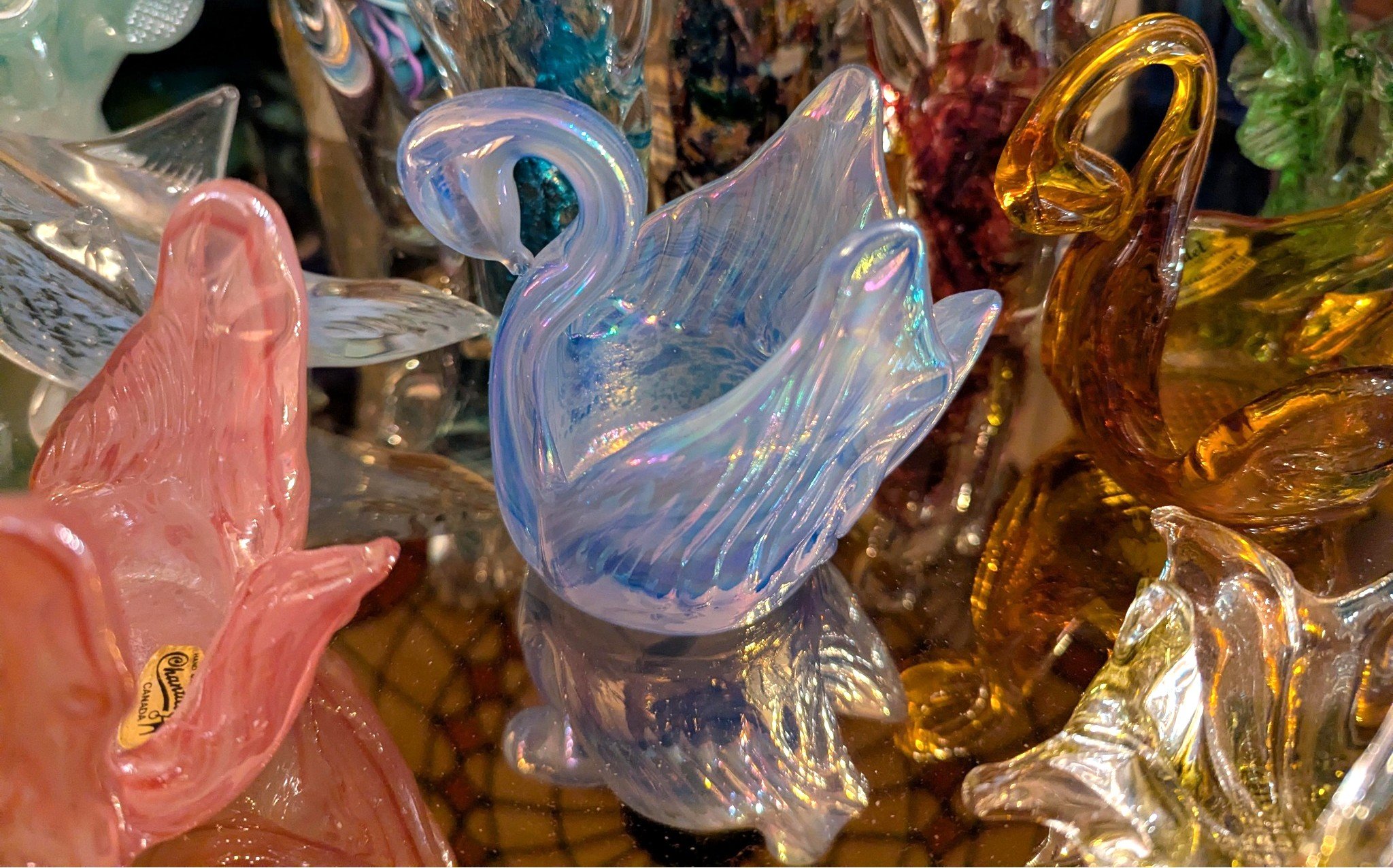
From the collection of Kevin Hall.
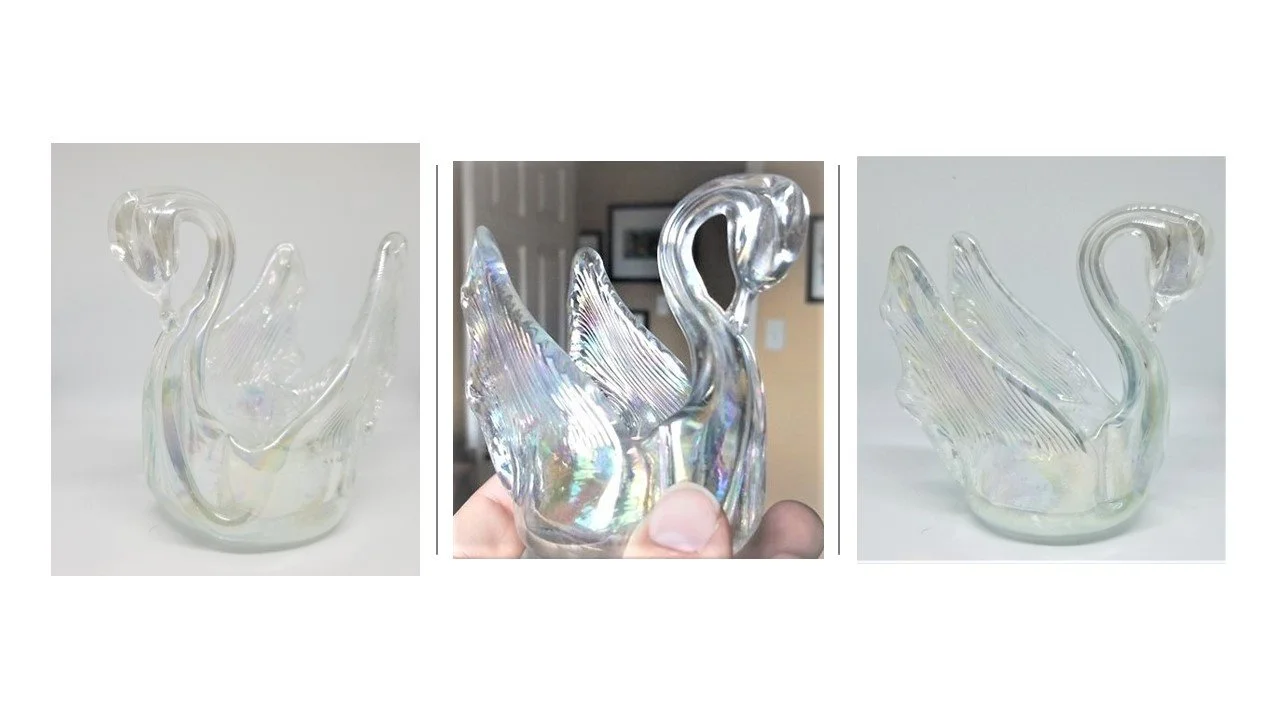
As well, we have found some of this style in iridescent clear crystal:
A special example – made by Chalet artist Roberto De Marchi. It remains in his collection.
The irradato 2-headed swan design in this “head down” style:
2 frequently seen colours:
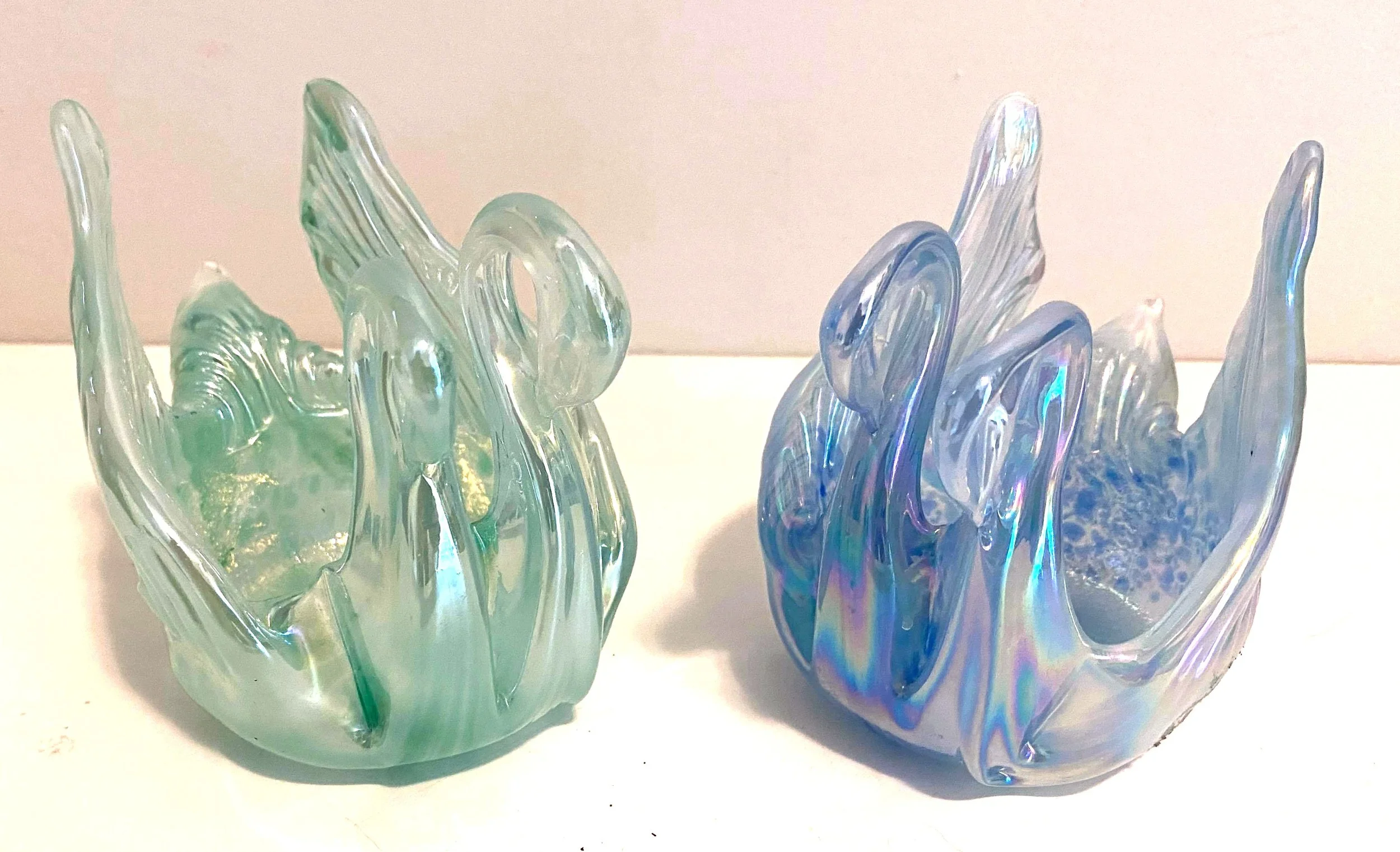
Photograph courtesy of Alex Wicks.
Other tones of blues:
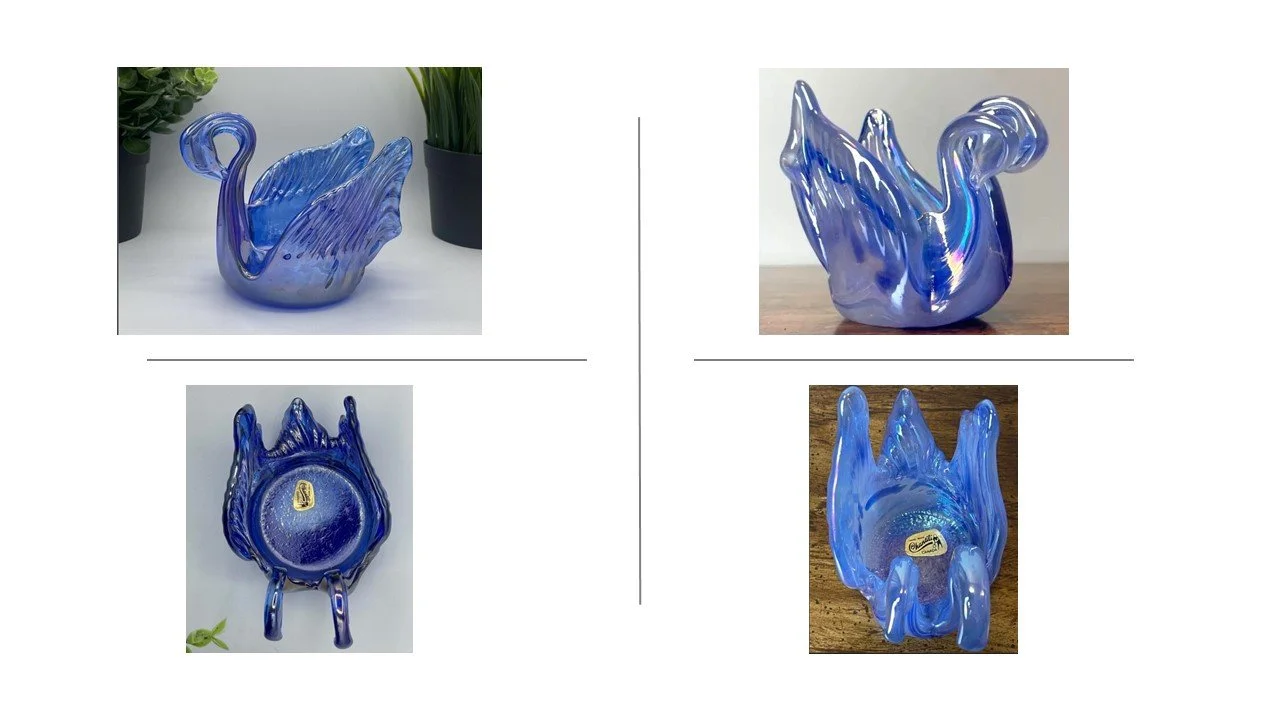
This style is also commonly found in various shades of irradato finished pink/cranberry.
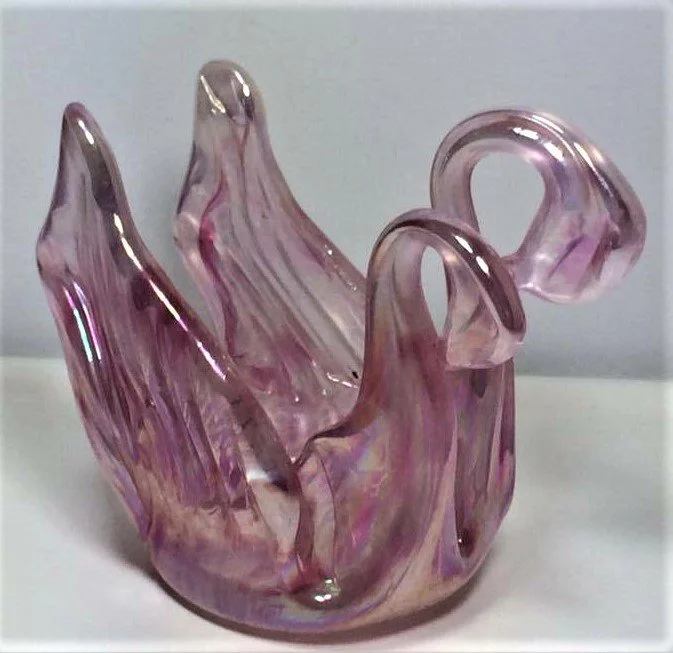
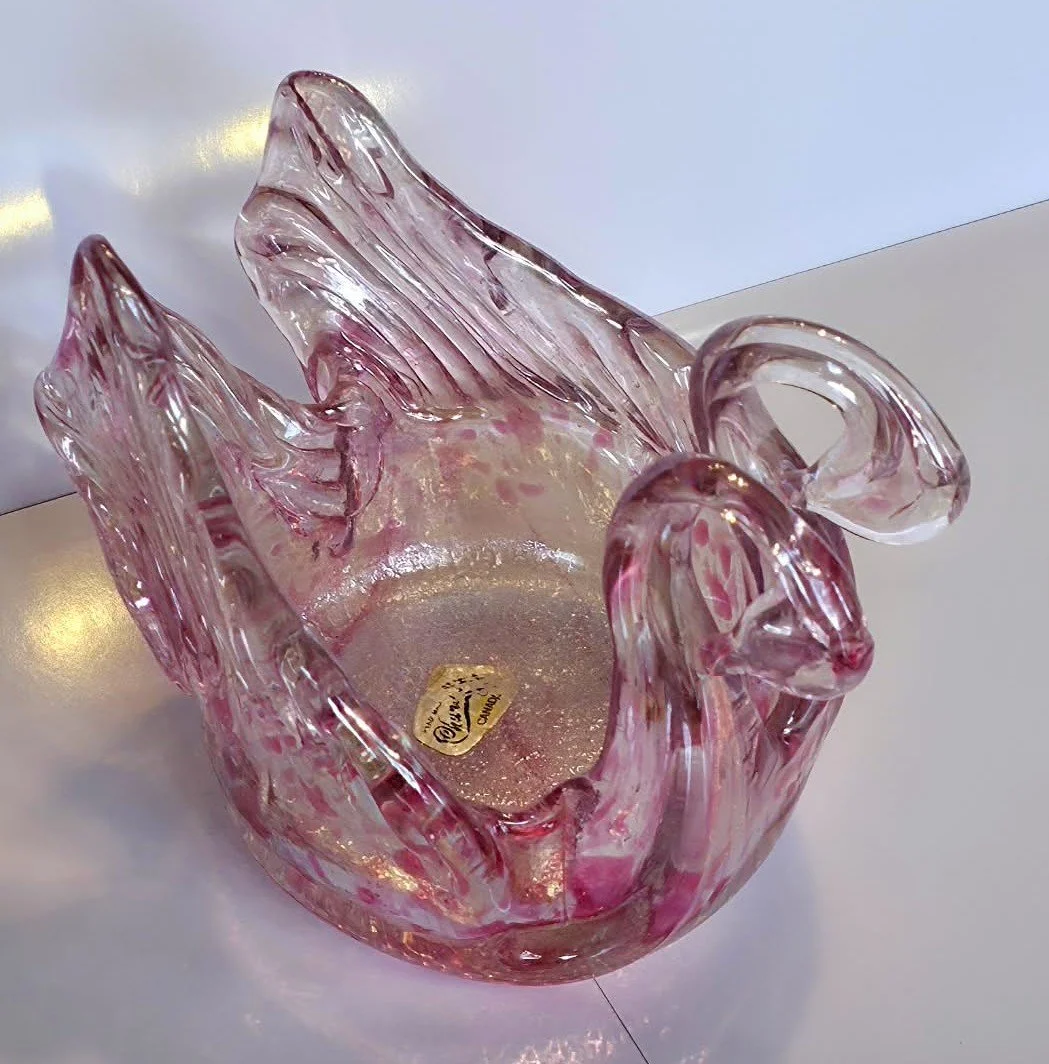
From the collection of Darcy Dietrich and Lorne Olafson.
The third design of Chalet irradato swan bomboniere is the “head out” style:
Once again in pink/cranberry:
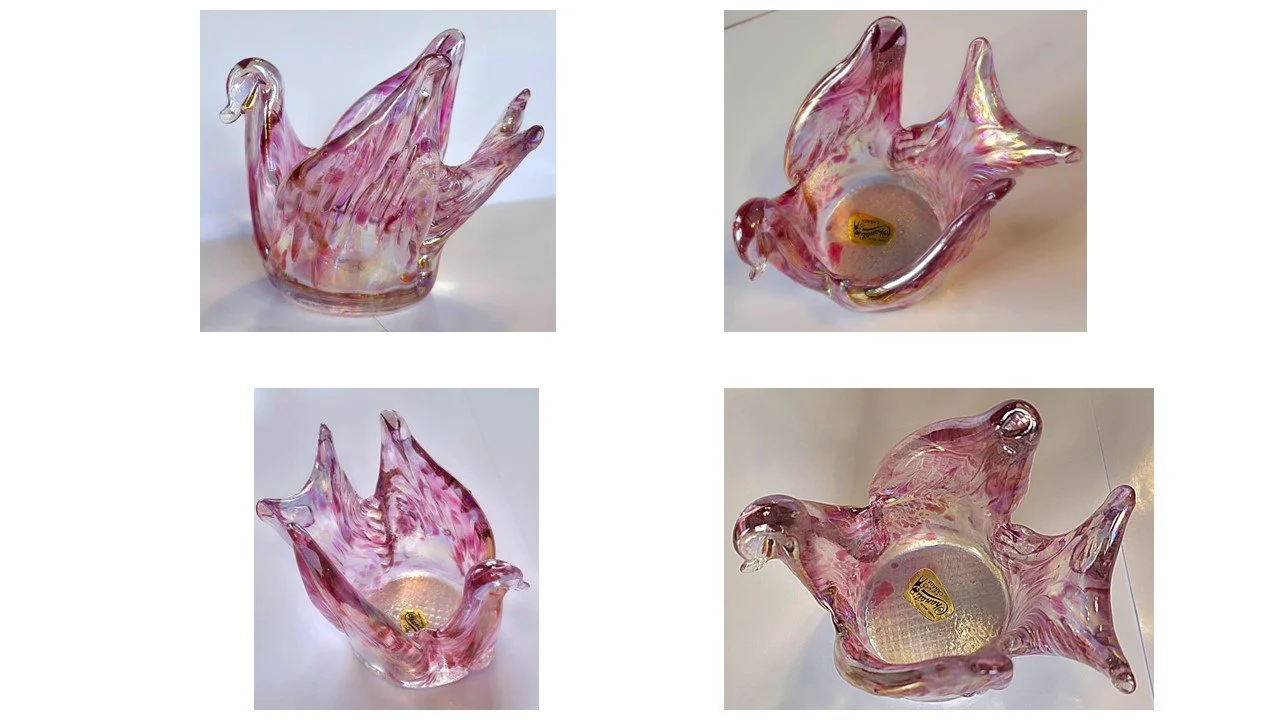
And, once again, from the collection of Darcy Dietrich and Lorne Olafson.
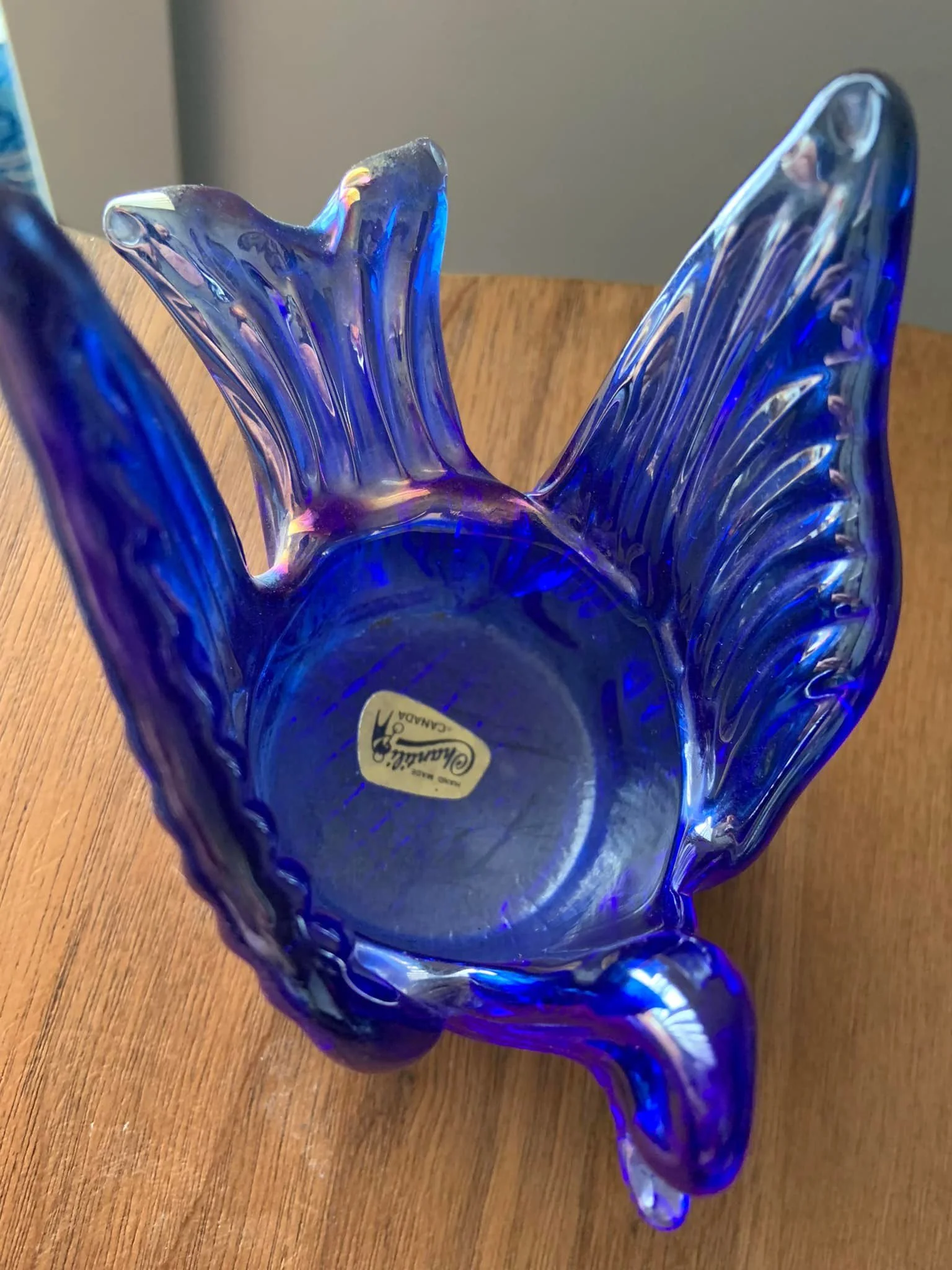
Also seen in shades of irradato blues:
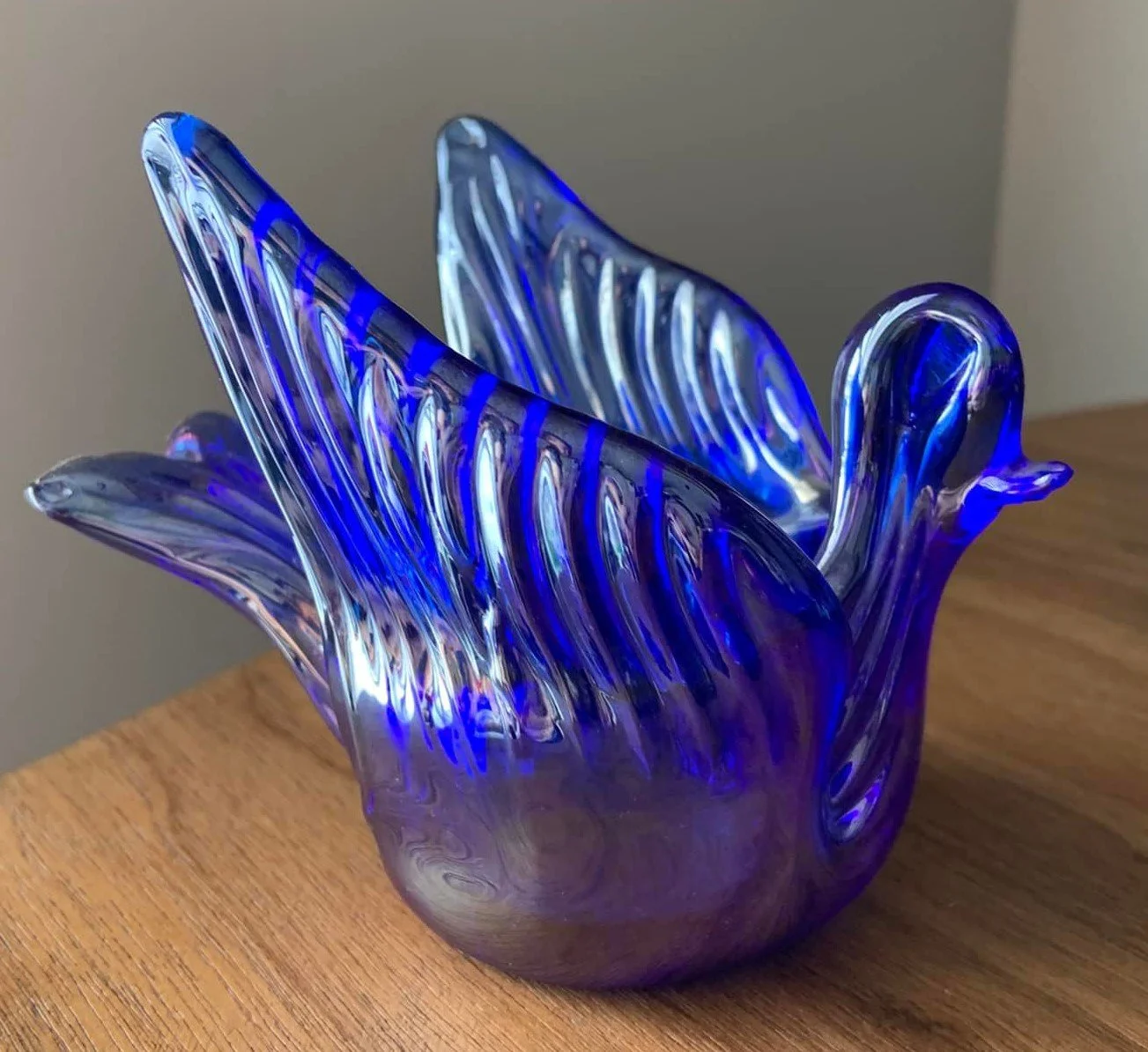
From the collection of Kim Tersteeg.
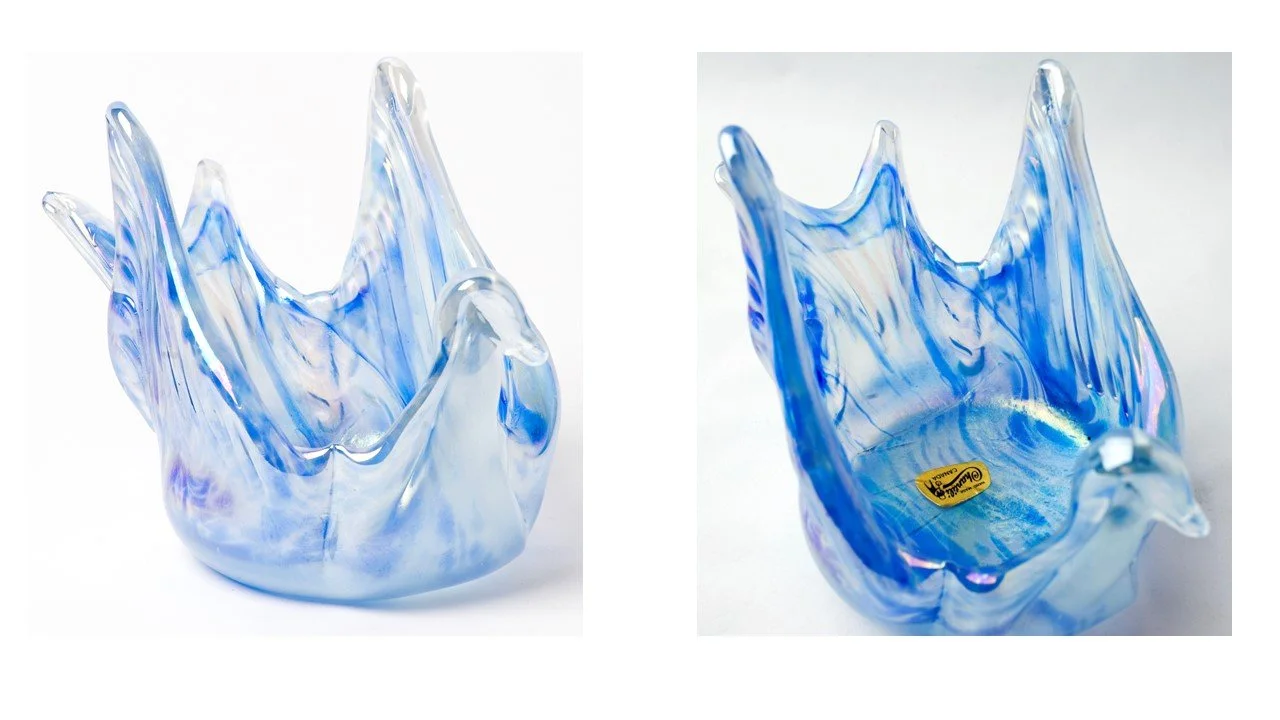
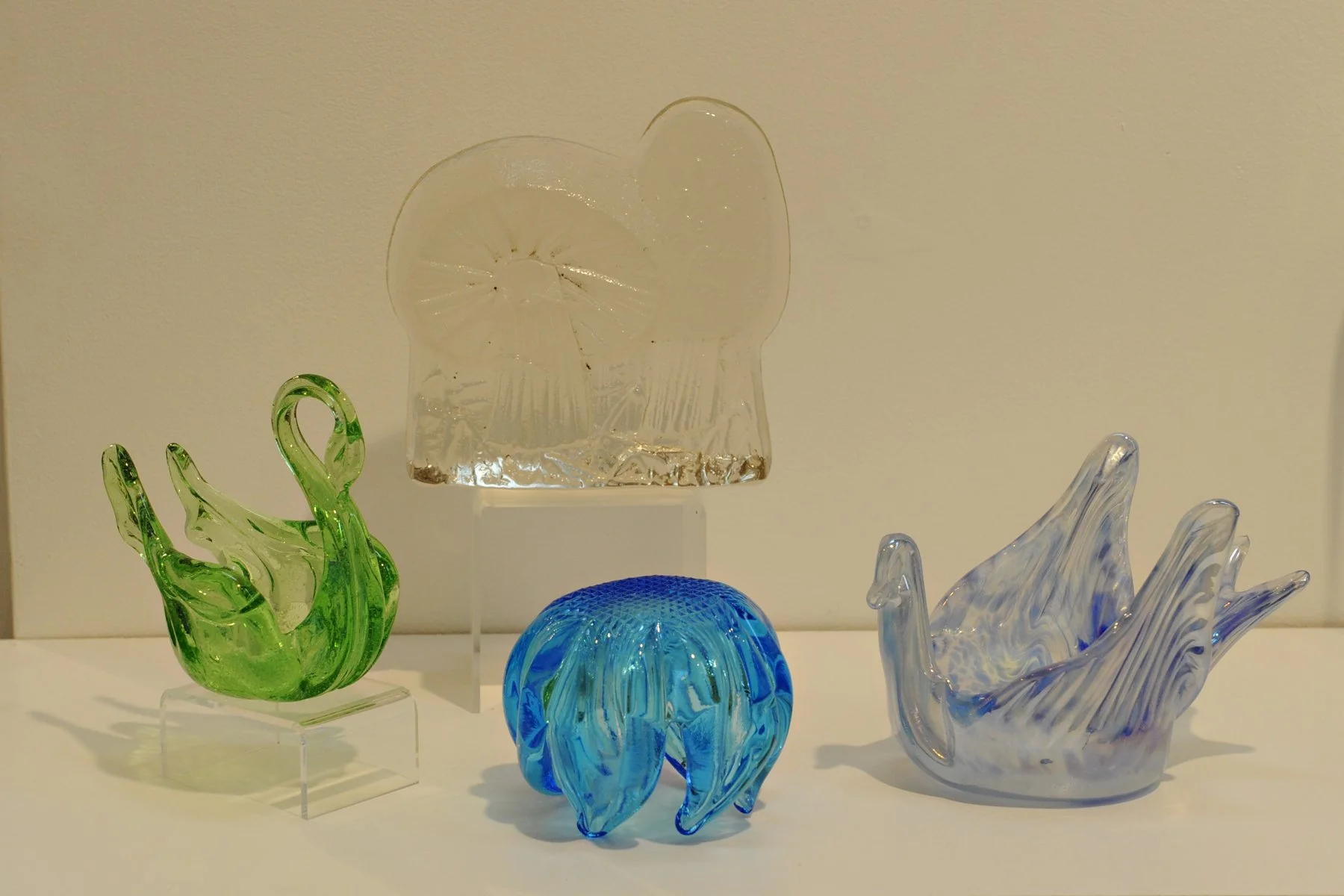
The bird at right, shown above, on exhibit at the 2010 Chalet retrospective. Photographs courtesy of Deborah Patterson.
Irradato basket style bomboniere have been discovered:
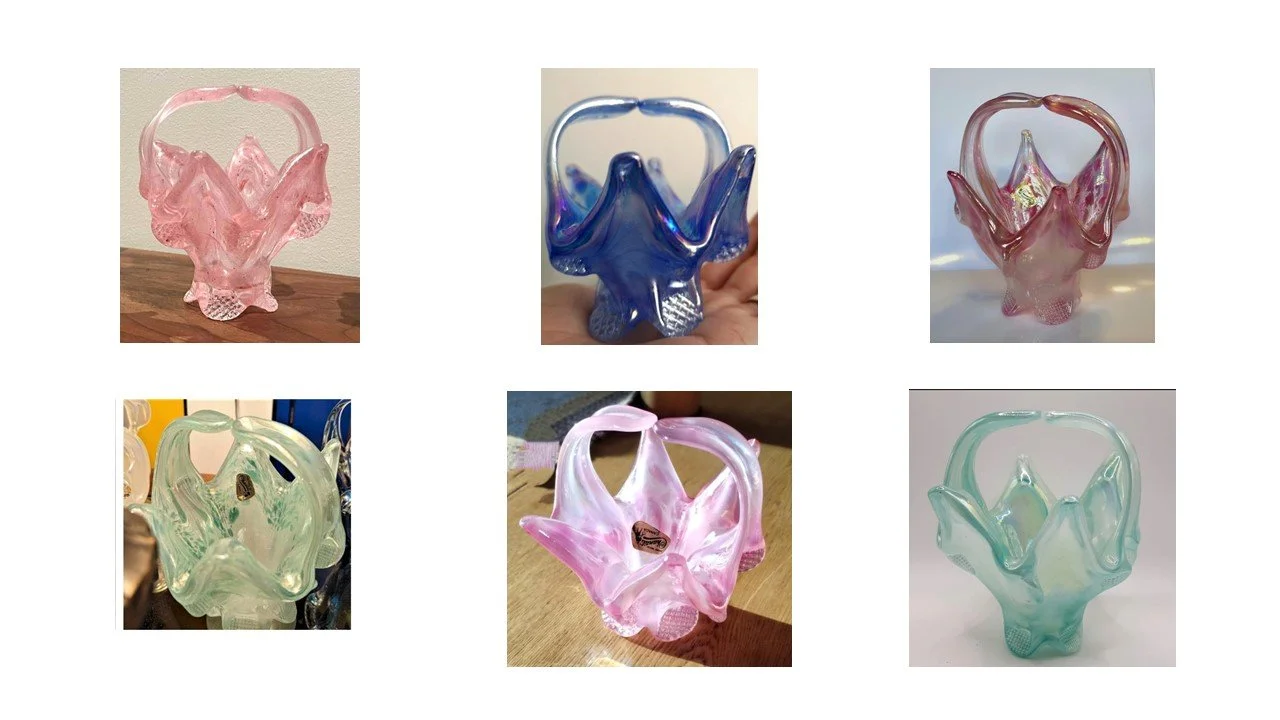
Left top to right bottom, from the collections of: Roses Jjaks, Josh Dolstra, Lorne Olafson, Darcy Dietrich and Evelyn Richards.
And this form of vase has the irradato finish as well. To date, it has only been found (verified Chalet) in the pink/cranberry:
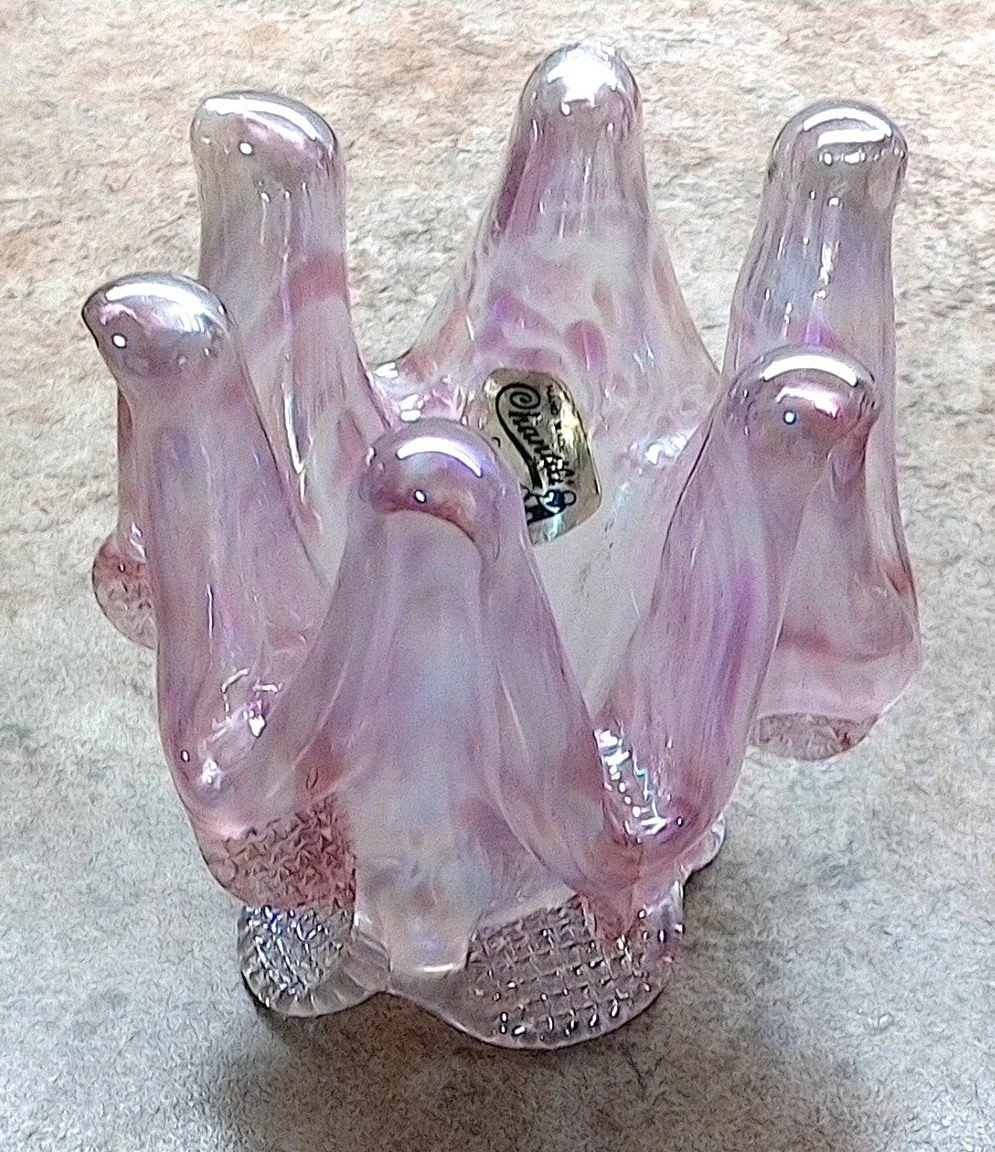
From the collection of Betty Clarke.
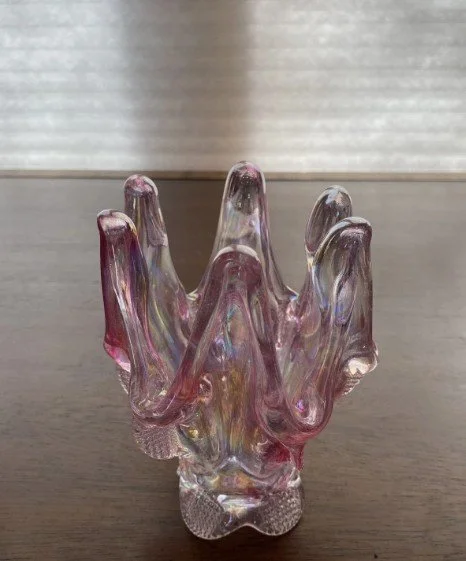
Lastly, the opal irradato finish and some Chalet opal irradato bomboniere:
To start, what is Chalet opal or opaline glass? Opal or opaline Chalet is clear glass that was made opaque through the addition of “opacifers” to the “melt” - the molten mix. An example:
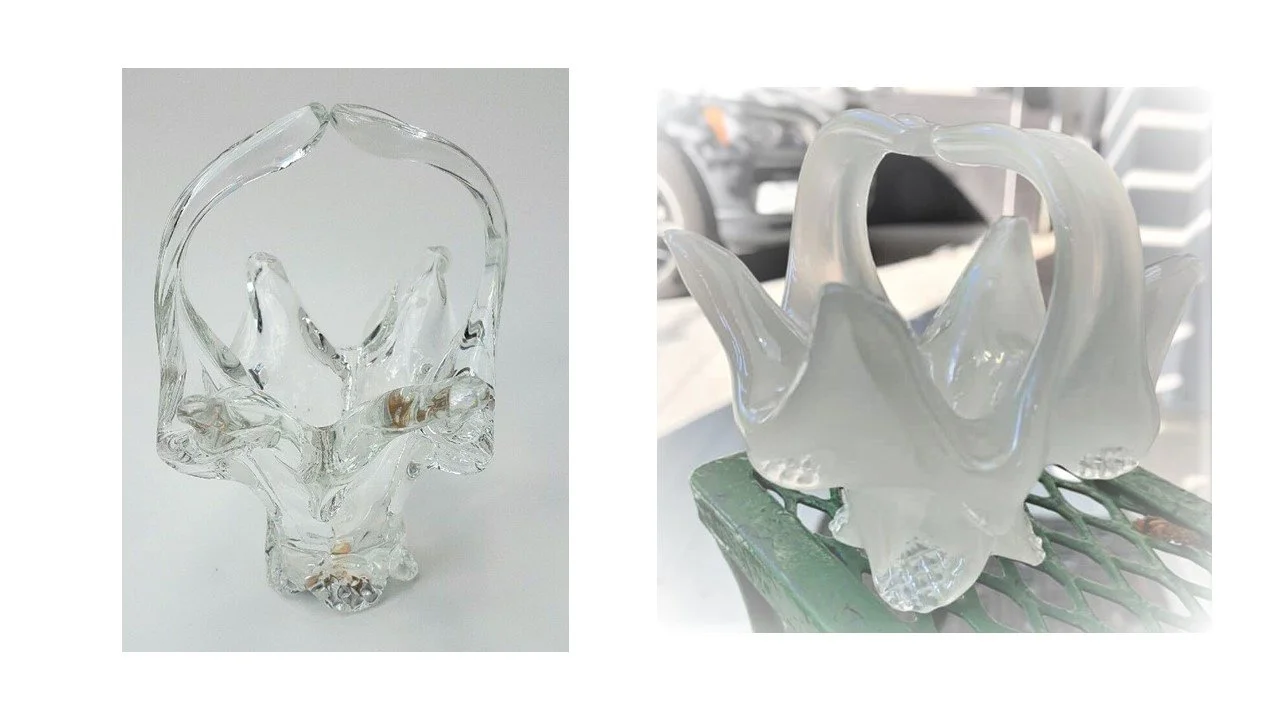
Clear to opal. Photograph of opal basket at right courtesy of Jackie Lyn.
Sometimes an irradato treatment/finish was then applied and the result was the irradato opal bomboniere. An irradato finish on opaque not transparent glass.
A clear to opal and then to opal irradato example:
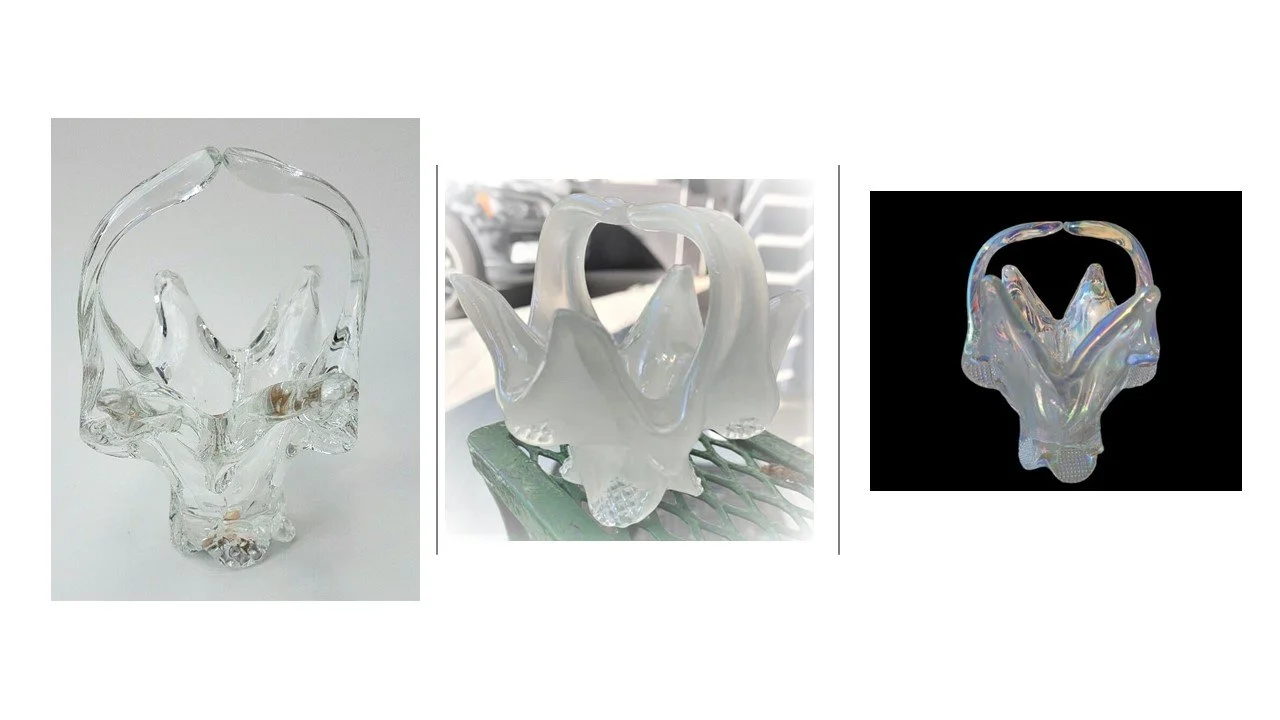
Before we look at Chalet opal irradato bomboniere forms, I would like to address a misperception regarding these forms. They are not opalescent glass. Opalescent glass is often confused with irradato glass or opal glass. However, they are not all the same. The characteristics of opalescent art glass are cloudy, milky, or iridescent effects. pieces often have white, swirling, or darting lines. Clouds of colour may also be present. Opalescent glass is formed by pressing glass with heat-sensitive components into molds, then reheating to create a white, raised pattern. Common colours are blue, cranberry, vaseline, as well as clear glass and often have a white, milky rim edge.
Some comparison examples:
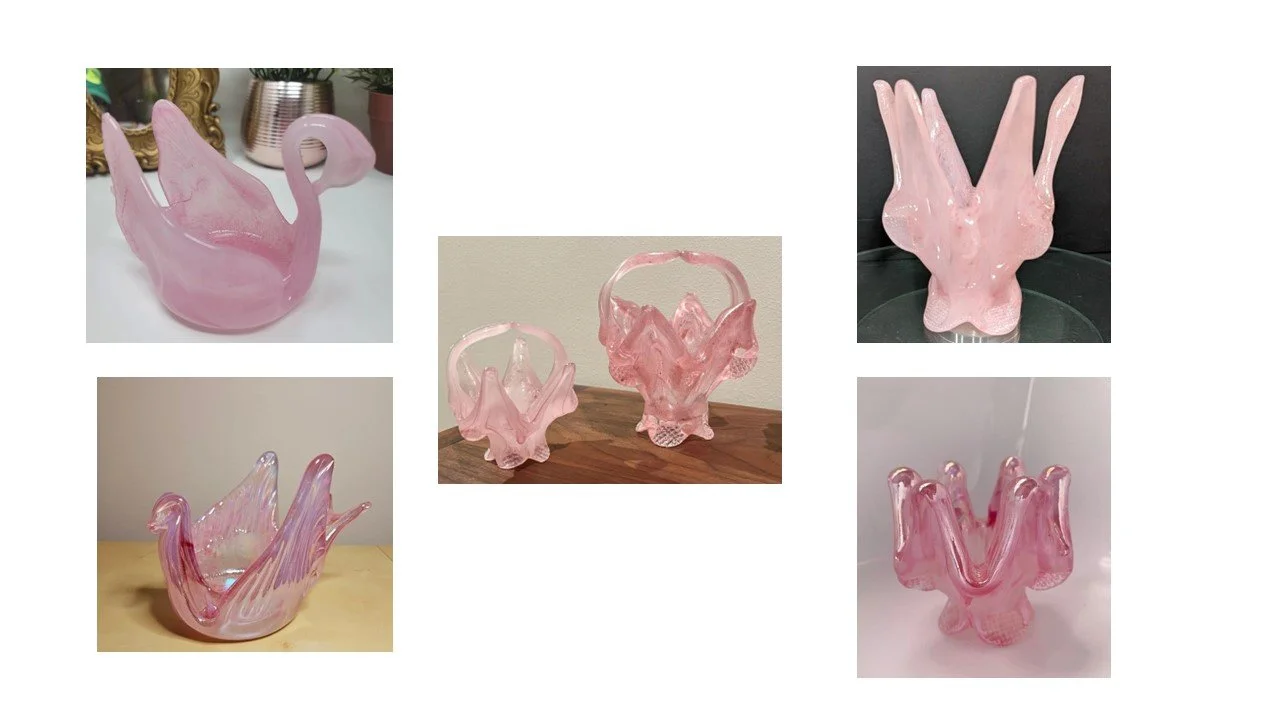
Pink opalescent swan top left and pink opal irradato swan at left bottom. In middle, the opal basket is the smaller in left of picture while the larger at right has an irradato finish. From the collection of Roses Jjaks. The pink vase bomboniere form at top right (unverified maker) is opalescent and the bottom right form is an opal irradato piece.
Chalet opal irradato bomboniere:
Typically found in pink or white with white being the more common:
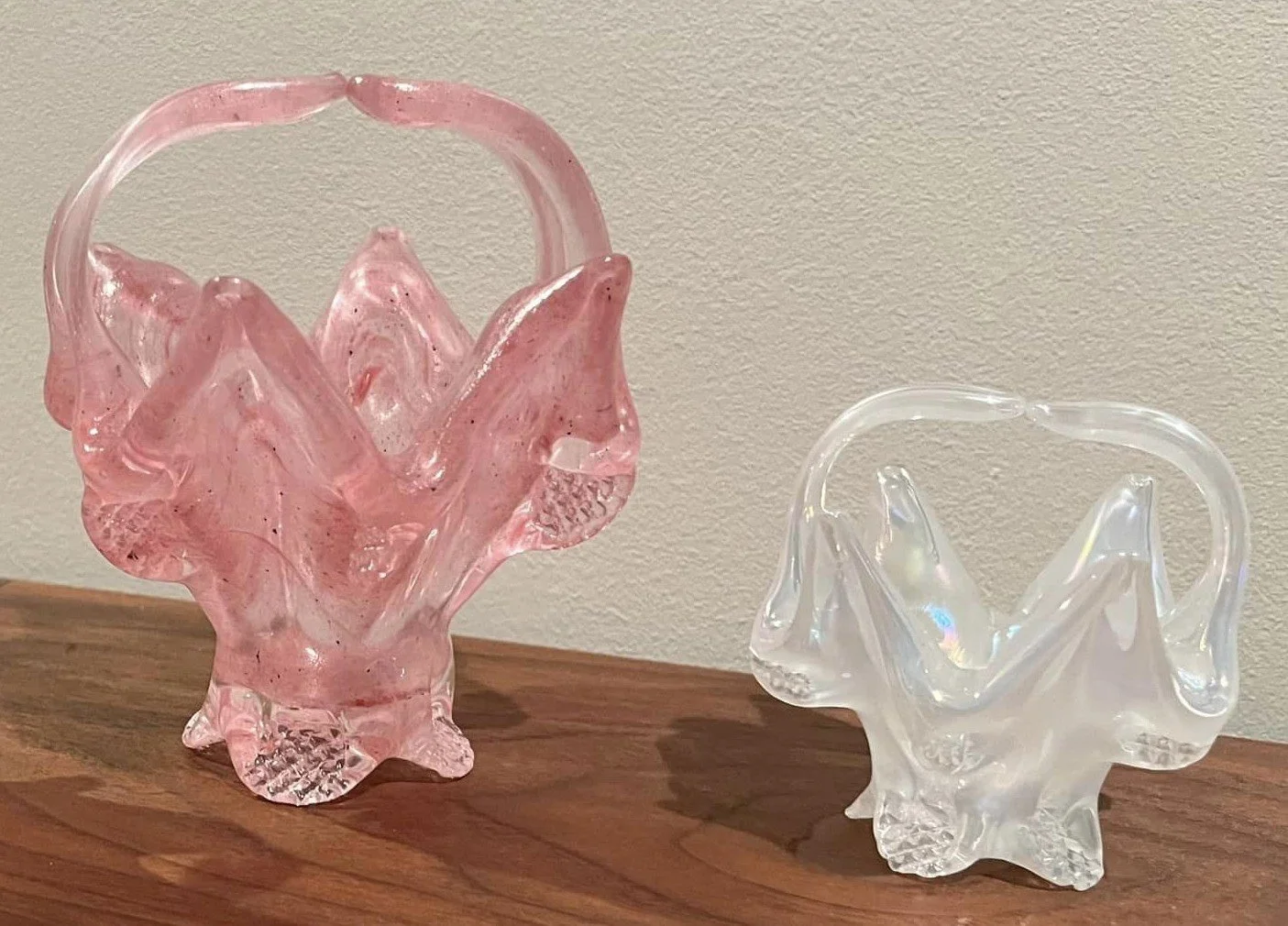
From the collection of Roses Jjaks.
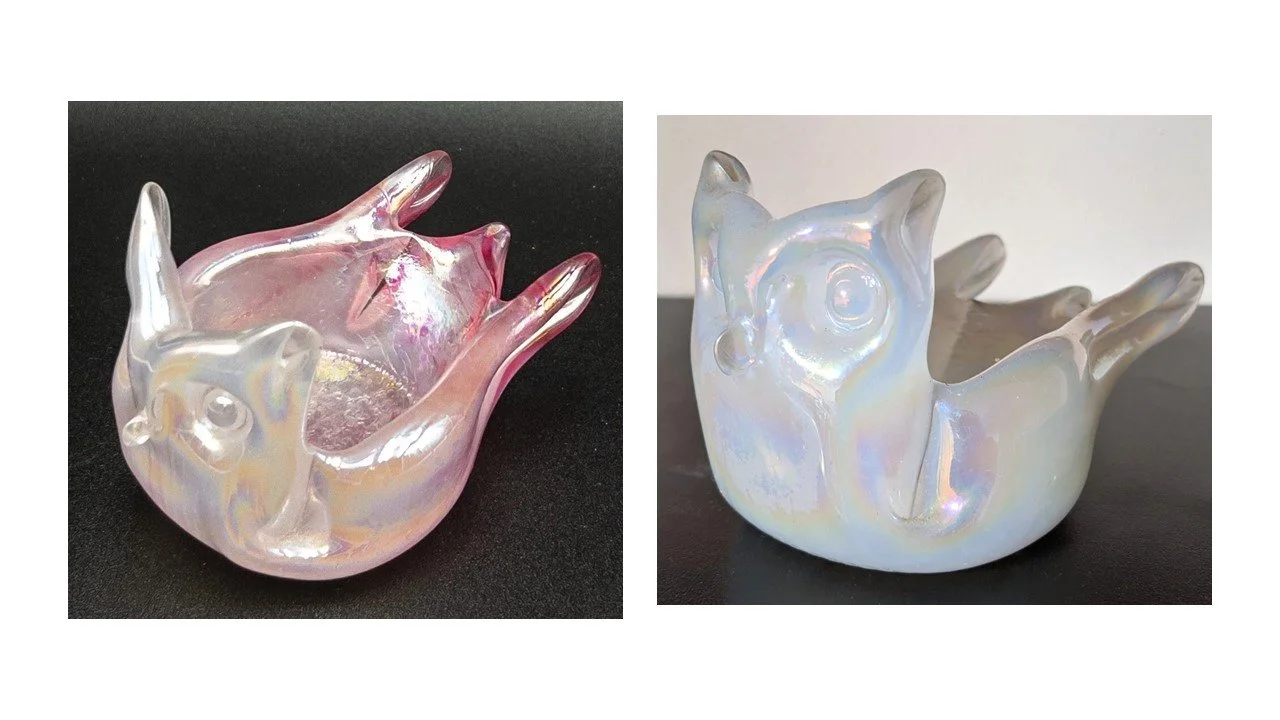
Owl on left from the collection of Gionny Gueli and owl on right from the collection of Stephen Malcolmson.
Opal irradato bomboniere have been found in swan and candleholder designs as well as the baskets and owl just shown.
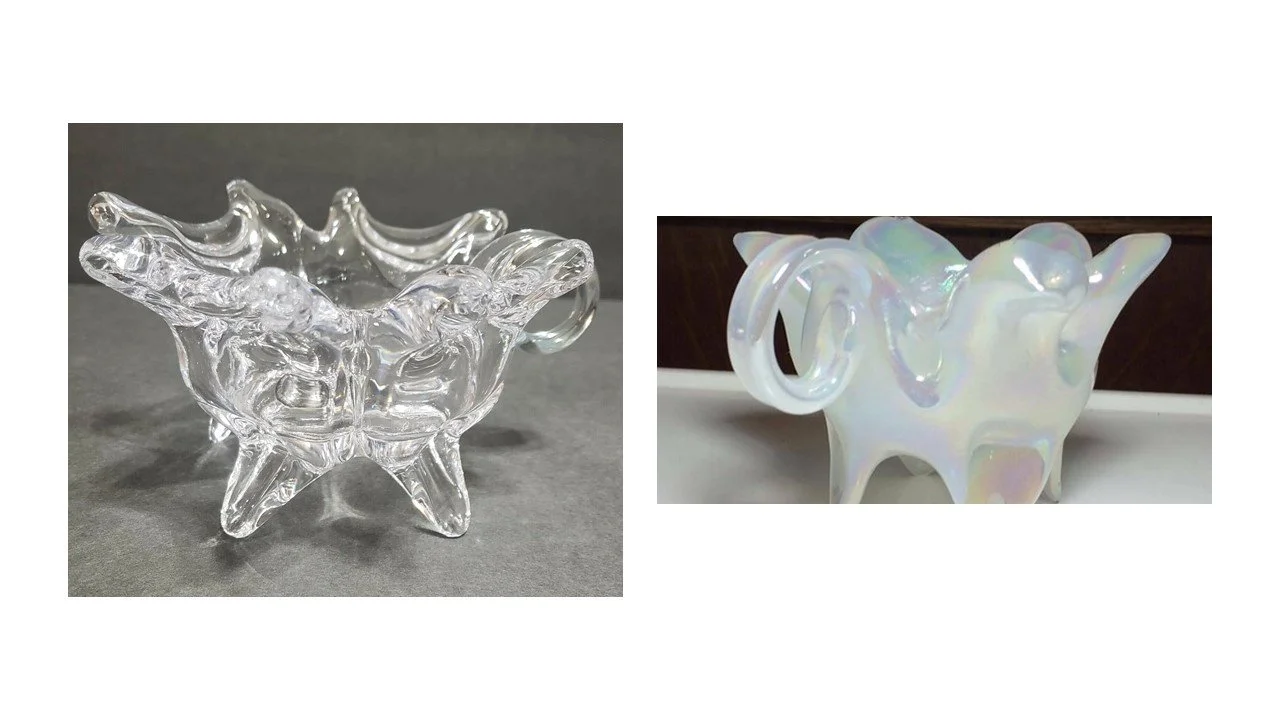
Candleholders are not as often seen as irradato forms. Like in the irradato styles, original brandings retained have been Chantili stickers.
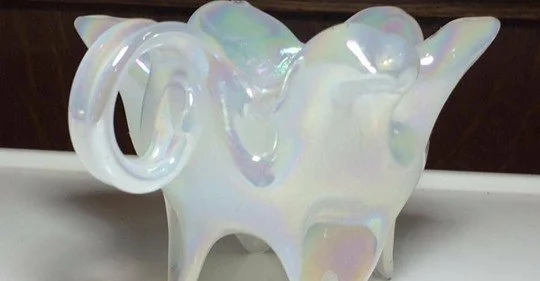
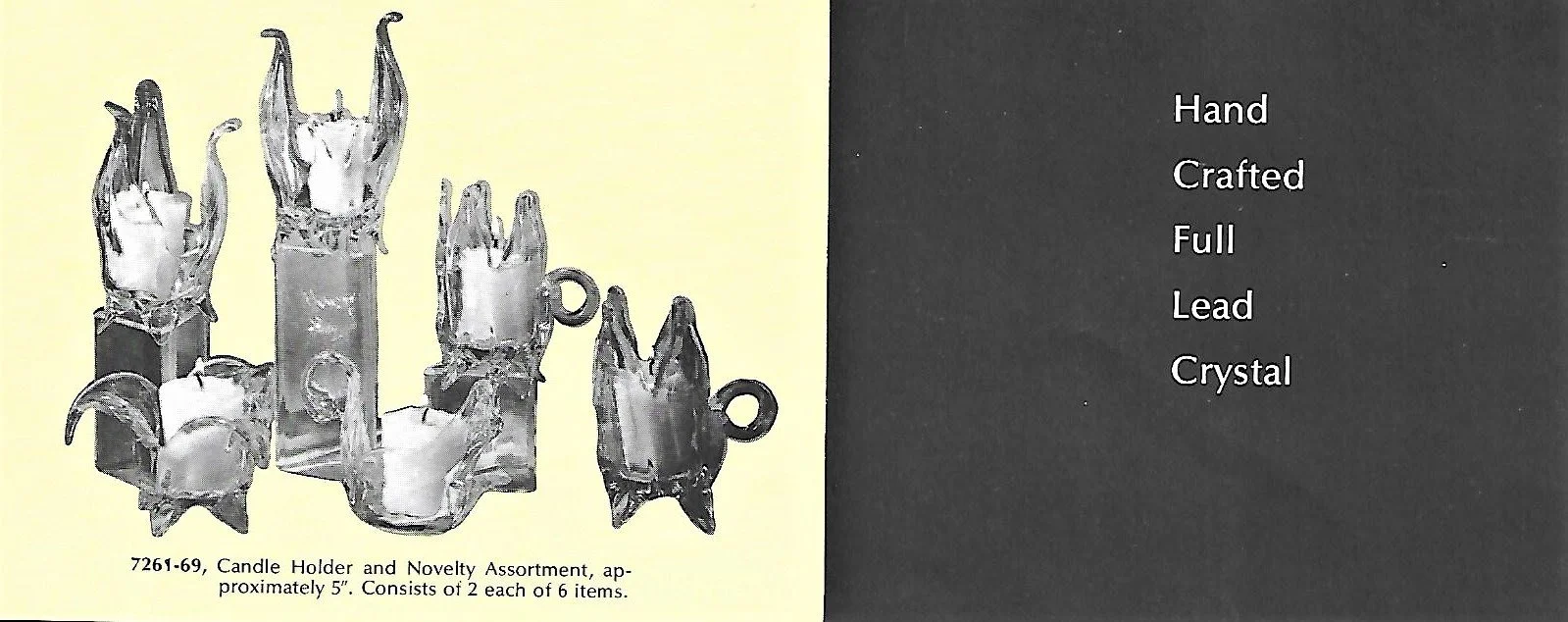
This candleholder form can also be found in clear crystal. Typically, when seen in clear, it is branded with the Riekes label.
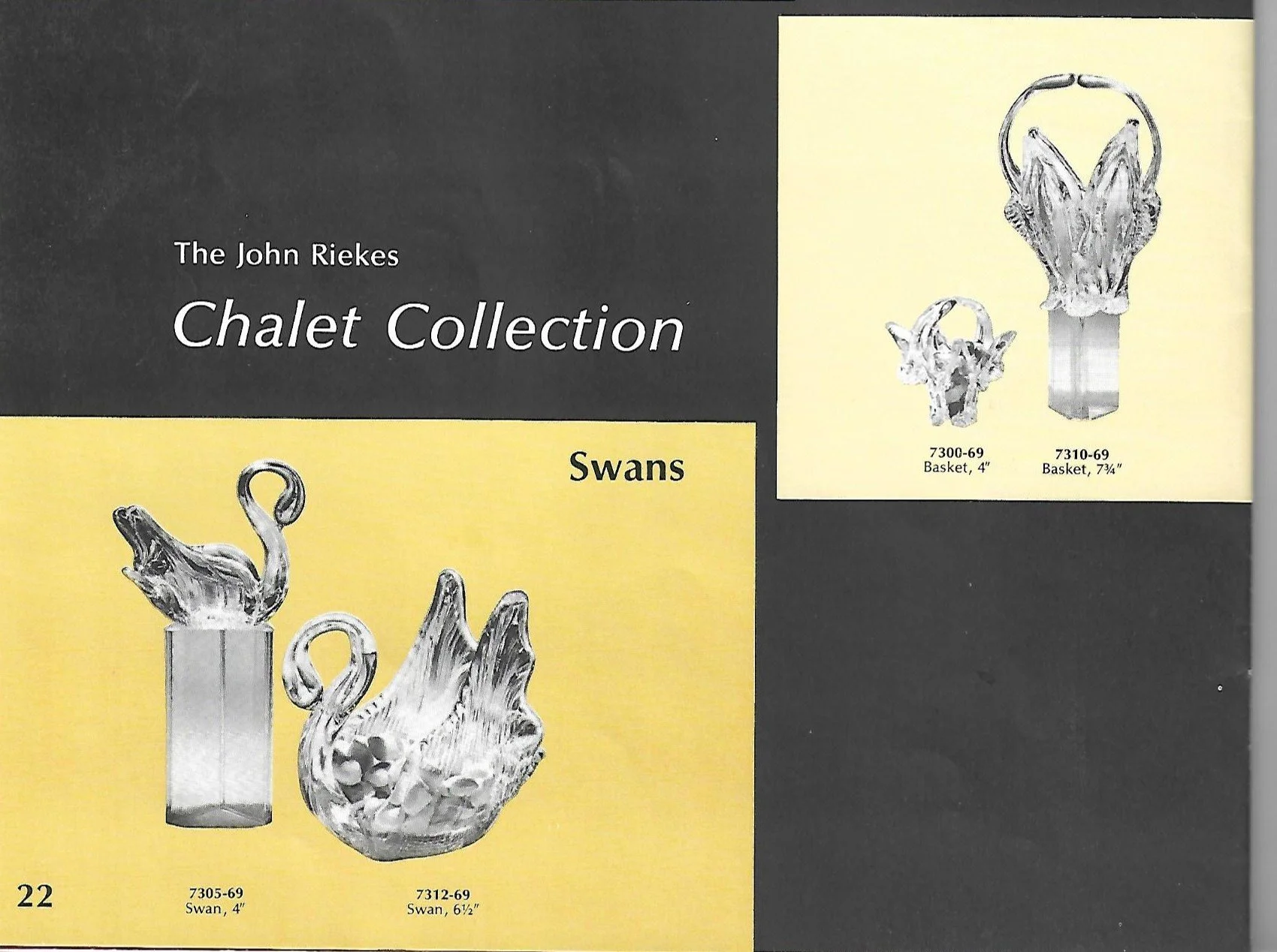
It is shown in the Riekes catalogue.
The opal irradato “1 head down” style swan:
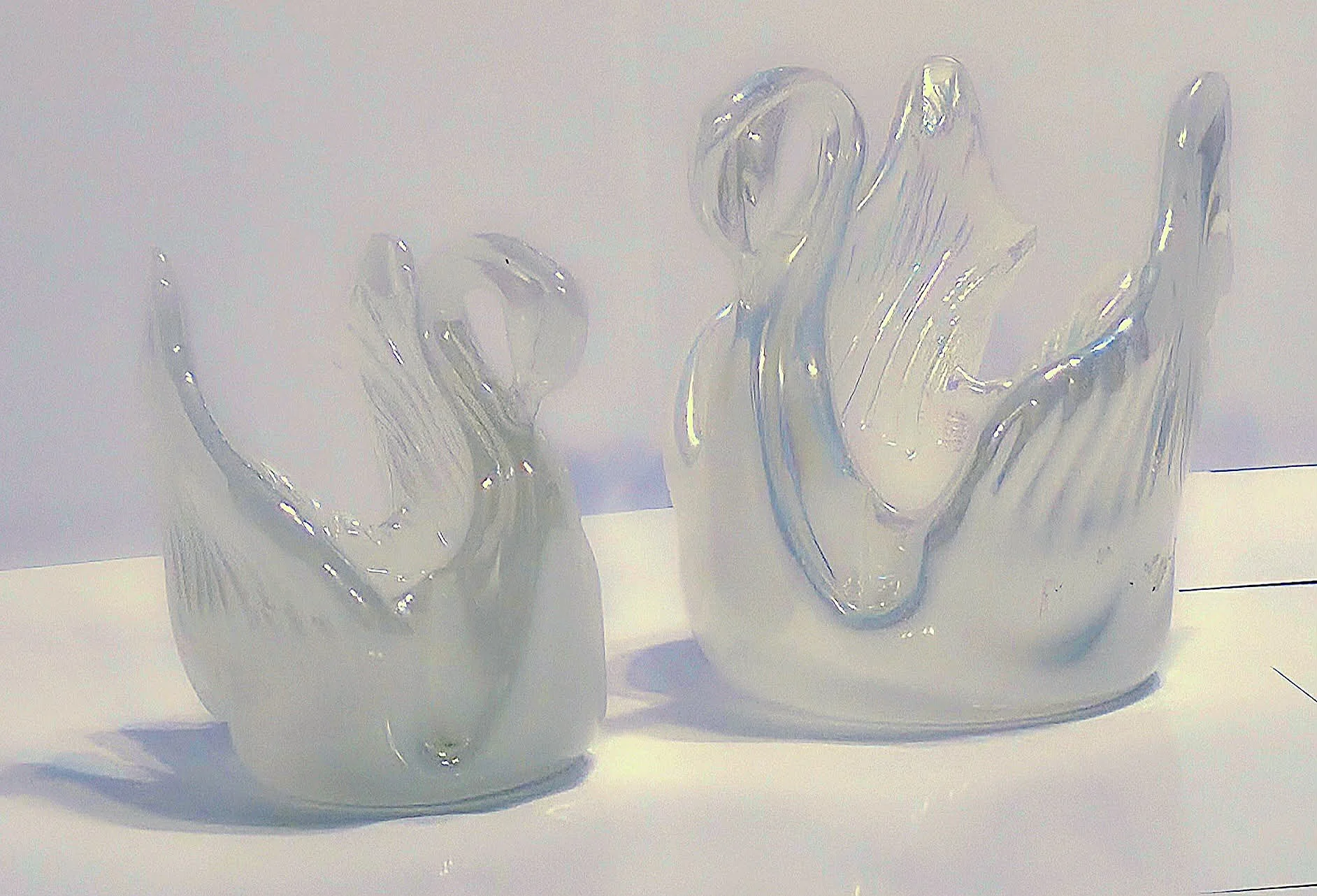
These swans flock with Darcy Dietrich and Lorne Olafson.
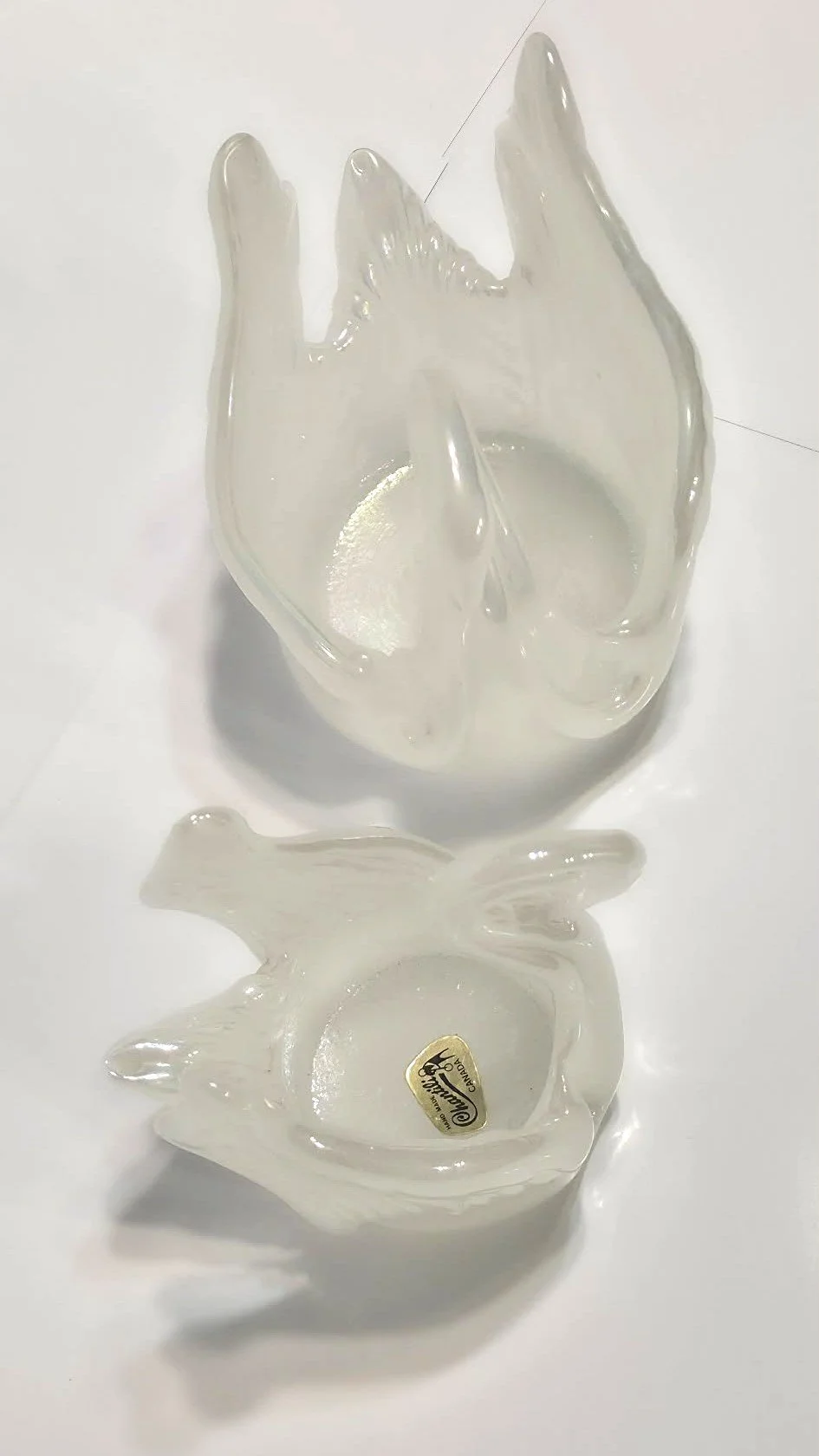
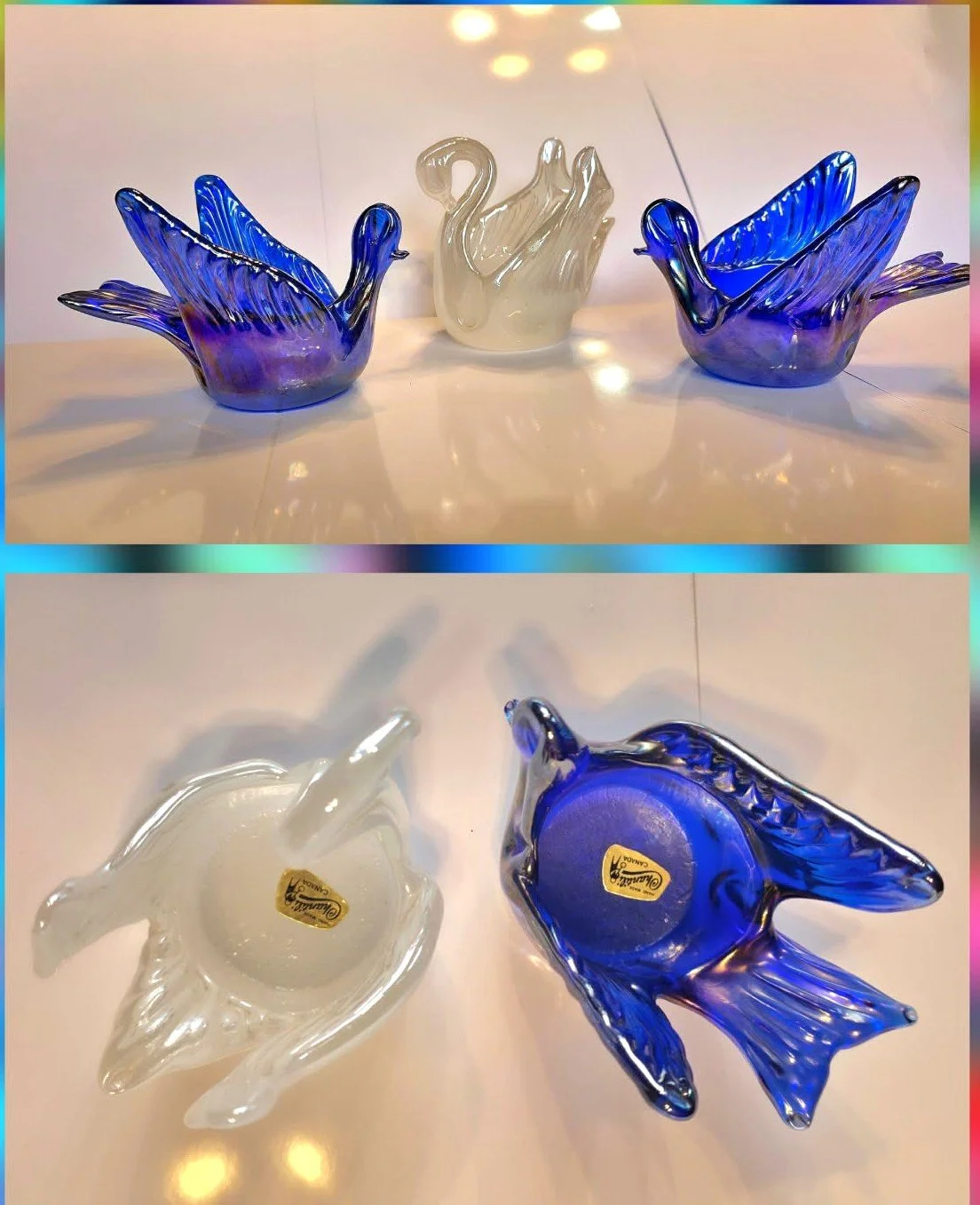
Irradato “1 head up” and “1 head out” styles have also been discovered.
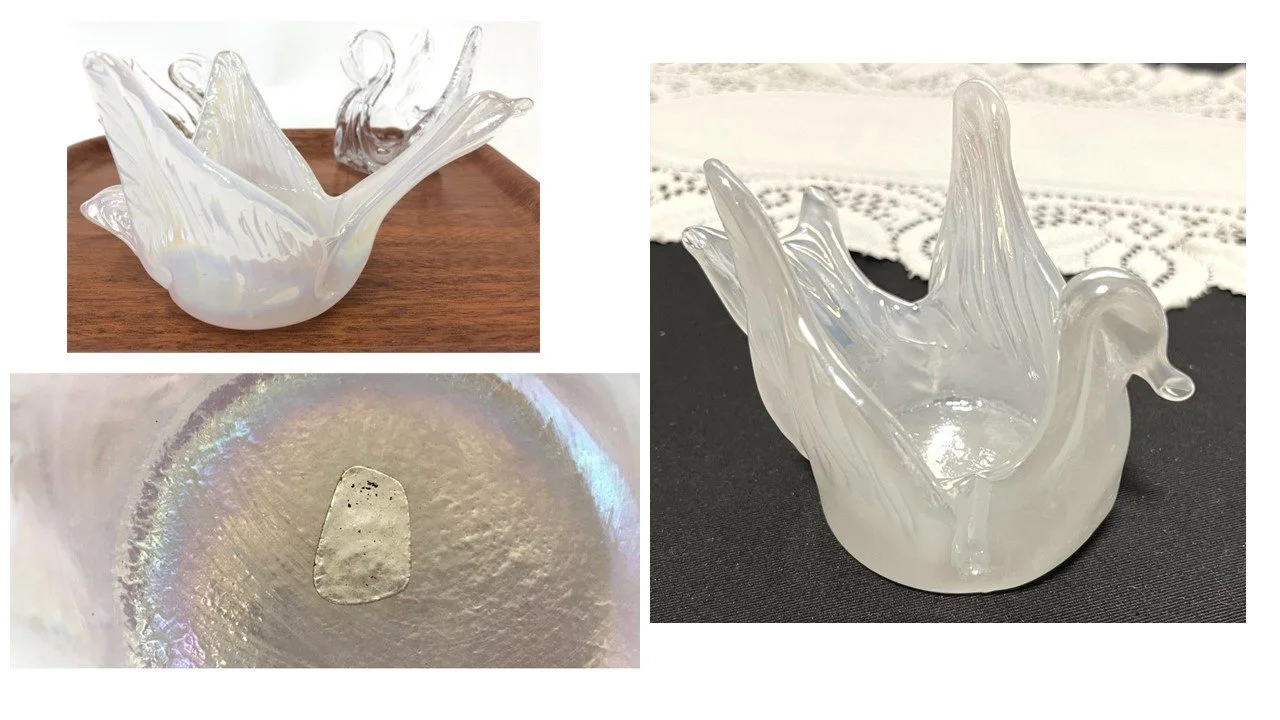
Swan at right from the collection of Darlene Merrett Puckey.
There can be confusion identifying between unmarked Chalet produced and unmarked Rossi made production bomboniere forms. And this does not get much easier with the irradato and opal irradato forms. Why are they identical?
After Chalet’s closure, Rossi and a partner (Morris Jaslow) bought Chalet equipment, materials and finished inventory. They used this to open Artistic Lighting (late 1975-1979) which operated in the old Chalet premises on Harbour Road. They did not own the name or the building – it was rented.
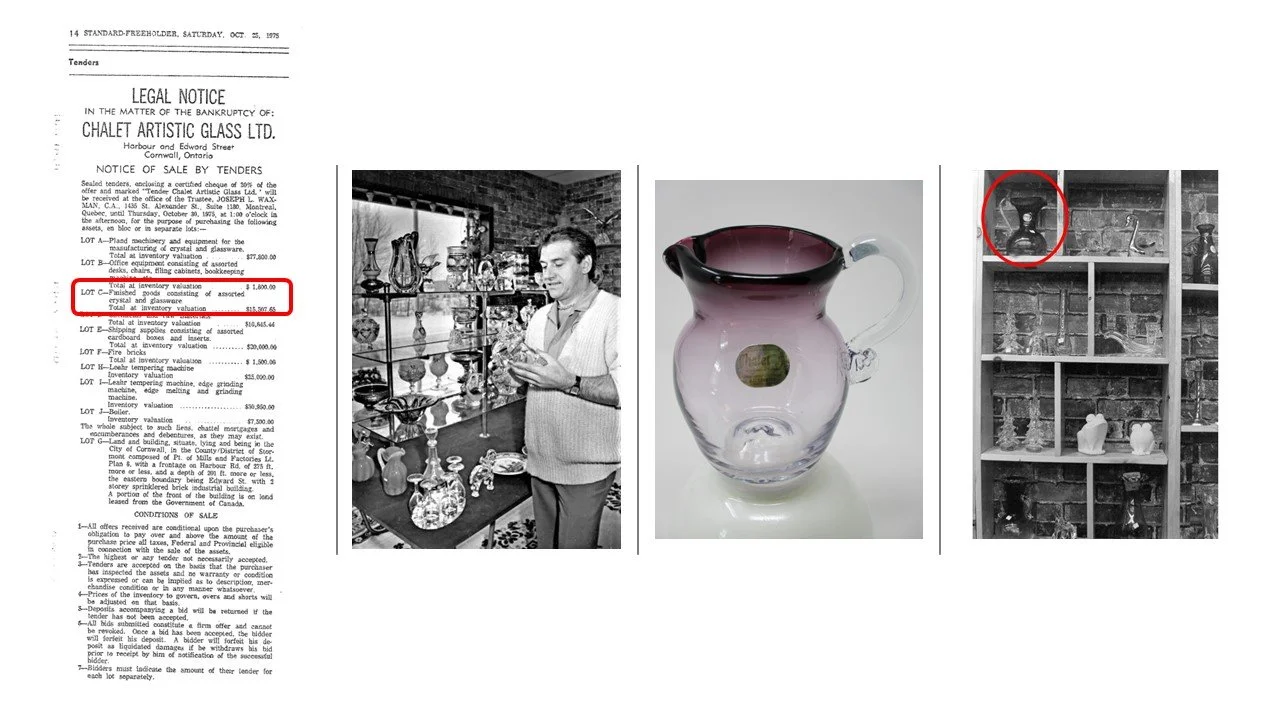
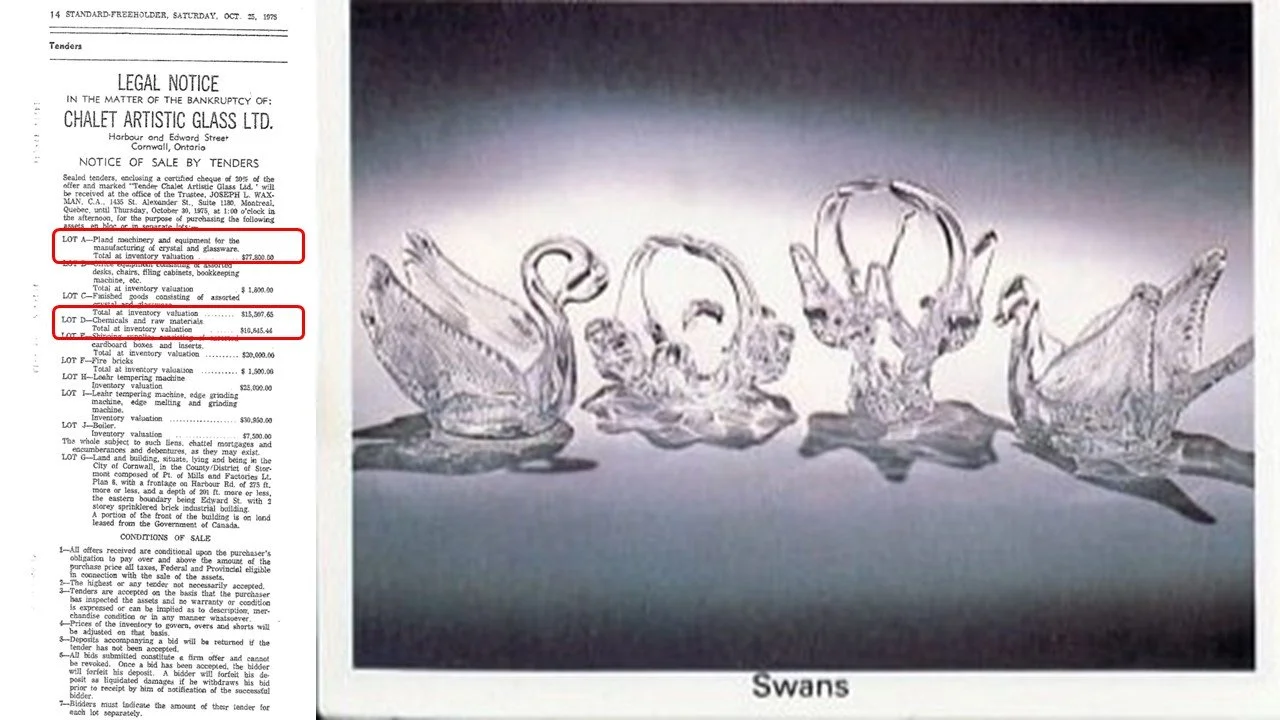
Not only did Rossi and Jaslow buy Chalet inventory (valued at $92,708.98 in 2026 dollars), but Chalet made and branded products were sold at both the Cornwall Artistic Lighting and the Rossi Artistic factories (1981-1994). The pitcher here was sold at Rossi Artistic Glass at the 7th Street location. You can also see a large clear crystal Chalet elephant in the Rossi showroom picture on the left at the bottom. Chalet bankruptcy sale notice at left in photo gallery.
Rossi continued to use the Chalet molds as well. From the 1988 Rossi Artistic Glass catalogue. Rossi catalogue page (on left) from the archives of the Cornwall Community Museum. Riekes Crisa catalogue page at left from 1976. Chalet had already ceased production.
Rossi made swan irradato bomboniere.
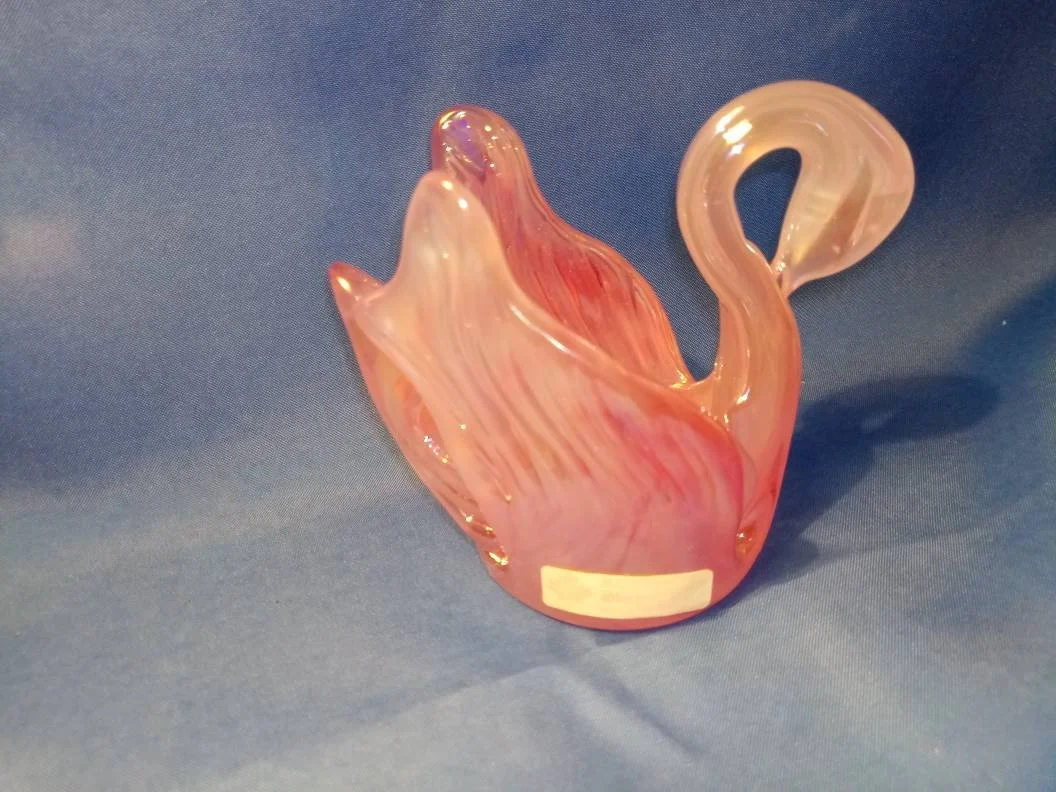
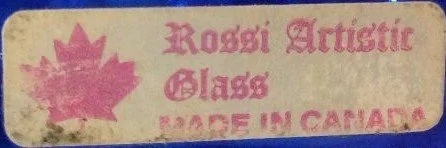
This swan, even without the branding, is easily identified as Rossi made as Chalet did not produce pieces in this colour.
The branding on this irradato bomboniere basket appears to be a Rossi company label at first glance but on a closer look - is a retailer’s boutique sticker.
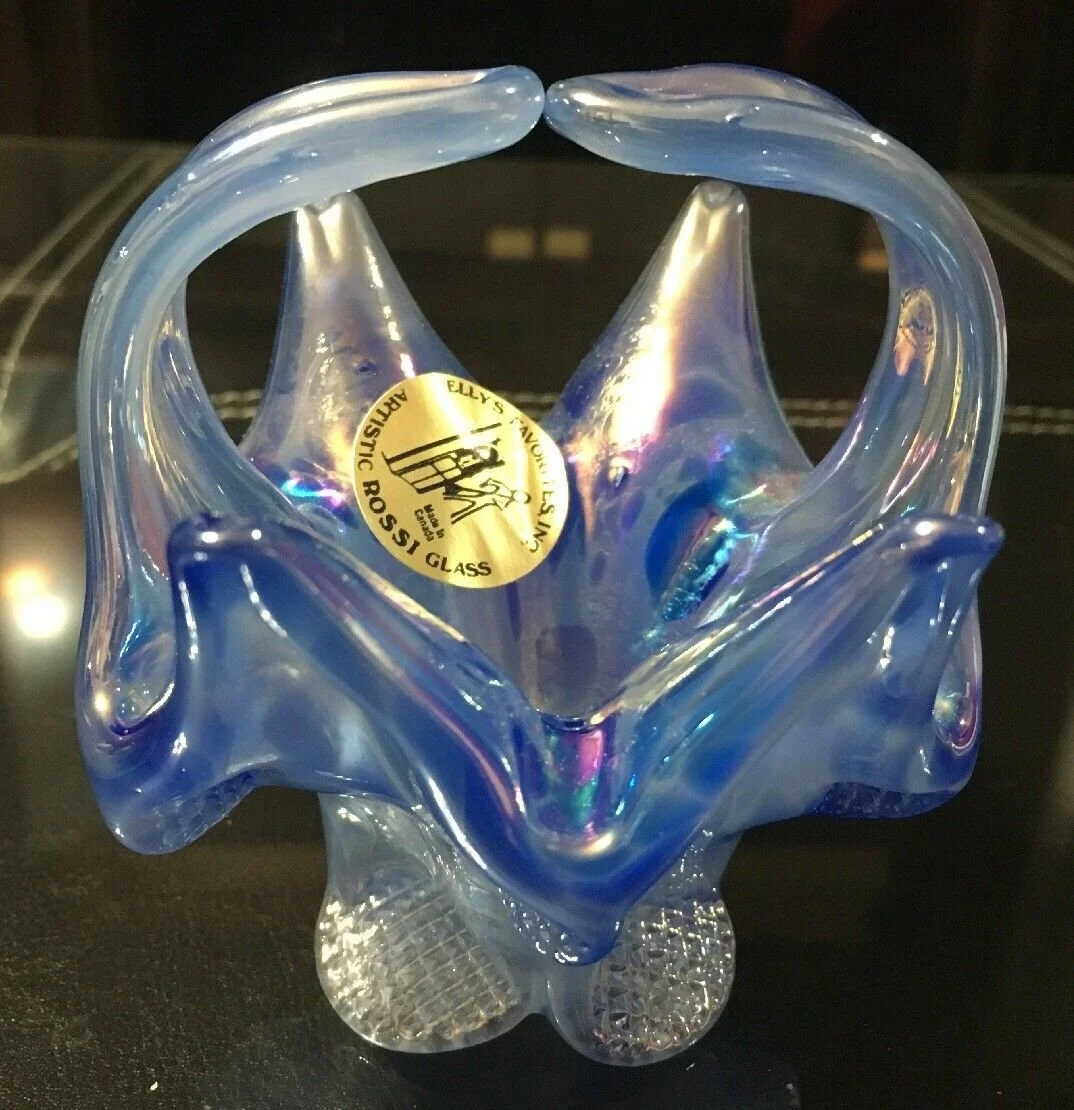
Rossi made or just Rossi Artistic Glass “Heritage Glass” branded? In my opinion, I do not think the following were Chalet bomboniere inventory because of both the colour and shape.
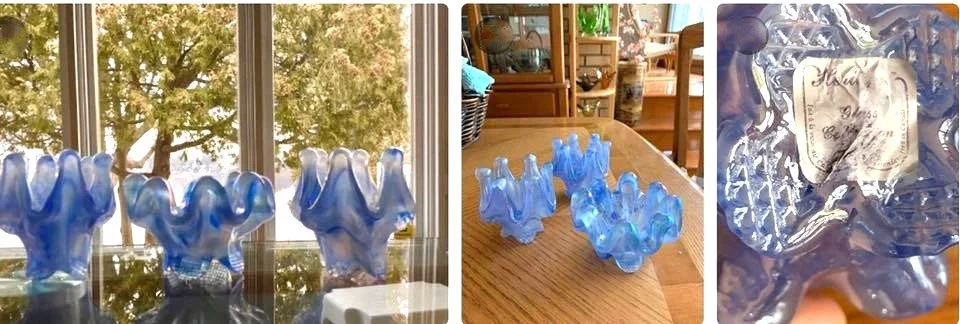
I feel the same regarding this piece.
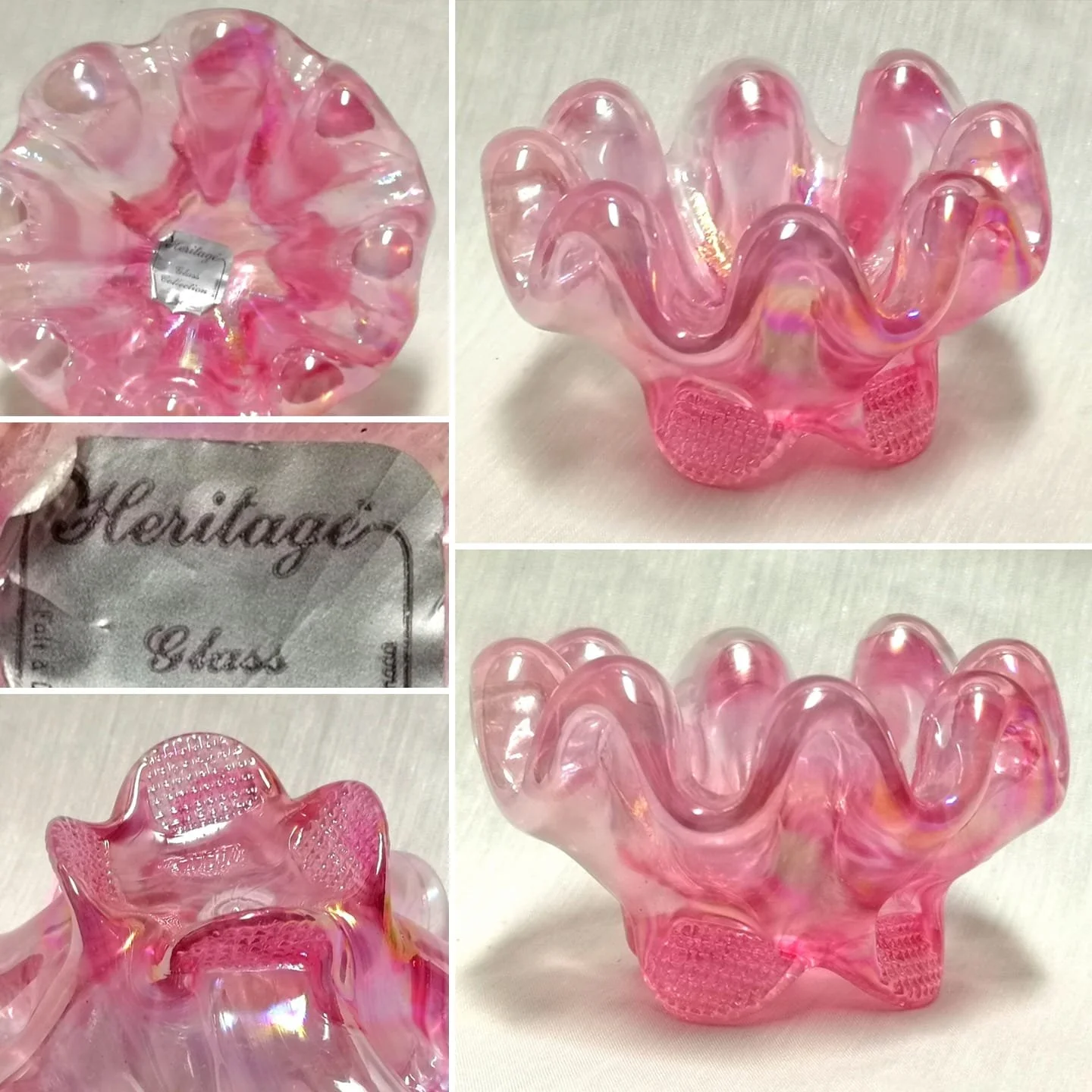
Photographs courtesy of Josh Dolstra.
However, if these swans did not retain their labels, what conclusion would you have come to regarding identification and with what justification?
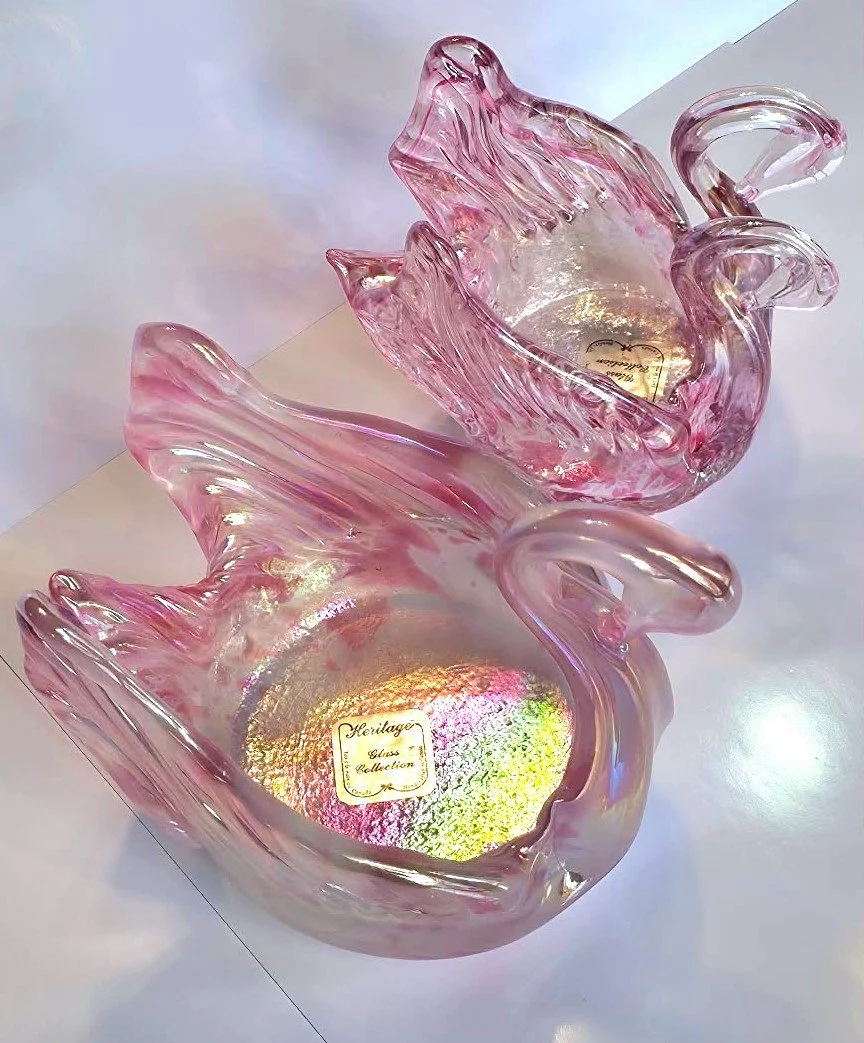
From the collection of Darcy Dietrich and Lorne Olafson.
A very few Rossi made/branded opal irradato have been found. These are very rare.
This bomboniere retains a Rossi “heritage Glass” label as well. And as with the swans shown above, I have to wonder if they are Chalet made with Rossi branding or actually Rossi made and Rossi branded. It is impossible to tell. However, this 2-headed swan design is most unlikely to be a Rossi design.
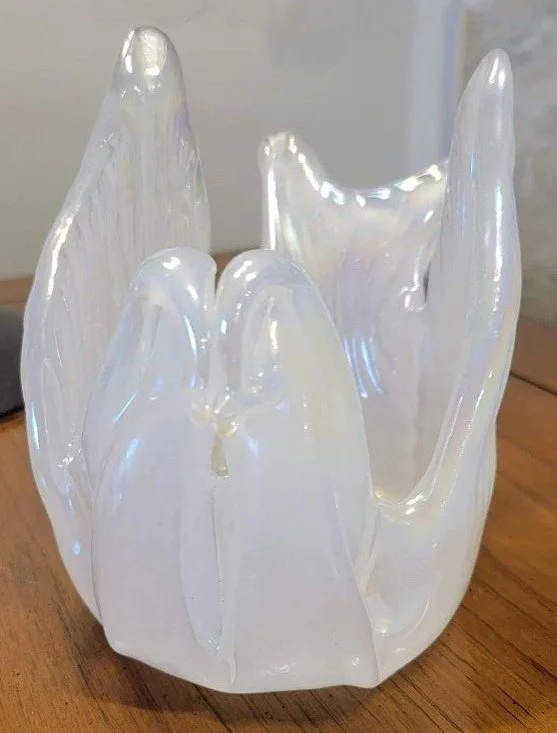
Here is the ultimate example of identification impossibility:
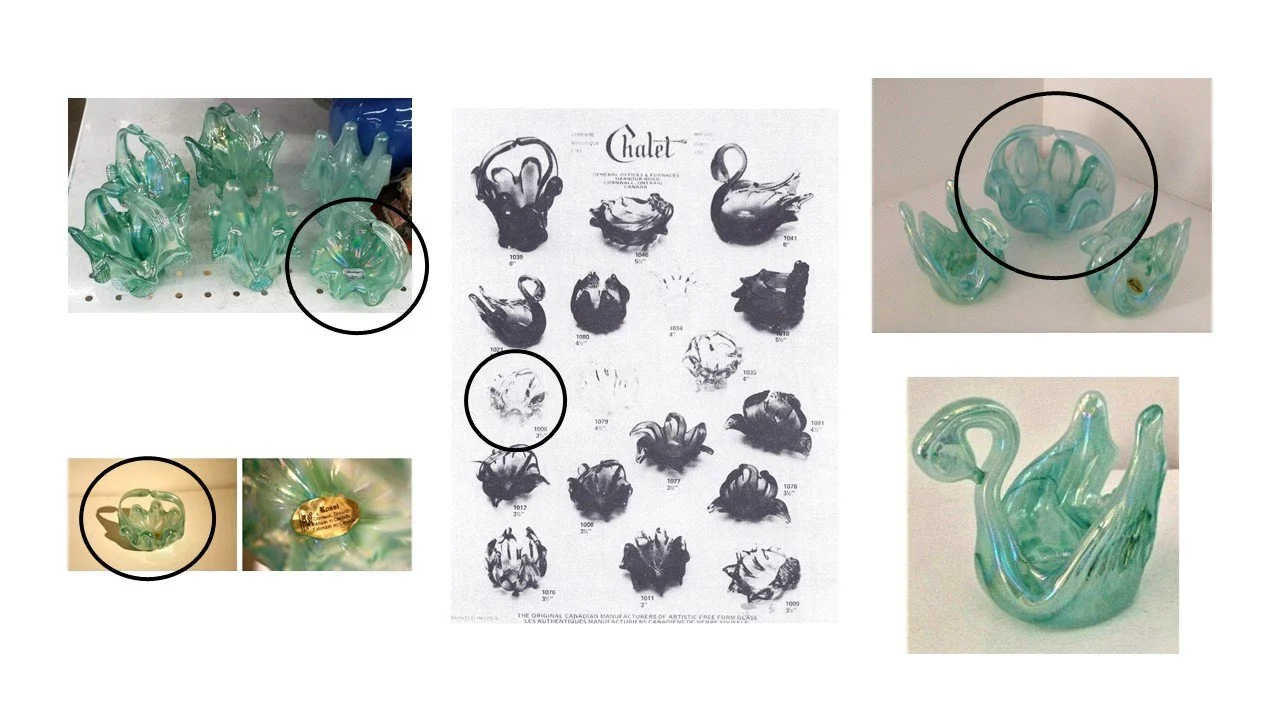
The green basket that is circled at top right is unmarked. It is in a colour that we have seen in both Chalet (swan at bottom right) and Rossi branded forms. Moreover, it is a style shown on one of the Chalet catalogue pages for the bomboniere. Although it is not featured on the 1988 Rossi catalogue page shown above, it is shown twice here (top and bottom left) retaining Rossi brandings. So, is this basket an unmarked Chalet piece or is it Rossi made? There is really no way to make a verified identification.
Let’s give our brains a rest and enjoy some Chalet “shimmer and shine!”
I am ending this article with a cautionary note. For courting, male bowerbirds build specialized structures and then decorate them with bright (often blue) objects such as flowers, feathers, berries, lost jewellery, bits of discarded plastic, and small pieces of glass. They may even arrange these items by color and size to create optical illusions.
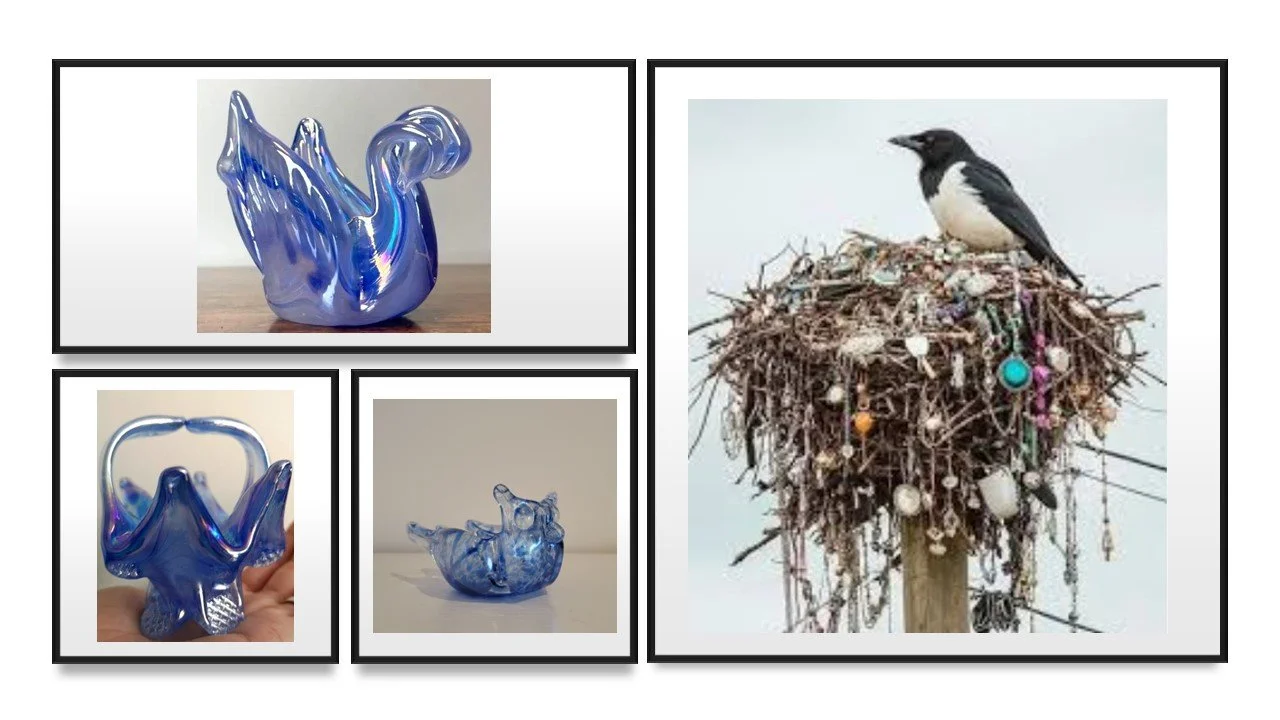
So, consider yourself warned and guard your Chalet “shimmer and shine” bomboniere jealously or you may find yourself missing a few pieces of glass! But at least your sacrifice will be in the name of love.
